The Interreligious Council of Bosnia and Herzegovina (IRC-BiH), joining representatives of Islamic, Orthodox, Catholic and Jewish religious communities, epitomizes a contextual approach to post-conflict coexistence and sustainable peacebuilding.
Religious leaders, like the emissaries serving on the IRC-BiH, can function as “bridges of peace,” coalescing their respective believers around conciliatory ideals: respecting diversity as the foundation of faith, differences as a blessing, friendship as a driver of mutual understanding, and religious communities as witnesses of hope and empathy.
While there is no universal blueprint for effective dialogue, it is no accident that the United Nations Alliance of Civilizations (UNAOC) convened its October 2025 conference, “A Call for Peace, an End to Wars and Respect for International Law,” in Sarajevo. This conference recognized the strides Bosnia and Herzegovina has made towards reconciliation and highlighted the role religious leaders play in stewarding lasting peace, historically and in the present day, for communities once stricken by war.
Before the two days of earnest discussion spotlighting peacebuilders in the Western Balkans and globally, the conference began with a moment of silence. This collective inhalation rose to the apex of the Gazi-Husrev-beg Library, a building partially destroyed during the Siege of Sarajevo three decades prior. It mutely invoked the world’s 56 active conflicts—from Palestine to Ukraine to Sudan. Surrounded by walls that witnessed war, we were reminded that the intangible value of living together in peace can be best understood by those who know the cost of its absence.
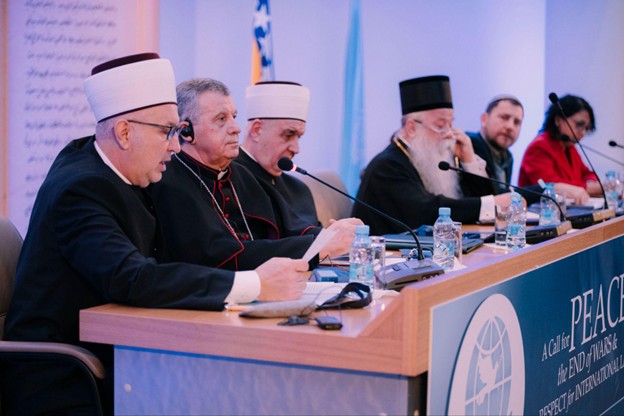
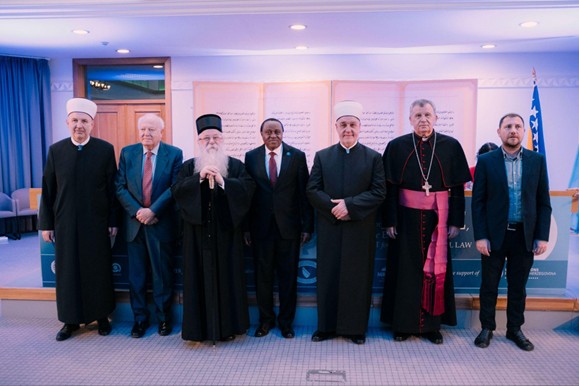
As the silence nestled in the audience, eyes turned to the dais. On it, arranged in a row, were Bosnia and Herzegovina’s most prominent religious leaders and members of its Interreligious Council, representing the Islamic, Orthodox, Catholic, and Jewish communities. For the next two hours, these leaders meditated on “Faith and Action” in peacebuilding, delineating their duty in advancing this process.
The following day, the Sarajevo Joint Statement declared religious leaders and faith actors as “Bridges for Peace,” who play a “vital role… in fostering mutual understanding, reconciliation and respect among communities… [while serving] as bridges for dialogue across divides, countering intolerance and violence, and promoting values of compassion, solidarity and unity in diversity.” In the IRC-BiH, one can envision this ideal.
The Origins and Context of the IRC-BiH
The IRC-BiH was initially formed in 1997 after the Dayton Peace Agreement, in partnership with Religions for Peace, as the first effort to establish interreligious dialogue and rehabilitate trust. The Council has since expertly navigated post-war interreligious tensions. Beyond mere symbolism, the IRC-BiH has actively shaped the landscape of co-existence and toleration, for example, drafting the Law of Religious Freedom adopted by the Bosnian parliament in 2004 and taking a multi-stakeholder approach to the protection of holy sites from 2010 to the present day. This nonpartisan track record of actuating interreligious peace has afforded the Council widespread credibility and recognition by national and international governing bodies and NGOs.
The IRC-BiH draws on the framework of inter-faith dialogue and peacebuilding stewarded by the Religions for Peace organization, which has helped found over the last 50 years more than 100 national Interreligious Councils (IRCs) in 6 regions. These IRCs, like the Council in Bosnia and Herzegovina, seek to upend “the status quo through our mutual conviction that religions are more powerful, inspiring, and impactful when they work together.” The “Call for Peace” in Sarajevo comes on the heels of the launch of the program by Religions for Peace and the UNAOC in Gernika, Spain, in April 2025. In connecting Gernika and Sarajevo, the “Call for Peace” articulates that “remembrance of war’s tragedies can serve not only as a warning but also as a catalyst for dialogue, understanding, and the building of a more peaceful future.”
Sarajevo as a Peacebuilding Exemplar
The IRC-BiH’s successes elevate it as a cardinal example of peacebuilding to be applied in other conflict-affected regions. During the “Faith and Action” session, Raisu-I-ulama Husein Kavazović, Grand Mufti of the Islamic Community in Bosnia and Herzegovina, asserted that “lessons from past crises open new channels of communication. Bosnia and Herzegovina—and Sarajevo—send a global message [as] examples of crisis management, peacekeeping, and restoring communication.” The Raisu-I-ulama continued, “Sarajevo has always been open to those seeking shelter.”
Similarly, Metropolitan Dabrobosanski Hrizostom Jević, Chairman of the Assembly of the IRC-BiH, cited the long legacy of interreligious councils in Bosnia and Herzegovina, suggesting that the first such IRC emerged in Sarajevo during the 1890s under Austro-Hungarian rule. Thus, for the Eastern Orthodox leader, the modern-day iteration represents a renewal and restoration of a much older tradition.
Rev. Dr. Tomo Vukšić, Archbishop of Vrhbosna, echoed this sentiment: “Religious communities are meant to serve as a good example… We are witnesses of hope.” Igor Kožemjakin, Hazan of the Jewish Community of Sarajevo, noted that while “[r]ebuilding coexistence is a living task for the present that must be nurtured through empathy… There is no universal blueprint for dialogue. The effectiveness of the approach depends on the context of each society.”
Finally, Mufti Dr. Nedžad Grabus of Sarajevo—Member of the Assembly of the Interreligious Council in Bosnia and Herzegovina, and Co-President of Religions for Peace—argued that BiH and its capital have “the power to connect people, providing an example to the world of successful interreligious dialogue. Many churches and mosques were rebuilt after the war, with people often donating to other religious communities outside their own to fund this reconstruction.” For Mufti Grabus, “Sarajevo has an open heart. It is a place of peaceful coexistence between people of different religious beliefs.”
Religious Leaders as “Bridges for Peace”
“Religious leaders and faith actors have long stood as pillars of social cohesion, and today, their role is more vital than ever in guiding their communities toward unity, compassion, dialogue, and mutual respect,” contended Under-Secretary-General Miguel Ángel Moratinos, High Representative for UNAOC and UN Special Envoy to Combat Islamophobia.
Thus, religious leaders and members of the Interreligious Council of Bosnia and Herzegovina fittingly set the stage for the “Call to Peace” in Sarajevo. Over the course of the “Faith and Action” session, different leaders explored the values they view as sacrosanct to their work as peacebuilders and faith leaders.
For Raisu-I-ulama Kavazović, encouraging open expression is crucial for “developing understanding between groups and enriching dialogue… diversity is the foundation of belief, community differences are a blessing.” He further stated that as “the evils of hate grow, [religious leaders] must reassert good neighborliness” and the “door of interreligious dialogue must remain open.”
Metropolitan Jević described friendship as a “moving force,” invoking the adage: “Meet your neighbor. Only then will you know yourself.” Indeed, for him, friendship contributes to the same ends as those the Raisu-I-ulama esteemed—fostering mutual understanding. Finally, Metropolitan Jević warned that without cultivating friendship, we risk getting “trapped in a false co-existence,” closing that “friendship is the catalyst for peace” and our mutual reliance across religious lines allows us to “live together.”
In the words of Rev. Vukšić, “human dignity is the key, shared value. God created all humans the same way in [his] image. Threats to human dignity, human rights, and peace violate God’s will and rules.” Witnessing God’s love, for him, is the “prerequisite of peacebuilding,” as “we are reflections of God, who is peace himself.”
Mr. Kožemjakin, speaking on behalf of Sarajevo’s five-century-old Jewish community and in his capacity as a member of the city’s Minorities Council, emphasized that “interreligious dialogue is a necessity, not a luxury after war.” Indeed, for Mr. Kožemjakin, religious leaders have a responsibility during crises, stating, “[o]ur words can enflame or calm.” In the post-conflict rebuilding process, he envisioned faith communities as “moral partners,” professing that “[p]eace is not the absence of conflict, but the presence of respect for each other.” Underpinning his outlook, Mr. Kožemjakin referenced the concept in Judaism, Tikkun Olam, meaning “preparing/repairing the world,” to argue that (re)building coexistence is “a living task for the present that must be nurtured through empathy.”
Closing out the “Faith and Action” session, Mufti Grabus said that “Mutual respect and human dignity are at the root of Islamic teachings. These are shared, common values. In Islamic teachings, God is peace. Violence destroys the essence of religion.” Then, charting a path forward for interreligious relations in Bosnia and Herzegovina and the role of faith leaders, Mufti Grabus posited that “[p]eacebuilding must have an intellectual and spiritual level.” As such, leaders must focus equally on addressing out-group bias in educational and religious settings.
The Future of Religious Peacebuilding in Bosnia and Herzegovina
Throughout the open convention of the IRC-BiH at the “Call to Peace,” its members acknowledged the challenges and external forces impacting their efficacy as peacebuilders.
In Bosnia and Herzegovina, for example, there is a dual reality of pluralism and segregation. In no context is this simultaneous proximity and separation more striking than the 56 instances of “Two Schools Under One Roof (TSUOR),” according to a 2018 report by the Organization for Security and Co-operation in Europe. Following the mass displacement and resulting ethnic/religious homogenization in many regions of BiH due to the conflict in the 1990s, Two Schools Under One Roof was enacted as a temporary measure. TSUOR represented a preamble for reintegration in response to the post-war ethnically divided education system.
However, in the three decades since their creation, the TSUOR model has become a facet of education in BiH, despite international community efforts to ensure its transition. In practice, Two Schools Under One Roof segregates children by ethnicity (and religion) with parallel mono-ethnic administrations running each “side” of the school. This system hardens inter-group divisions, buoys mistrust among members of different national groups, and, ultimately, impedes reconciliation.
Within Two Schools Under One Roof, there is a de facto separation of religious education. Despite Bosnia and Herzegovina’s historic and contemporary ethnic/religious diversity, TSUOR delimits religion as a strict and impassable marker of identity. These divisions implicitly affect how students perceive the “other.” Two Schools Under One Roof and the ethno-nationalist outlook the system enshrines are antithetical to interreligious dialogue.
Importantly, these schools encapsulate the limitations discussed by the Interreligious Council members. For example, Metropolitan Jević referenced a “parallel, conflicting world to the one of friendship and understanding” ruled by national and political interests. TSUOR serves as a reminder that religious leaders are but one indispensable component of post-conflict peacebuilding.
Indeed, for Metropolitan Jević, “the purpose of religious leaders is to serve as good examples to the world and their communities of believers who trust them. In this way, leaders can encourage love, good will, and friendship between people.” Raisu-I-ulama Kavazović held that “[e]ach person should look within themselves to identify and develop peace from within. God is the source of this inner peace. Together we must work on spreading good. First, we should focus within each of our own [religious] communities.” He concluded, “[r]eligious leaders must point out the good, condemn the bad, and remain conscientious, despite political pressures.”
All IRC-BiH members also stressed the importance of applying one’s religious knowledge and craft to action. Rev. Vukšić and Mufti Grabus offered hopeful examples of innovative inter-faith educational programs that empower future peacebuilders in Bosnia and Herzegovina. For Rev. Vukšić, schools at all levels should “teach tolerance, forgiveness, trust, and coexistence. These values parallel the teachings of different religions.” Instilling these principles equips youth with the tools to be local peacebuilders across religious gulfs.
In the past, Council members have walked together through the streets in Sarajevo, sending a public signal of coexistence. Mr. Kožemjakin, nevertheless, pushed to have inter-faith alliances “move from symbolic to tangible,” for example, through long-lasting non-sectarian community education programs, youth projects, and basic social services provisions. “We must celebrate diversity through action,” he called. Mr. Kožemjakin implored, “[w]e can all take small steps to achieve trust and reconciliation.”