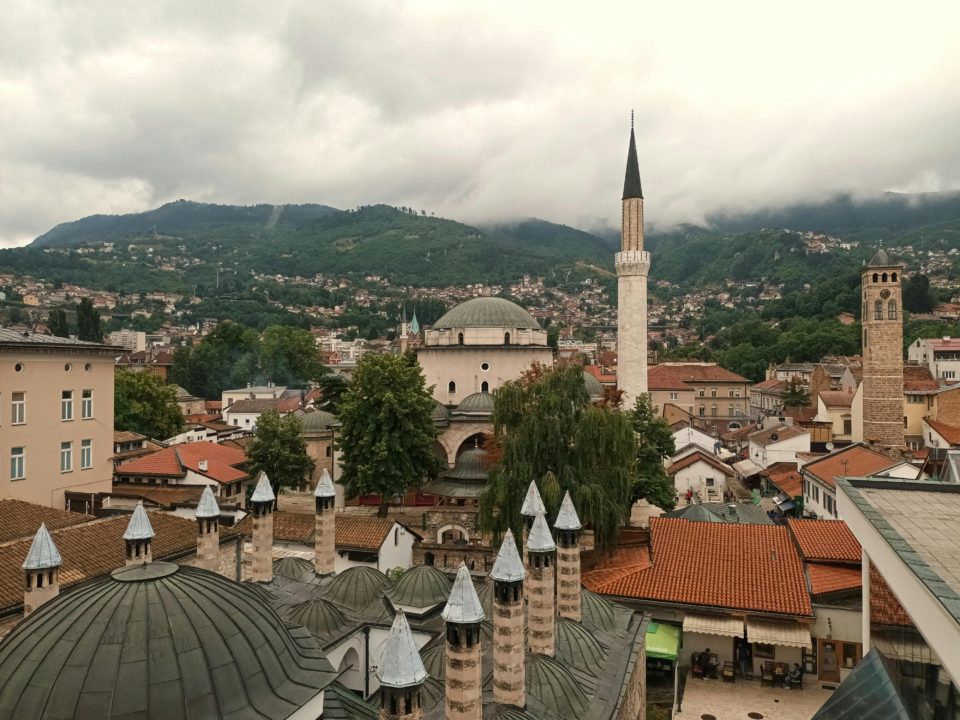
Gazi Husrev-Bey Mosque is located in the Baščaršija neighborhood of Sarajevo’s Stari Grad Municipality.
It is often cited as the largest mosque in Bosnia and Herzegovina (BiH) and the Balkans. It is unique in that the call to prayer, or adhan, is delivered directly from the minaret rather than played from a recording, as is the practice in most mosques in recent years. In addition, the entire Qur’an – hatma – is studied there every day.
Gazi Husrev-Bey Mosque, together with Sarajevo’s Catholic and Orthodox cathedrals and Jewish Synagogue, represents the identity of the BiH capital. Alongside believers, it attracts many tourists and visitors from across the world.
“Sarajevo has its own breadth and perspective. It’s a city that has something for everyone. Everyone is welcomed here,” said Effendi Edin Hamzakadić in front of the Gazi Husrev-Bey Mosque, addressing the participants of the State of Peace Youth Academy from Bosnia and Herzegovina, Croatia, Serbia, and Montenegro.
The youth academy, which gathered 50 young people from BiH, Croatia, Serbia, and Montenegro in August, was organized this year by the European Union and the Post-Conflict Research Center.
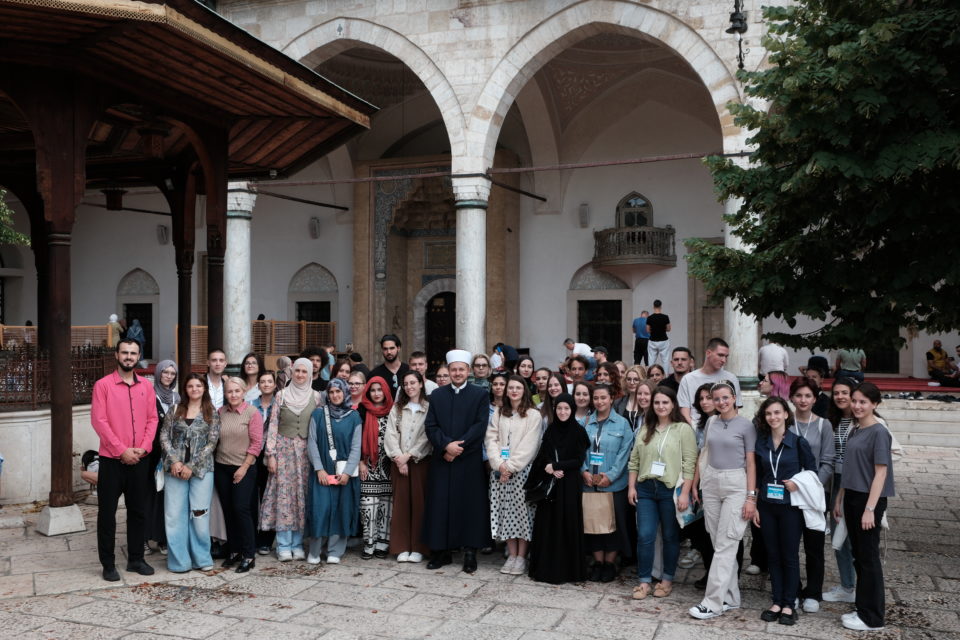
Efendii Hamzakadić explained that the spirit of Sarajevo, defined by religious coexistence, has never been extinguished despite a tumultuous history, and he hopes that it never will be. As evidence of this spirit, he pointed to the close proximity of about 400 meters between the mosque, church, cathedral, and synagogue. “At the same time, you can hear the call to prayer from the minaret of the Bey Mosque, as well as the bells from the towers of the church and the cathedral, which makes the center of the Old Town a true multi-ethnic symbol, often referred to as the European Jerusalem,” said Hamzakadić.
Golden Arabesques, Marble, and Inscriptions
Hamzakadić emphasized that Gazi Husrev-Bey is considered the largest mosque not only in BiH but the entire region. It was built in 1531 under the supervision of the chief architect of the Ottoman Empire, Adžem Esir Ali, as part of the Gazi Husrev Bey Waqf, after whom it was named.
Gazi Husrev-bey was Bosnia’s greatest historical benefactor. According to the available information, he ensured the construction of the mosque and a madrasa, which is the oldest educational institution in BiH with a continuity of over 490 years. He also oversaw the construction of a library, the country’s oldest cultural institution, as well as an imaret or public kitchen, a clock tower, a bazaar, and other edifices.
In the course of its history, Gazi Husrev-Bey’s Mosque has also suffered structural damage, including from numerous fires as well as shelling during the 1990s war. The most recent reconstruction was completed in 2001.
Efendii Hamzakadić emphasized that Sarajevo has always protected its places of worship, even in the most recent war. “Here, as you can see, you will not find a mosque, synagogue, Orthodox church, or Catholic cathedral destroyed,” he said.
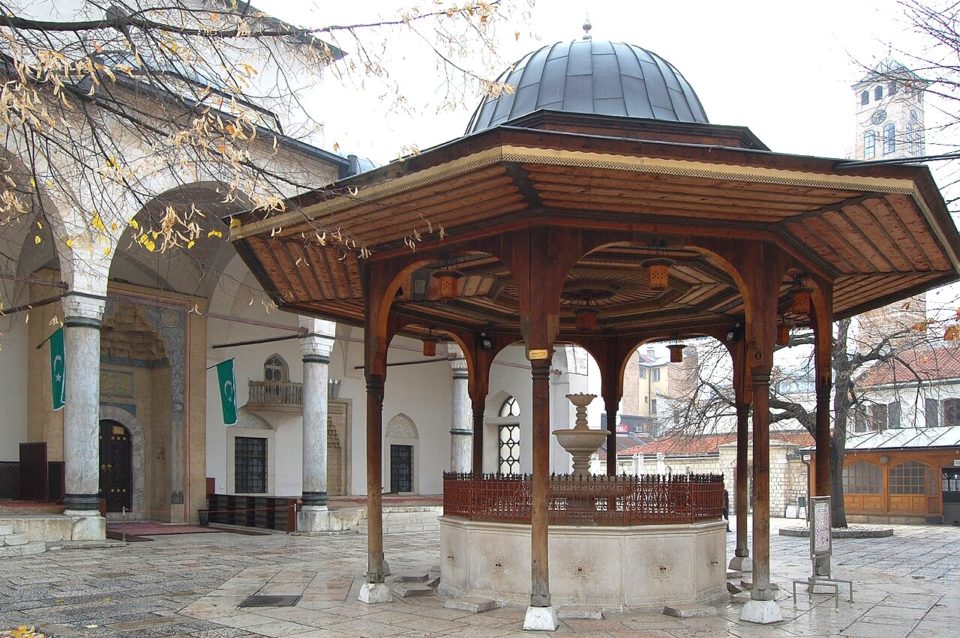
The courtyard of the mosque is paved with hewn stones, similar to those from which the wall around the courtyard was built. It has entrances on two sides, opening onto a central fountain.
The front façade of the mosque is adorned with marble columns that divide the mosque into five equal parts. The two on the right are intended for men’s prayer, the two on the left for women’s, and the one in the center is the main entrance. Each of these parts is covered with domes decorated with calligraphy.
The main entrance to the mosque and the mihrabs are decorated with golden arabesques, marble, and an inscription that exalts Gazi Husrev-Bey and gives thanks to God. There are additional entrances on both sides of the mosque – one for women and one for men. Next to the men’s entrance is the minaret from which the call to prayer is recited. Next to the women’s entrance are two mausoleums belonging to Gazi Husrev-Bey and Gazi Murat-Bey Tardić, the first trustee and Gazi Husrev Bey’s best friend.
Atop the mosque is a central dome, 26 meters high and decorated with numerous arabesques and calligraphy. At the point where the dome connects to the walls, there is a small terrace, which is strategically placed for lighting candles that were used to illuminate the mosque.
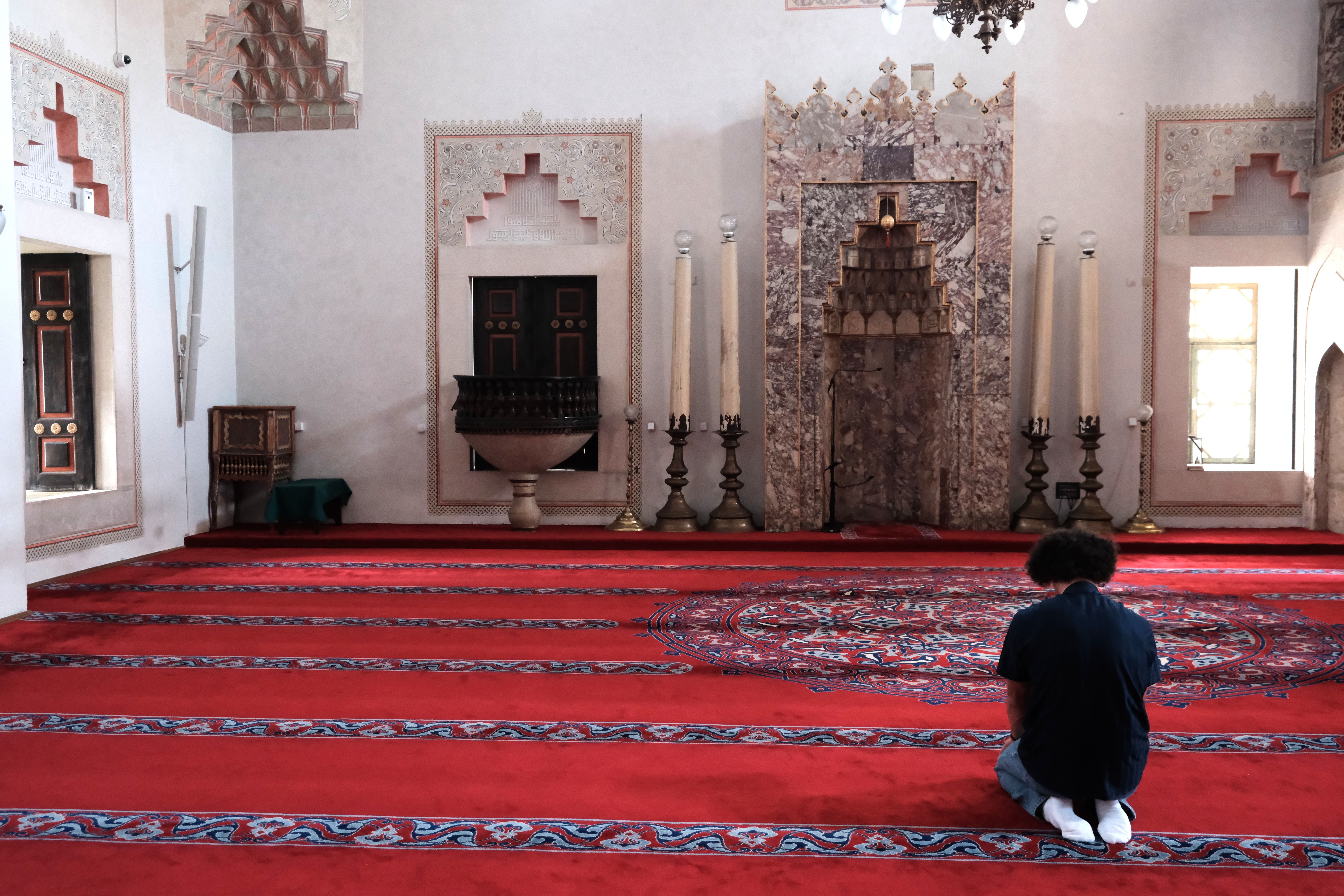
In the front, there is a central mihrab decorated with red marble. On the right side is the pulpit or mimber made of seven different marbles, from where the imam of the mosque gives sermons after the Friday prayer, which men attend weekly.
“We have freedom of speech here. Every Friday, when I preach, I personally compose each of my sermons, so I choose each of my spoken words personally. This is a rare example in the entire Islamic world of imams having such freedom,” said Effendi Hamzakadić.
Opposite the mihrab is an interior balcony, where the muezzin leads the prayer. There is also a space for guests who are not praying and a space for lectures and instruction.
Midnight at Sunset
Next to the mosque is the Clock Tower, built as the only public tower to track lunar time, in which midnight occurs at sunset. Following lunar time necessitates climbing the 30-meter-high tower once a week to reset the clock. During the time of Gazi Husrev-Bey, the Clock Tower was used to accurately determine the time of prayer in the mosque.
There is a public fountain in the right-hand corner of the mosque’s courtyard. According to legend, whoever drinks water from this fountain will return to Sarajevo.
Sarajevo is a reflection of centuries of coexistence among different confessions, religions, cultures, and traditions. Efendii Hamzakadić highlighted the work of the Interreligious Council of BiH, which consists of members of the Islamic, Jewish, Catholic, and Orthodox communities: “Bishops, cardinals, muftis, and rabbis meet here and we are proud of that.”
He emphasized that peace must always be strived for and insisted upon.
“If the Islamic community alone calls for peace – or the Catholic Church or the Jewish community or the Orthodox Church – we will not get much. We can do more if we act together. So, at any cost, peace is our priority,” said Hamzakadić.