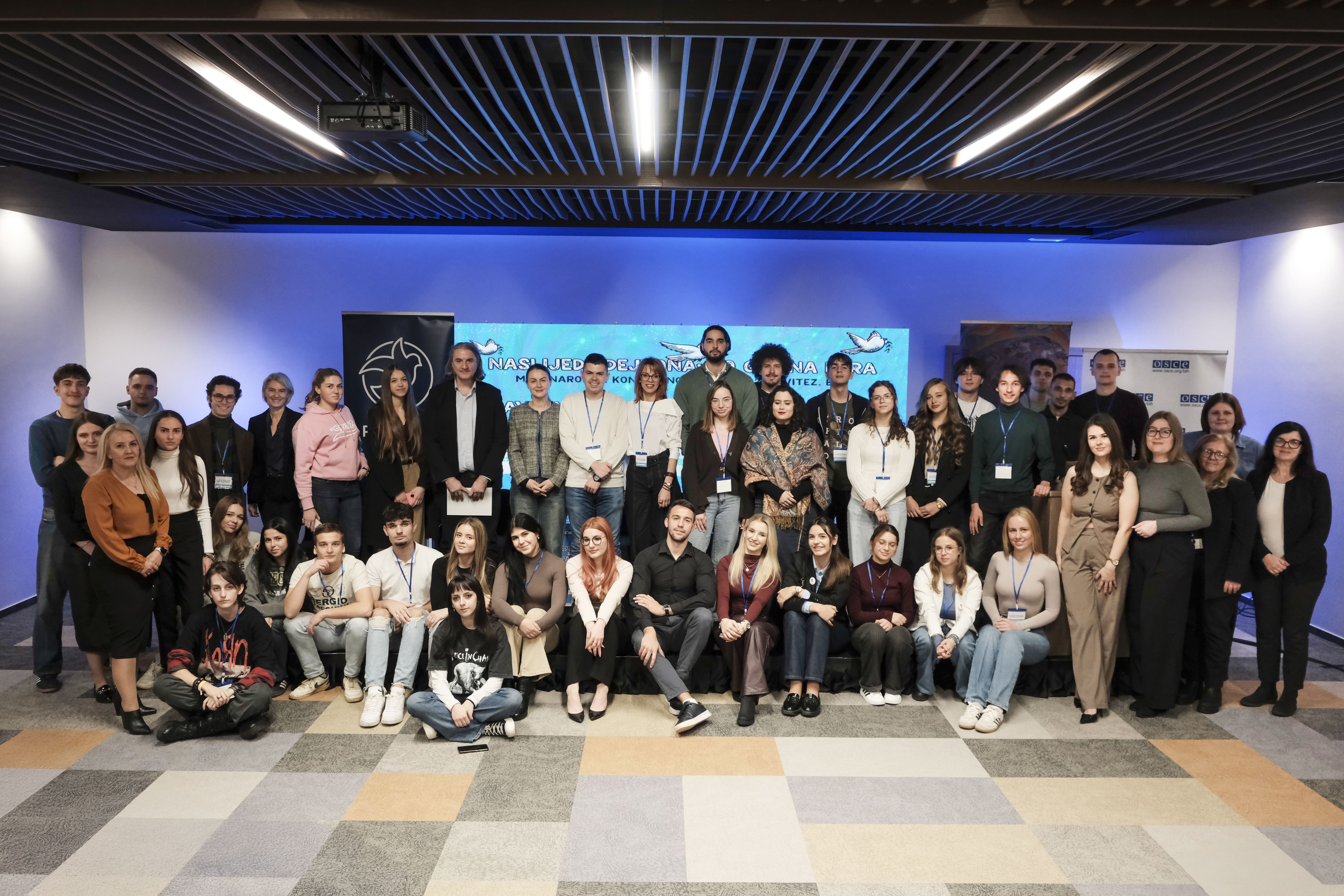
The conclusion drawn from the international conference “Dayton Legacies: 30 Years of Peace” was that there is no option other than peace in Bosnia and Herzegovina (BiH).
Youth and the European path were additionally highlighted as the basis for building a better and more inclusive society without divisions.
The conference was held in Vitez on December 1, 2025, organized by the Post-Conflict Research Center (PCRC), with the support of the OSCE Mission to BiH and the Pro Peace organization with co-financing by the European Union.
The Dayton Peace Agreement, signed in Dayton, Ohio on November 21, 1995, and initialed in Paris on December 14, 1995, brought peace to BiH and established the country’s current constitutional and legal framework. The conference “Dayton Legacies: 30 Years of Peace” critically reviewed the functioning of this framework 30 years later, analyzing how it adapts to contemporary challenges. The conference also discussed the importance of peace and the role of young people in building on this peace agreement.
Finding Hope in the Ideas and Courage of Young People
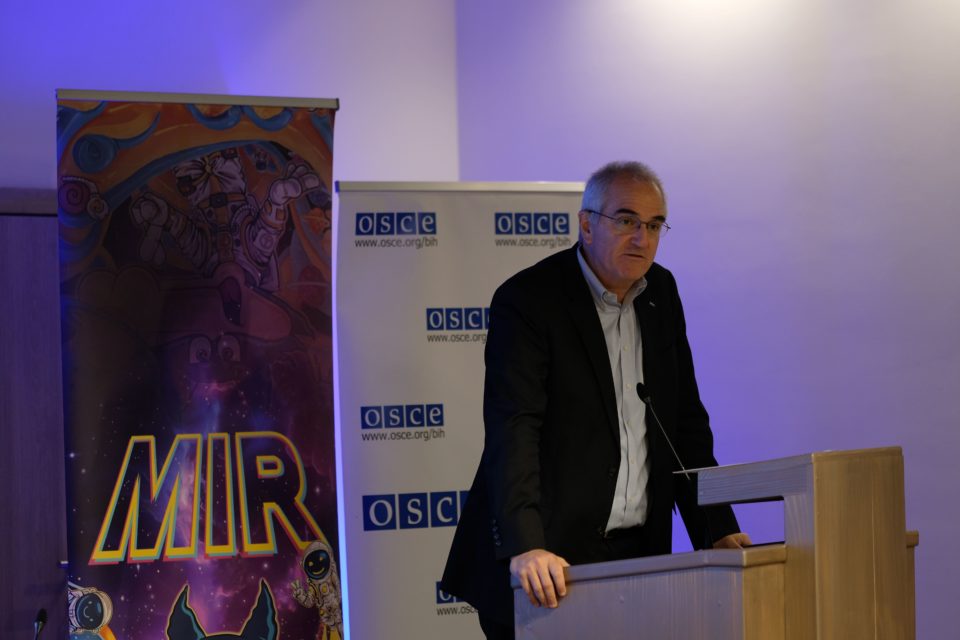
Ambassador Rick Holtzapple, head of the OSCE Mission to BiH, asserted that “there is no alternative to peace” and acknowledged the fragility of social relations in post-conflict environments. Addressing youth in particular, he stressed that their voice has the potential to change communities, nurture dialogue, and build an inclusive and democratic future. He recalled how far this country has come in the 30 years since the Dayton Peace Agreement while noting much work still lies ahead in order to build a society based on human rights, the rule of law, and mutual respect.
“Youth are key actors in building a society based on human rights and the rule of law. Your ideas and courage give hope,” said Holtzapple, adding that local communities like Vitez are the best examples of how trust can be restored.
Velma Šarić, the founder and president of PCRC, dedicated the Center’s commemoration of 30 years of peace to young people, opening a space for them to discuss how they see their communities, their futures, and BiH’s path toward greater stability.
Šarić recalled the importance of art and journalism in peacebuilding and presented projects such as Mir magazine and the Balkan Diskurs platform, which allow young people to become active narrators of social change.
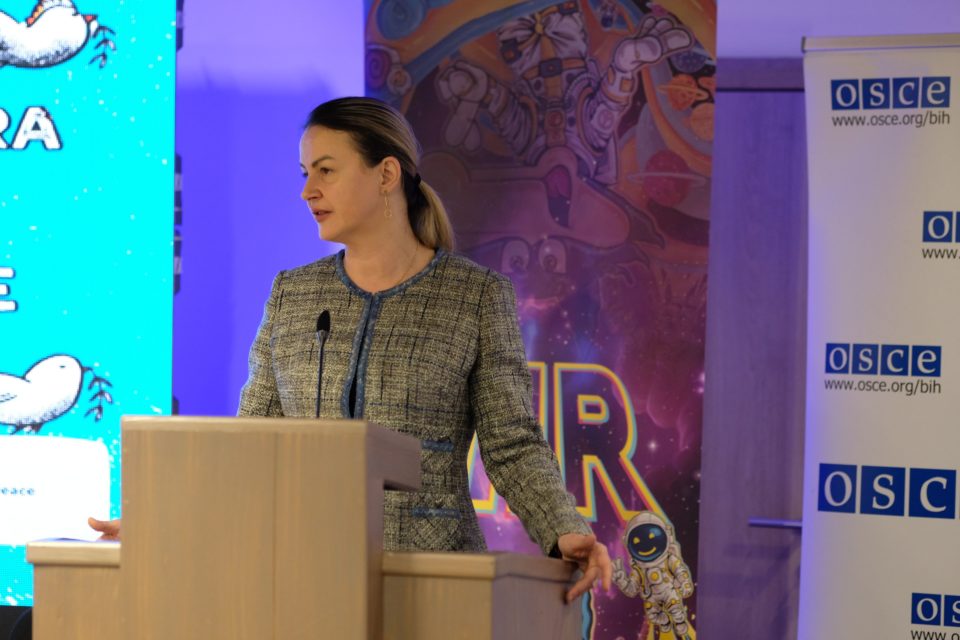
The poetic address of young Almir Agić, the author of the collection The Cactus in the Orchid Field, who uses poetry in the fight against prejudice against the Roma, evoked emotional responses from the audience. He reminded those present that “there is no peace without unrest” and that emotions are an integral part of the process of dealing with the past.
The conference also featured the opening of “On the Margins,” an exhibition by PCRC and the OSCE Mission in BiH that presents stories about Roma life and seeks to dispel the stereotypes and prejudices that prevail in Bosnian society about its most numerous minority.
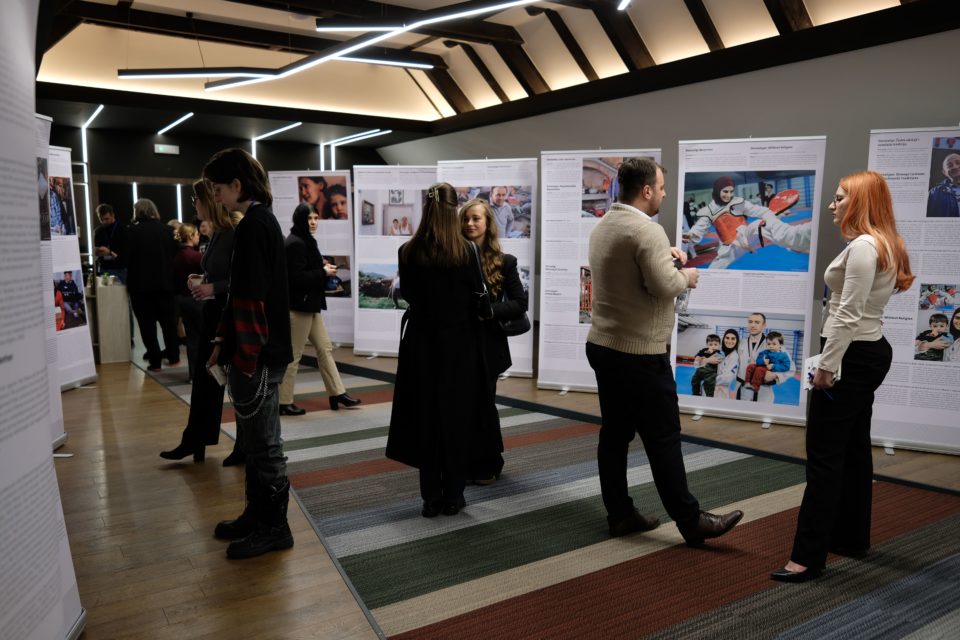
The Imperative of Peace Education
The first panel of the conference discussed peace education. Professors from Sarajevo, Banja Luka, and Vitez spoke about models of nonviolent communication, interdisciplinary approaches, and the challenges they face in working with young people.
Larisa Kasumagić-Kafedžić, founder of the Peace Education Hub and professor at the University of Sarajevo’s Faculty of Philosophy, spoke about the project “Peacebuilding pedagogies in higher education.” She pointed out that universities have an obligation to research and teach about peace.
“At the Peace Education Hub, we use models of nonviolent communication as just one of the approaches we apply through our program. We have various programs and strategies, and we try to situate peace in an institutional context through different frameworks that often fail to recognize this aspect of development as part of the scholastic process,” said professor Kasumagić-Kafedžić.

Professor Đuldina Kurtović from Sarajevo’s Third Gymnasium and Musical High School emphasized that the obstacle to the development of critical thinking is not young people but rigid programs.
“Students want to learn and discuss, but we have to provide them with the space and methods that make this possible. What the students and I recognize together is that certain topics, such as universal values, are often treated as abstract concepts. We are afraid that when they leave school, these concepts will remain only theoretical without practical content,” Kurtović reflected.
She added she applies critical thinking to the real problems facing BiH: “As a subject, critical thinking forces us to go beyond the scope of school, beyond what standard education systems offer, and to demand that essential skills continue to develop. It is getting better, but we definitely need more support to further strengthen it.”

Professor Milica Jošić-Milinović, senior assistant from the University of Banja Luka’s Faculty of Philology described how crucial an interdisciplinary approach is for the integration of peace studies in education: “When we talk about peace education, we all know that this is a segment that is generally lacking in our system. The Holocaust and Peace program was a great opportunity to integrate these modules into classes and to find time and space to discuss these topics through an interdisciplinary lens.”
Jošić-Milinović also pointed out that peace is not an exclusively historical concept but also intersects with language, literature, culture, and art. “Through different stories and storytelling, students have the opportunity to see things from other’s perspectives. This is extremely important for the development of empathy,” she noted, adding that every foreign language teacher actually deals with a much broader framework than language: “We teach culture, art, and different narratives that carry values.”
She mentioned the importance of art in particular, stressing that exhibitions, like “On the Margins,” open up space for understanding people that society often neglects: “Spreading stories – whether through art, language or literature – is the best way to nurture active listening, respect for others, and the development of interculturality.”
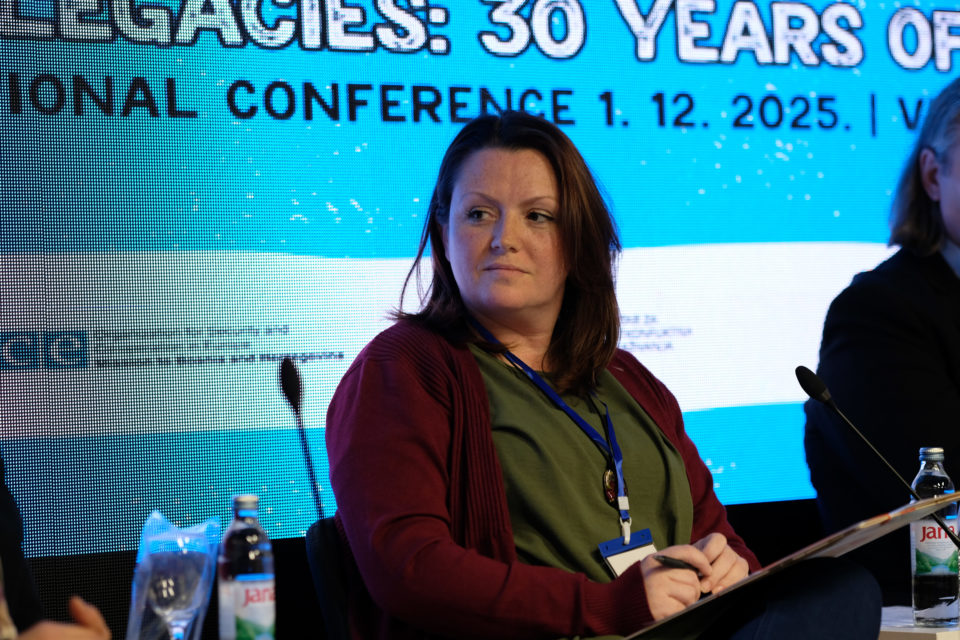
Professor Goran Šimić, dean of Law Faculty at Vitez University reflected on the importance of the education system in breaking down one-sided narratives that generate mistrust and division. He shared a personal story about when the term transitional justice first entered public discourse: “Exactly 15 years ago, the concept of transitional justice was almost non-existent in public space. Today, I teach a subject that is only taught at our university and have authored the world’s first university textbook in this field.”
He highlighted the major challenges facing modern education: “Our education has been producing ethno-calculations for decades. Young people come to university with the belief that only their ethnic group has suffered. This is an educational tragedy.”
Essential Knowledge and Universal Values
Professor Šimić pointed out that current textbooks and curricula contribute to divisions, as they present one-sided narratives: “Even when textbooks don’t lie, they only present part of the truth. If a student believes that there is only one truth – that of their own ethnic group – then there is no room for knowledge, dialogue, and facts.”
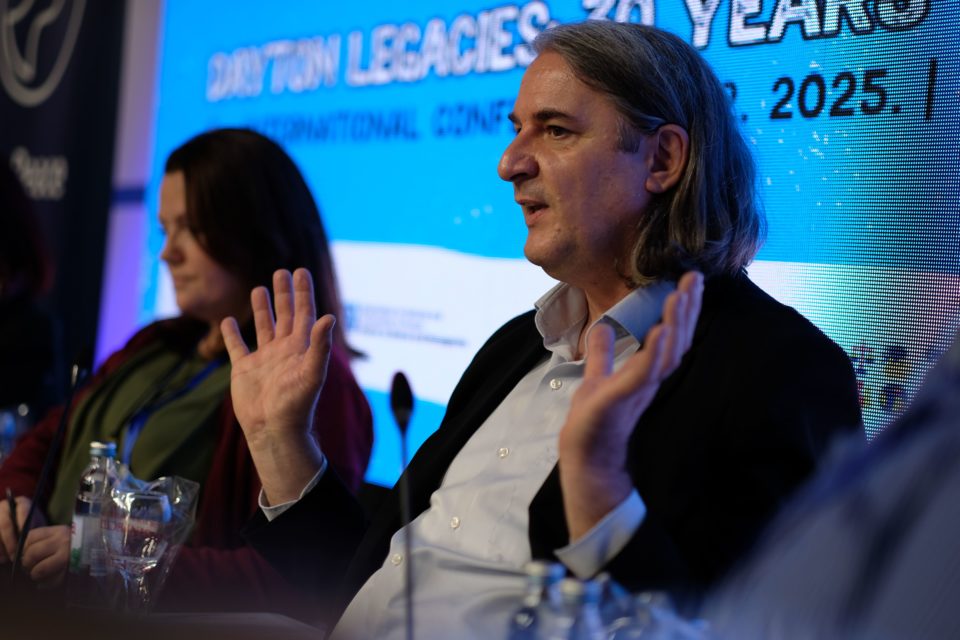
“Education is the space where peace either begins or disappears. If we want change, we must give young people knowledge and universal values,” said Šimić.
Panel moderator Tatjana Milovanović discussed the handbook Holocaust and Peace, produced by PCRC in cooperation with its partners, which concerns peace education and offers practical examples. This handbook has become an integral part of the formal education program in the Sarajevo Canton. “Our manual could soon be implemented in two more cantons in Bosnia and Herzegovina,” said Milovanović.
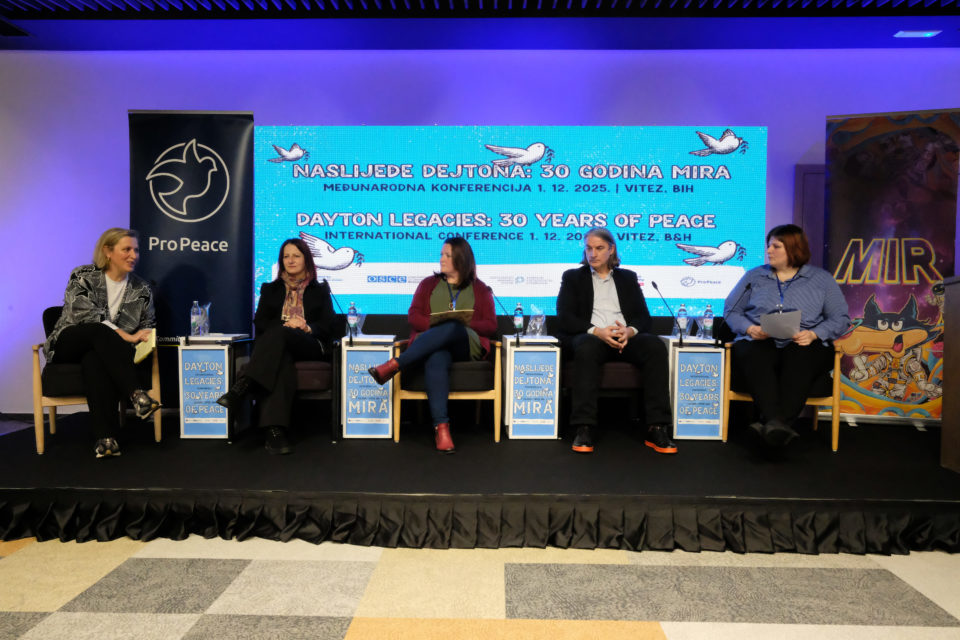
Jelena Savić, a participant from Banja Luka, said that participating in the panel on education helped her better understand critical approaches and the importance of objective facts in education.
Conference participant Berin Korman explained that the combination of education and open discussions enabled him to acquire new knowledge and skills that he will apply in the future.
“Dayton Legacies: 30 years of peace” continued with a conversation between representatives of international institutions in BiH and activists, who shared their knowledge of what they are doing to prevent divisions not only in BiH but across the region.