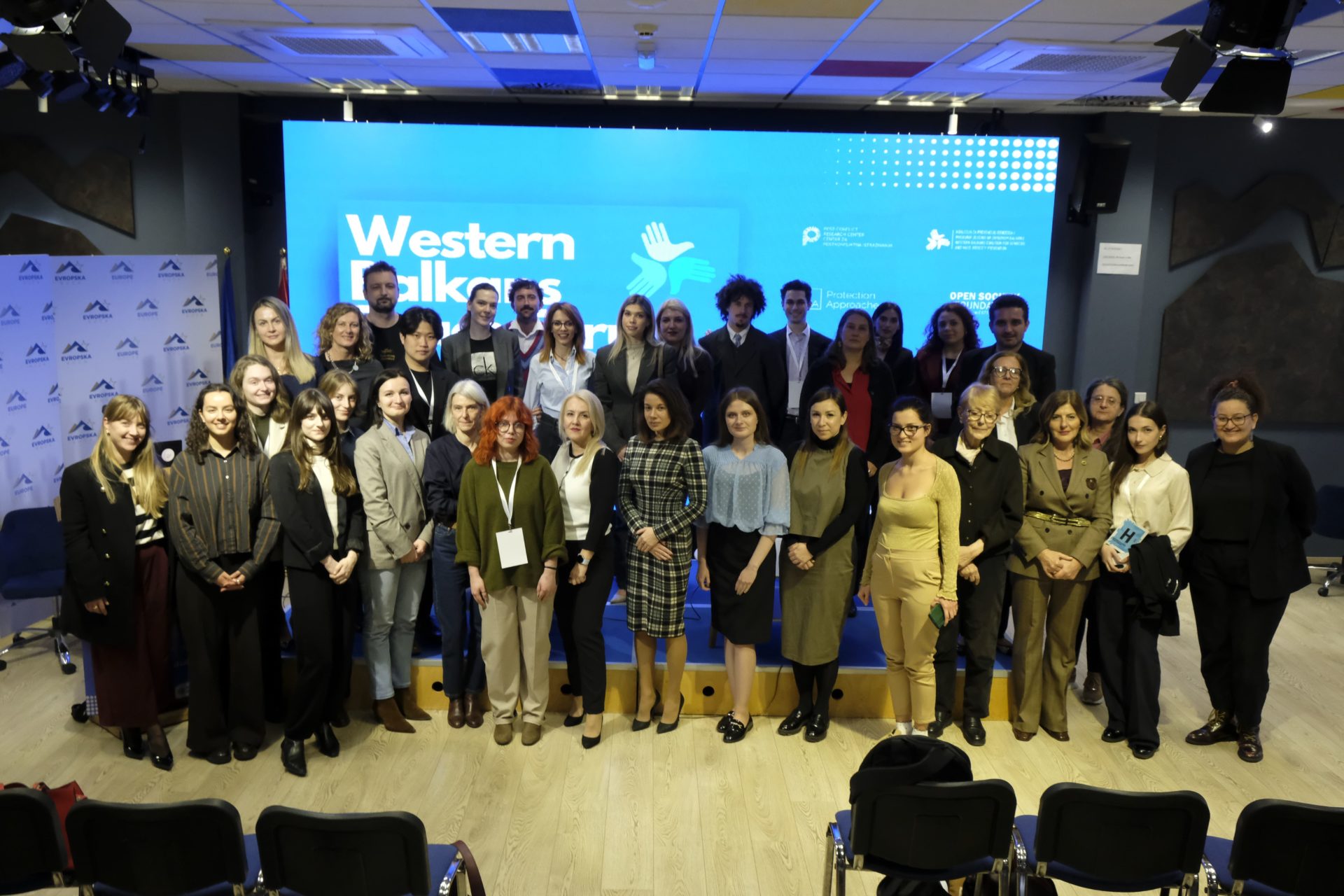
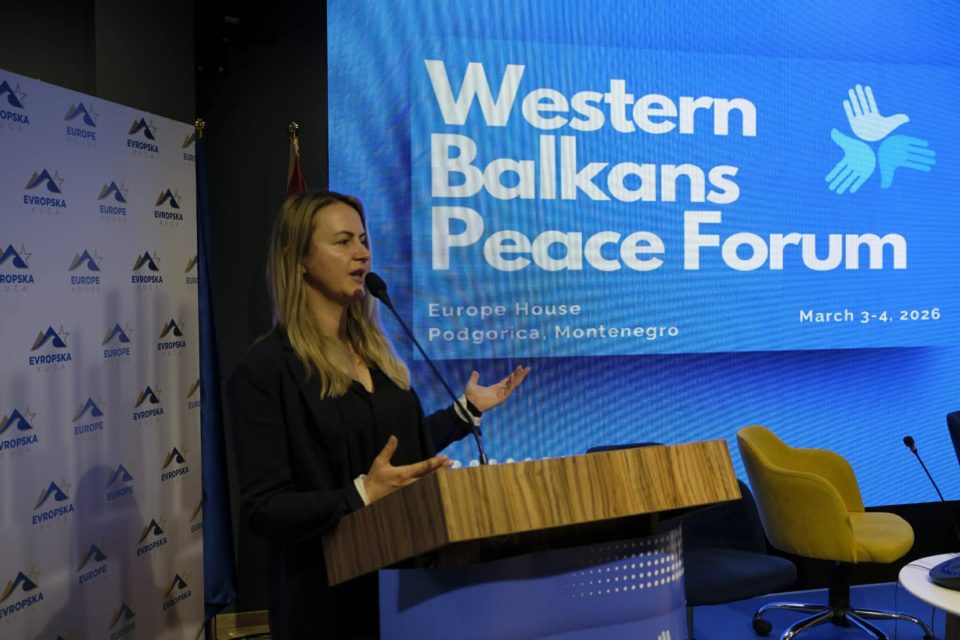
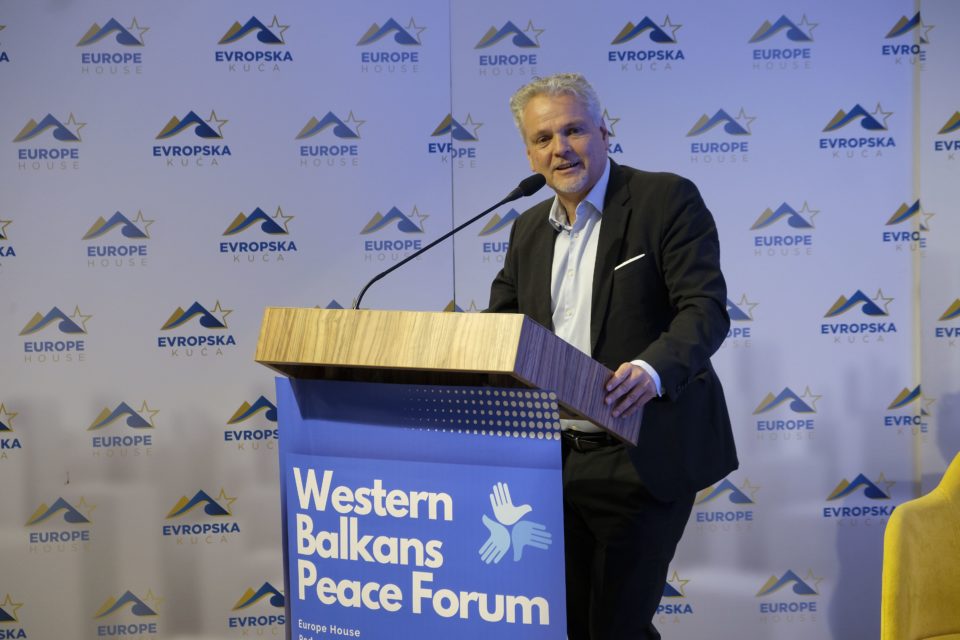
On March 3 and 4, 2026, representatives of 25 civil society and international organizations converged on Europe House in Podgorica, Montenegro, for the inaugural Western Balkans Peace Forum (WBPF), organized by the Post-Conflict Research Center (PCRC) with its partners.
Over the course of four panels, the debut of a poignant documentary film Children of Sarajevo, which symbolically marked the end of the siege of Sarajevo – the longest siege in modern history – and multiple side events, participants probed the challenges and successes of peacebuilding and rights advocacy in the region.
Activists from across the Western Balkans discussed, and shared approaches and ideas on topics ranging from preventing identity-based violence, mapping hate speech, rights education to strengthen post-conflict democracy, chronicling the experience of children during war, conceptualizing memorialization as prevention, and advancing survivor rights. They talked about how to reckon with the normalization of hate speech, the most effective practices for youth engagement, and the pressing need to protect human rights and civil society activists enduring legal and financial reprisals.
The Western Balkans Peace Forum opened a window into a shared future, one linking local Western Balkans civil society and international organizations in a transnational and multilateral advocacy network. The WBPF, like EU accession, has transformational potential. Both are peace and stabilization strategies. Both embody the assertion in EU Ambassador to Montenegro Johann Sattler’s welcoming remarks that “peace is not self-sustaining. It must be worked on every day and renewed every generation.” The Schuman Declaration, which Ambassador Sattler also quoted, rang as true in Podgorica as it did over 75 years prior in May 1950 when it envisioned a unified European economic community: “World peace cannot be safeguarded without the making of creative efforts proportionate to the dangers which threaten it.” The WBPF is such a creative and proportionate step.
In her opening comments, Velma Šarić, President and Founder of the Post-Conflict Research Center (PCRC), put it simply: “The Western Balkans Peace Forum is more than a conference. It is a platform for reflection, dialogue, and connecting local realities with regional and international processes. [We] created this forum because we believe that peace in the Western Balkans is directly connected to European security and the future of Europe.”
History has a knack for rhyming, and the Western Balkans Peace Forum was no exception. Its setting, Podgorica (“under the small mountain”) has a distinct history of bringing together a potpourri of cultures and peoples, from Bosnia and Herzegovina, Croatia, Serbia, Kosovo, elsewhere in Montenegro, and across the globe. In a similar spirit of peace, compromise, and new beginnings, 148 years ago to the day, on March 3, 1878, the Treaty of San Stefano was signed in Constantinople, ending the Russo-Ottoman war. Importantly, the Treaty moved Montenegro towards independence, achieved later in July of that year, and ceded territory, including Podgorica, to the Montenegrin state, ending four centuries of Ottoman rule.
The WBPF would not have been possible without the generous support of the European Union, the Open Society Foundations, the Center for Human Rights and Democracy (CEDEM) Montenegro, Protection Approaches, Impunity Watch, the Global Initiative Against Impunity, and the Council of Europe, among many other partners. While the forum marked a new and auspicious beginning for regional advocacy, it was not without direct precedent. The WBPF evolved from three previous gatherings in Podgorica organized by PCRC for its peer members of the Western Balkans Coalition for Genocide and Mass Atrocity Prevention (CGMAP). As Velma Šarić averred in her prelude, “PCRC is committed to building long term spaces for dialogue, education, and policy engagement… The issues of the Forum [covered] are real and affect [our] communities every day.”
Shared Challenges for Civil Society in the Western Balkans
Over the two-day event, three challenges were repeatedly referenced: 1) the mainstreaming of divisive identity-based narratives and the normalization of hate speech; 2) how to proactively engage and educate youth born after the wars in the 1990s, insulating them from historical revisionism and genocide denial; and 3) inadequate protection mechanisms for human rights and civil society activists on the frontlines targeted by lawfare and physical intimidation for doing their essential advocacy work.
During the first panel of the WBPF, “Preventing Identity-Based Violence in the Western Balkans: Civil Society and International Responses,” speakers discussed how divisive identity narratives have been enshrined institutionally and administratively. Hate speech erodes trust between citizens and in institutions; the Western Balkans are a microcosm for this trend. For example, Milica Pralica of the Citizens’ Association Oštra Nula, based in Republika Srpska, Bosnia and Herzegovina, described how “identity-based violence is transforming—it is becoming more dangerous.” Pralica particularly mentioned the process of digital radicalization and the rise of dehumanizing rhetoric during electoral campaigns.
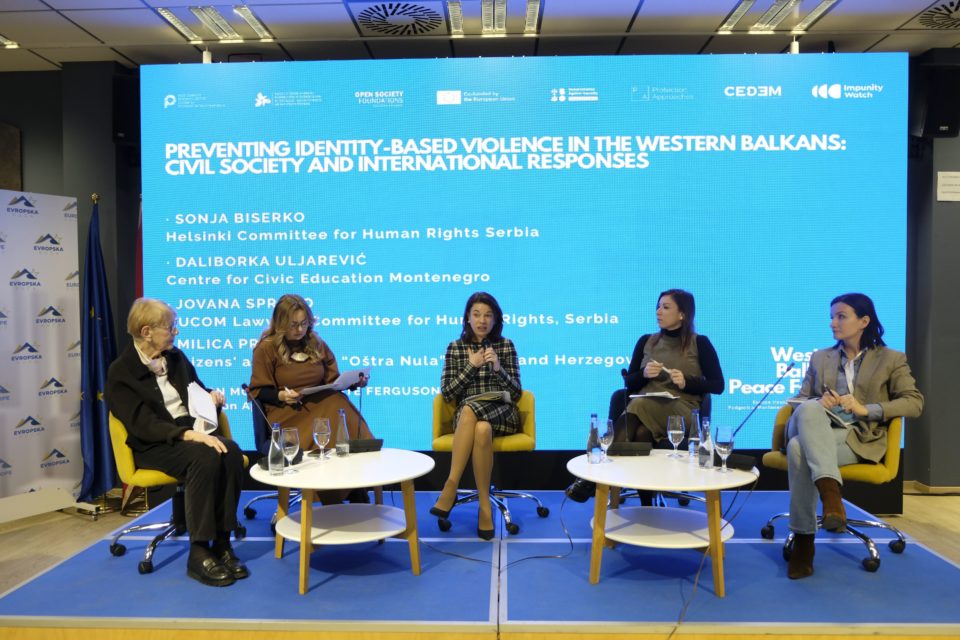
Following the first WBPF panel, CEDEM’s presentation on “Mapping Hate Speech in Montenegro” synthesized a more systematic perspective. This report provided a window into how hate speech spreads, who normalizes it, and why legal systems fail to root out these deleterious narratives in one Western Balkan society. The consequences of this trend are stark: self-censorship; a sense of impunity among offenders; a culture of inaction; structural exclusion; social desensitization; and, most strikingly, rights existing only in the letter of law, not practice.
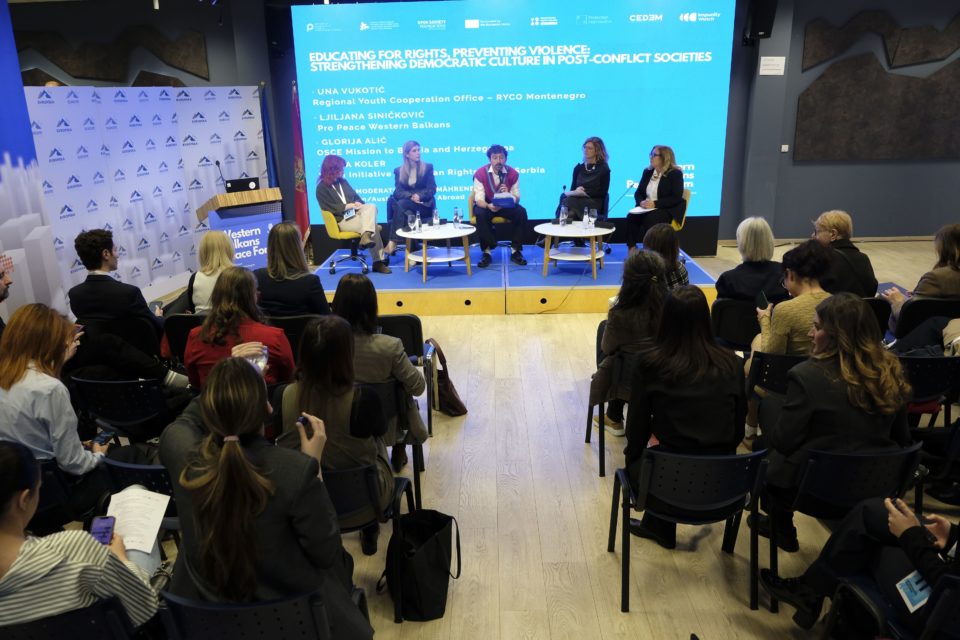
In the second panel of the Western Balkans Peace Forum, “Educating for Rights, Preventing Violence: Strengthening Democratic Culture in Post-Conflict Societies,” presenters noted how, amidst rising historical revisionism and genocide denial, engaging the post-war generation has never been more pressing. Illustrating this challenge, Dalia Koler of the Youth Initiative for Human Rights (YIHR) Serbia shared their observation that the mass student movement in Serbia advocating for the rule of law and accountability for political corruption, by and large, does not connect these calls to the political conditions of the 1980 and 1990s that precipitated war and mass atrocities. Indeed, Koler echoed the perspective voiced on the first panel by Sonja Biserko from the Helsinki Committee for Human Rights Serbia that this historical ignorance functions as a breeding ground for revisionism and denial.
A third challenge cited frequently throughout the WBPF related to the harassment and intimidation faced by human rights defenders in the region. Jovana Spremo of the YUCOM Lawyers’ Committee for Human Rights in Serbia initially raised this impediment on the first panel, adducing concerning trends of activists enduring physical attacks and arrests without due process, often under the guise of sedition or “betraying their country’s constitution for simply advocating for equal, guaranteed rights for all.”
Resilience in Practice: Comparative Wisdom from across the Region
Although recognition of shared challenges reinforced the common experience of the WBPF participants, the value of the forum emanated from its platforming of resilient solutions and comparative learning.
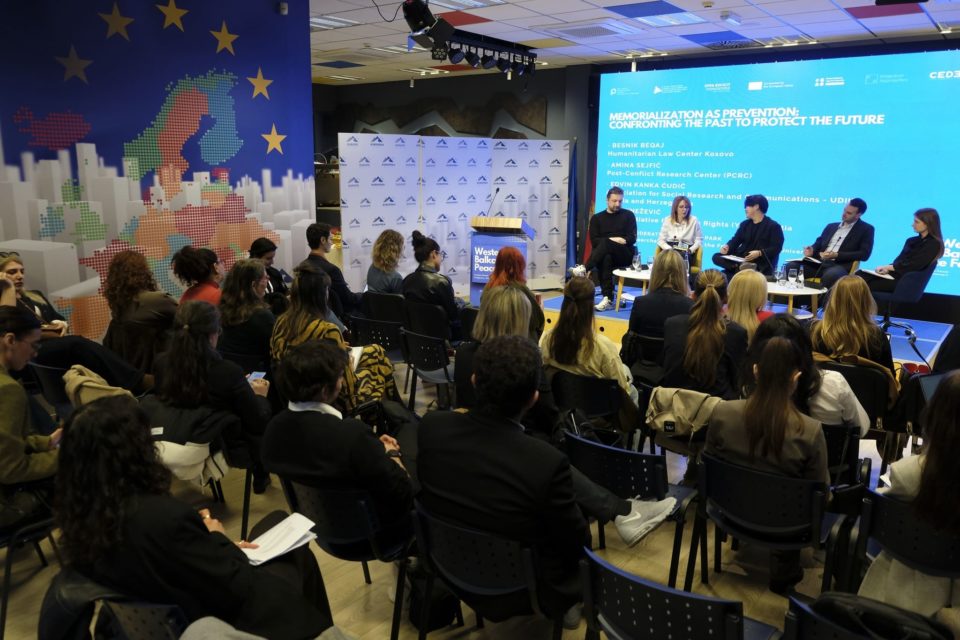
Regarding the first obstacle, the WBPF’s third panel, “Memorialization as Prevention: Confronting the Past to Protect the Future,” outlined how inclusive memorialization, paired with large-scale exposure to these memorials through formal and non-formal education programming, fight the spread of hate speech. Iris Knežević of YIHR Croatia said it clearly: even for an EU member state like Croatia, constraining hate speech requires constant and consistent implementation. Building upon Knežević’s perspective, Amina Sejfić of PCRC emphasized schools as the incubation stage for immunizing youth to harmful identity-based prejudices. For Sejfić, peace education, based on judicial facts, holds immense potential and is the only real solution.
At the same time, to mitigate hate speech’s corrosive spread, media and state institutions must be held accountable for platforming or tacitly accepting such harmful narratives. In panel four, “Victims at the Center: Advancing Survivor Rights in the Western Balkans,” Mehmet Musaj of the Kosovo Rehabilitation Centre for Torture Victims, laid out how a survivor/victim-centered approach to combatting hate speech empowers those most dehumanized by politicians’ inflammatory speech. Survivors’ inclusion and the sharing of their stories through informed consent leads to more effective, participatory policy.
On the second challenge, several WBPF panelists discussed the impact of direct, sustained contact through student exchanges for engaging youth in “dealing with the past.” For example, the second panel’s Una Vukotić of the Regional Youth Cooperation Office (RYCO) Montenegro and Glorija Alić of the OSCE Mission to Bosnia and Herzegovina detailed how bringing together youth groups across physical boundaries and unspoken community divides breaks down stereotypes and can catalyze meaningful relationships and dialogue. These engagements, in turn, create further space for inclusive memorialization.
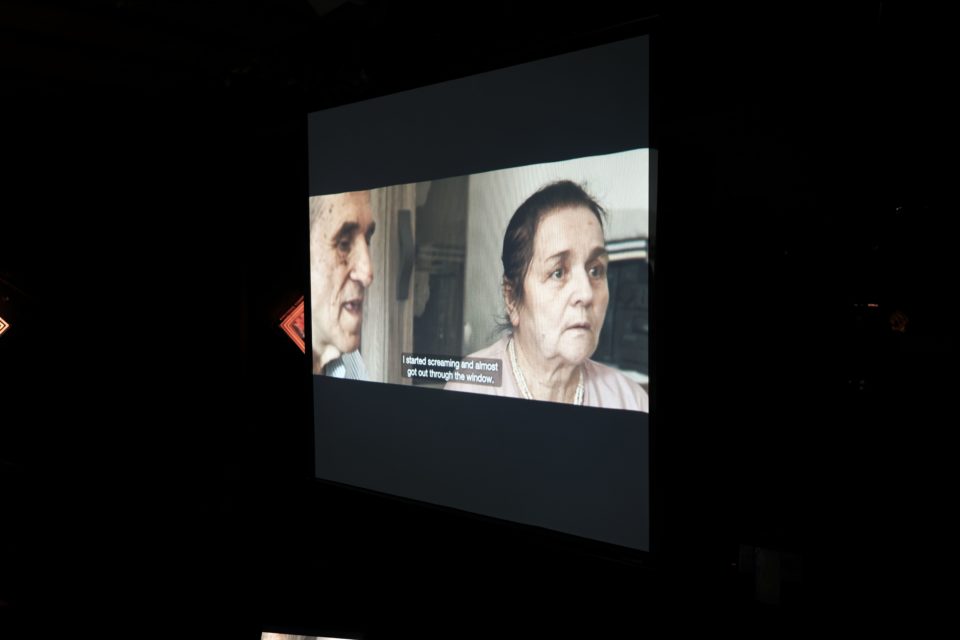
Additionally, powerful storytelling – through documentaries, journalism, or other mediums – is a panacea for ignorance or disinterest among youth. The Montenegro debut of the PCRC-produced documentary “Children of Sarajevo” attested to Velma Šarić’s view that the judicial legacy, of court facts and victim testimonies collected by the ICTY and national courts, lives on. By elevating these narratives, such as parents’ recollections of lost children during the Siege of Sarajevo, in all their unadulterated emotion, grief, and trauma, victims remain core to the transitional justice process, as the fourth panel articulated.
To address the third burden facing participants in the Western Balkans Peace Forum, extant UN and EU legal frameworks represent strategic tools to protect human rights and civil society defenders around the region. The legal cadres relevant to Western Balkans CSOs include the UN’s 1998 Declaration on Human Rights Defenders or the EU’s 2024 anti-‘SLAPPs’ (Strategic lawsuits against public participation) Directive. Stipulations, like Priority Five of the integration process of Bosnia and Herzegovina to the European Union, can also be leveraged for advancing transitional justice.
During a morning workshop on “Linking Local Efforts to International Advocacy,” Dr. Kate Ferguson and Farida Akram Mostafa of Protection Approaches named the urgency that many WBPF panelists felt. They argued that “[we] can’t live under the false assumption of business as usual. We must think creatively about who to call to action.” The Forum itself is a model transnational and multilateral advocacy network. Regionally, the Western Balkans offers a window into global illiberal trends. But it is not just a cogent case in point; the Western Balkans denote a crucial battleground for arresting democratic backsliding. This fight begins with standing up for rights defenders and the rule of law, wherever breaches may occur in the region.
When the Forum Ends, the Work Begins: Doing Our Little Bit of Good
Returning to the opening remarks of Ambassador Sattler, the telos of Western Balkans Peace Forum finds purchase. Ambassador Sattler said: “the recipe for peace is simple to define but not easy to master. It’s based on shared institutions, the rule of law, the protection of minorities, and accountability for crimes. And, yes, it’s a work in progress.”
Prevention efforts must begin early, whether with human rights, civic, and media literacy education, inclusive memorialization practices generated from the judicial legacy of court facts and survivor testimonies, or holistic student exchanges bringing together youth across the Western Balkans. These practices are foundational democratic safeguards. As Schuman declared in 1950, these efforts must also be proportionate to the tide of revisionism, hateful rhetoric, and denial rising in the region. The WBPF is a launchpad for such resilient resistance.
Finally, South African Archbishop Desmond Tutu, Nobel Peace Prize recipient for his work in anti-apartheid activism and Truth and Reconciliation, grounds us with wisdom for carrying the momentum of the Western Balkans Peace Forum forward. Tutu once said: “Do your little bit of good where you are; it’s those little bits of good put together that overwhelm the world.” Across the Western Balkans, WBPF participants are doing their “little bit of good” and seeking ways to support one another.