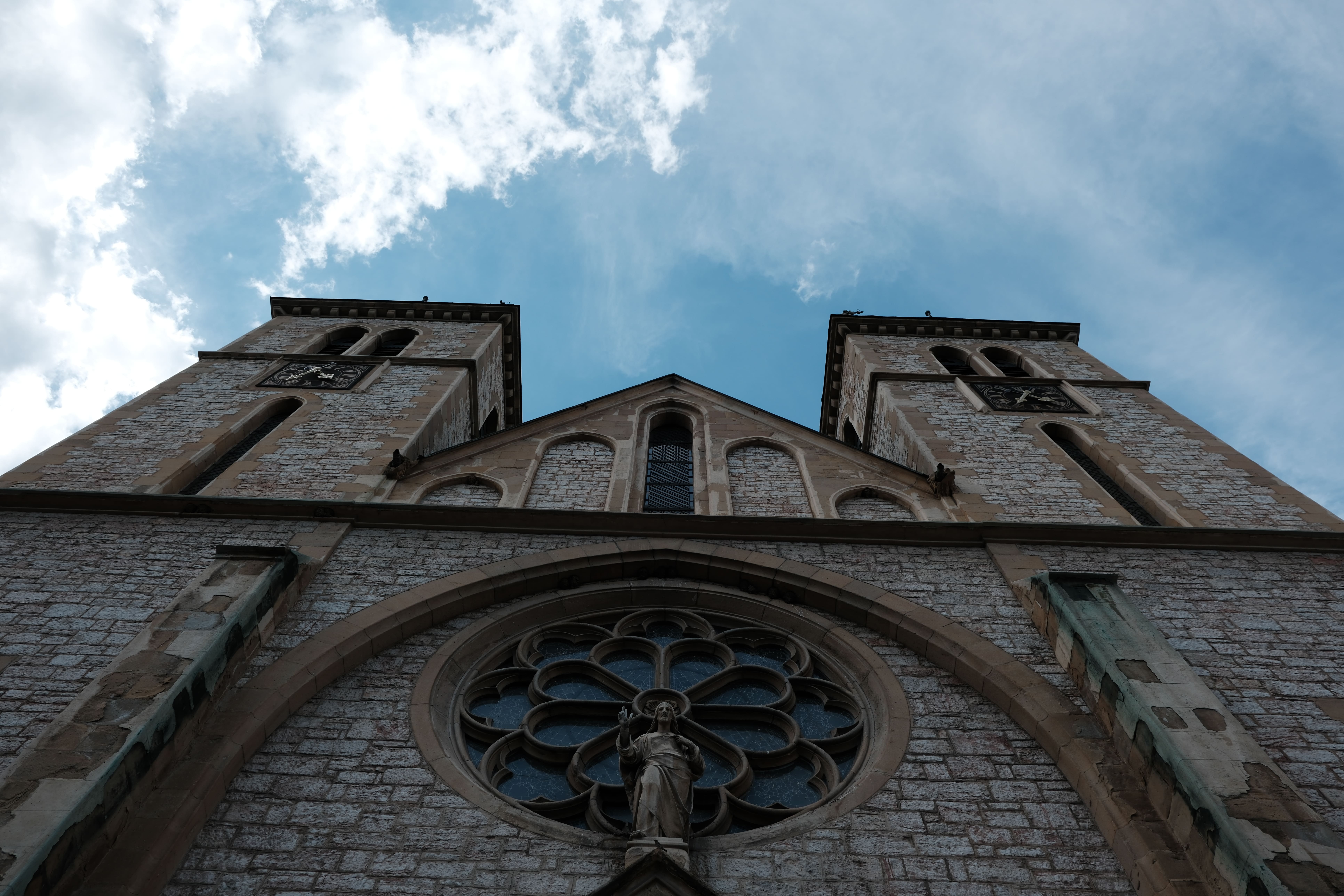
The Cathedral of Jesus’ Sacred Heart, known as the Sarajevo Cathedral, is located in the heart of Sarajevo on Fr. Grga Martić Square.
One of the most important religious buildings in Bosnia and Herzegovina (BiH), it is the seat of the Archbishop of Vrhbosna, who manages the Archdiocese of Vrhbosna in the name of the Holy Father, the Pope from Rome. As a parish cathedral that serves the people, it is one of the rare cathedrals in the world to have a practical function. It also has a symbolic dimension, as a meeting place for different religions and nationalities and a Catholic building in front of which many meetings and agreements begin.
September 2026 marks the 137th anniversary of the dedication of Cathedral of Jesus’ Sacred Heart. The cathedral was dedicated on September 14, 1889, on the feast of the Exaltation of the Holy Cross. At the solemn commemoration of the 130th anniversary of the dedication of the Cathedral, Metropolitan Archbishop of Vrhbosna Cardinal Vinko Puljić and the longtime secretary of St. John Paul II, Cardinal Stanislaw Dziwisz, from Krakow, prayed together next to the grave of Dr. Josip Štadler, the first archbishop of Vrhbosna, who is buried beneath the Sarajevo Cathedral.
Cardinal Puljić recalled that Cardinal Stanislaw had previously prayed at the Sarajevo Cathedral in April of 1997, during the Pope’s pastoral visit to Sarajevo and BiH. During this visit, the Holy Father brought the Lamp of Peace to the cathedral, where it bears witness to this day.
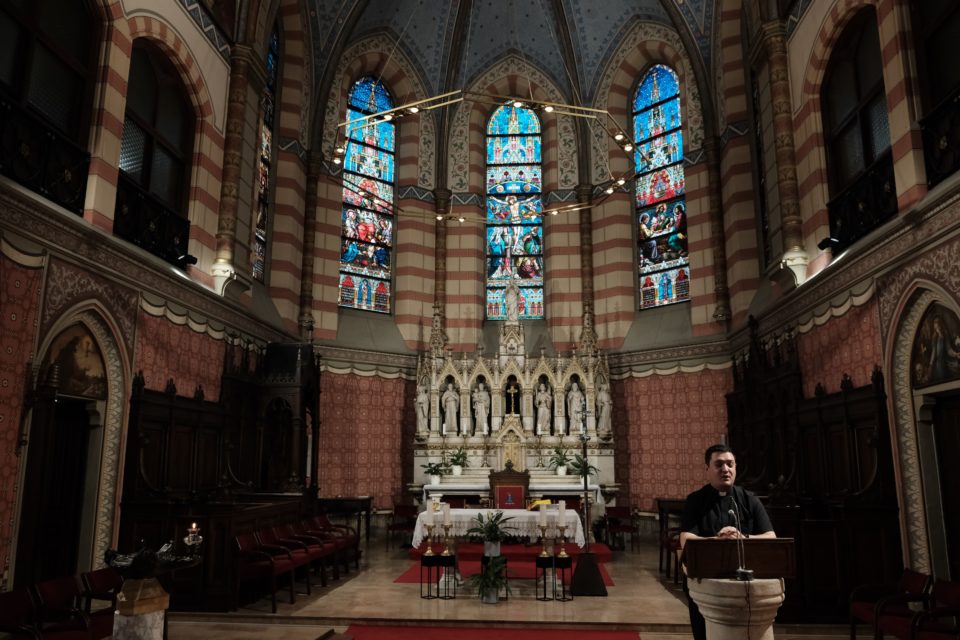
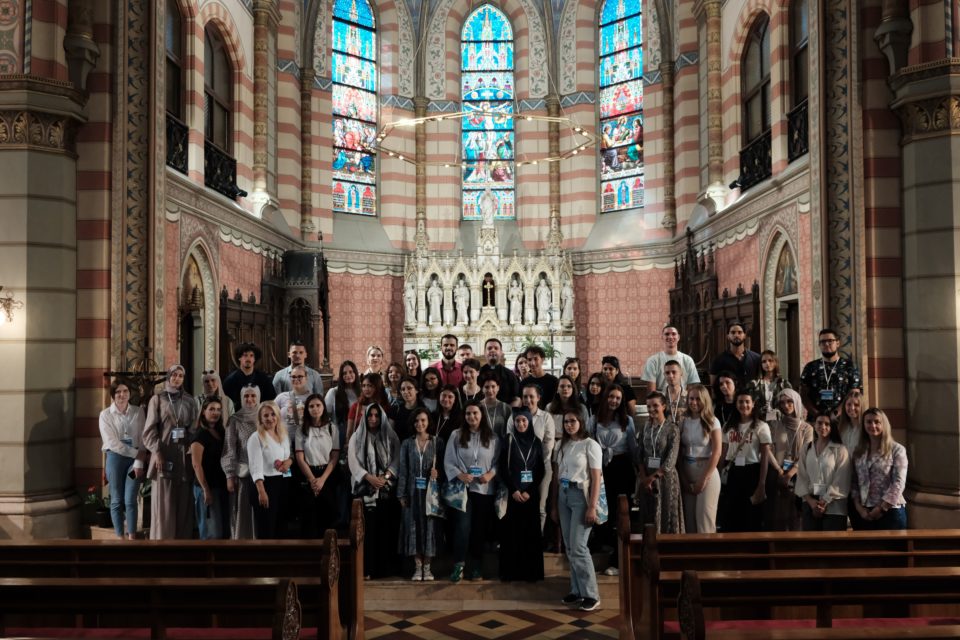
Last August, participants of the State of Peace Youth Academy, organized by the European Union in BiH in cooperation with the Post-Conflict Research Center, went to see the Lamp of Peace in the Sarajevo Cathedral. On this occasion, the 50 participants, hailing from BiH, Croatia, Serbia, and Montenegro, were addressed by assistant pastor Father Vlado Vrebac, who graciously answered their questions.
“The Lamp of Peace was brought by Saint John Paul II during his visit to Bosnia and Herzegovina in 1997, so that it would burn permanently in the Cathedral and remind us Catholics and all those who enter the Cathedral to be a beacon of peace and to shine for peace in this world,” Father Vrebac said.
Open During the War
Father Vrebac explained that the first archbishop of Vrhbosna, Dr. Josip Štadler, who served from 1889 to 1918, was responsible for the construction of several buildings: the Sarajevo Cathedral, the nearby seminary, the building where he lived, the Seminary in Travnik, and three or four monasteries across BiH.
“We like to joke that what the servant of God Josip Štadler built during his lifetime, we struggle to maintain today,” added Father Vrebac. Dr. Štadler was buried in the Cathedral, as bishops are traditionally buried in the churches where they served as a monument to their dignity and power.
The construction of the Cathedral was entrusted to baron Karl Schwartz, an entrepreneur from Vienna, under the supervision of architect Josip Vancaš. Archbishop Štadler consecrated the building and dedicated it to the Heart of Jesus. The exterior length of the cathedral is 41.90 meters, the width is 21.30 meters, and the upper part is 24.30 meters.
Pastor Vrebac noted that it was constructed in the Neo-Gothic architectural style.
“As a neo-Gothic church, it is quite simple without a lot of stone decorations, with some statues and reliefs, which reveal its religious significance. At that time, top artists worked on furnishing the Cathedral,” added Father Vrebac.
During the war in BiH and the Sarajevo siege—the longest siege of a capital city in modern history—the Cathedral was not destroyed or burned, but it was badly damaged.
“All the decorative glass you see was shattered by shrapnel, and when you exit, you will see fragments of stone that were blown off by the shelling of Sarajevo, because shells were also falling around the Cathedral. With the help of donors, we managed to restore the Cathedral to its original order and appearance. It has been standing for more than 130 years now, and we hope that it will continue to do so,” said Father Vrebac.
He pointed out that throughout the war, the Cathedral continued to function. Masses were held, people came, sometimes even under threat of death from the front lines on Mount Trebević, from where the whole city is visible. As Father Vrebac observed, “when things are at their worst, people have the most courage.”
Going Back to God
Sunday Mass is a crucial element of practicing the Christian faith. The Pastor explained that Sunday serves as the central day for the community to gather to commemorate the Resurrection of Jesus Christ. As for prayer, the frequency of practice is left to the personal responsibility of each Christian and their individual relationship with God. Generally, there are three times a day when a Christian should remember God in prayer, which is why the sound of the church bell is so important.
“The bells usually toll in the morning at six, at noon, and in the evening at six or seven o’clock, and then every Christian should say a prayer. Yet, I repeat, how much someone practices, that’s up to them, but the sound of the bell reminds us of our relationship with God, so that we have a visible, that is, an audible reminder to return to God,” added Father Vrebac, who has been a priest for 11 years.
He explained that he decided to become a priest in response to God’s call and specifically to serve the people wherever the bishop sends him within the parishes in the Vrhbosna archdiocese.
Catholic priests, unlike Orthodox priests, do not marry. According to Father Vrebac, they practice celibacy “so that they can more easily, through their solitude, try to respond to their own and God’s demands, and serve the community.”
“In the Catholic Church, you have dozens of priests and clerics. The priesthood was founded by Jesus Christ through his apostles to preach the Gospel, and the religious order developed throughout history, as an organized form ordained by God in order to live a certain charism in the church, help the poor, heal the sick, preach the Gospel, study theology and the like. So, each Christian cleric has a special task within the Catholic Church,” explained Father Vrebac.
In addition to the Sarajevo Cathedral, the participants of the State of Peace Youth Academy also visited the Gazi Husrev Bey Mosque, the Cathedral Church of the Nativity of the Blessed Virgin Mary, and the Ashkenazi Synagogue. Father Vrebac aptly reminded them that coexistence is built with those around you. If we can live in peace with our neighbors—be they Muslim, Serbian, Catholic, or Buddhist—we can live in peace with anyone in the world: “The essence of a human, their humanity, shows in their interactions with those they are with. If we can’t show it there, all our outpourings of humanity elsewhere are for naught.”