During the war in Bosnia and Herzegovina (BiH), children were among the tens of thousands of victims—killed by shelling, sniping, shooting, and other means.
They were killed in their homes, while playing with their friends, walking, riding bicycles, at school, or were separated from their families and taken to their deaths. More than thirty years later, in some communities, the names of the murdered children have long been carved into stone, while in others, they have not yet been given the right to be part of such a culture of remembrance. In general, experts believe that the culture of remembrance surrounding child victims and survivors remains underdeveloped, selective, and lacking in ethical responsibility.
For the parents and relatives of murdered children, monuments and memorials serve as places of comfort and remembrance. Experts in transitional justice say they are not only symbolic tributes that help foster a culture of remembrance, but also essential mechanisms for acknowledging crimes and recognizing victims. They provide permanent public spaces where people—including younger generations—can learn about the past and better understand the enduring value of peace.
Despite their importance, it remains nearly impossible to erect a monument or memorial in some areas.
Organizations dedicated to remembrance, such as the War Childhood Museum (WCM)—the world’s only museum exclusively devoted to documenting the experiences of people whose childhoods were shaped by war—say that the representation of children in BiH’s memory politics is often selective and instrumentalized. “Children appear as symbols of innocence and collective loss mainly in commemorative contexts, while permanent institutional attention and ethical responsibility for their experiences are absent,” says Aynura Akbaš, a WCM research coordinator.
Places Where Memory Has Its Own Form
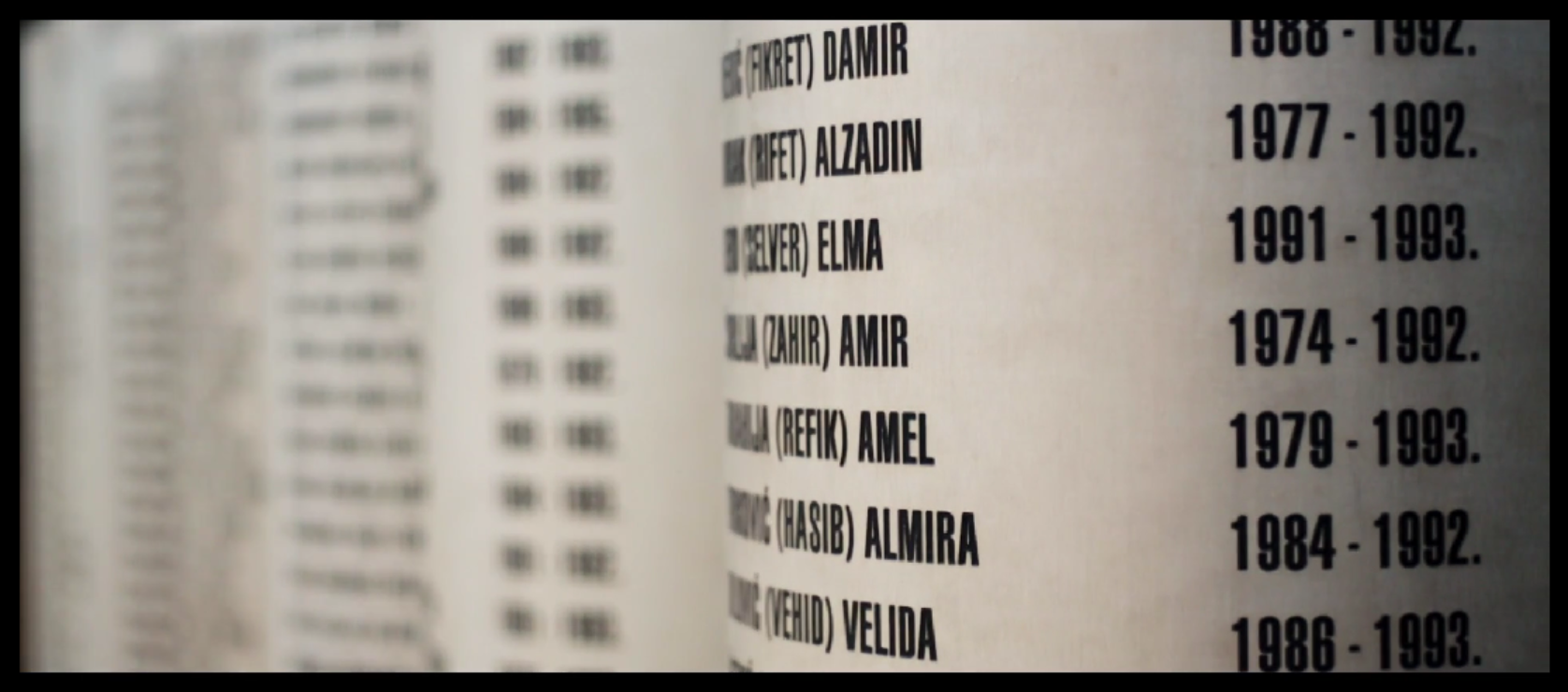
In the Bosnian capital, the Memorial to the Murdered Children of Besieged Sarajevo 1992–1995 is located in Veliki Park. The monument bears the names of 509 of the 1,601 children known to have been killed during the siege, each accompanied by the names of their parents and the years of their birth and death. The memorial was built in 2009, designed by sculptor Mensud Kečo.
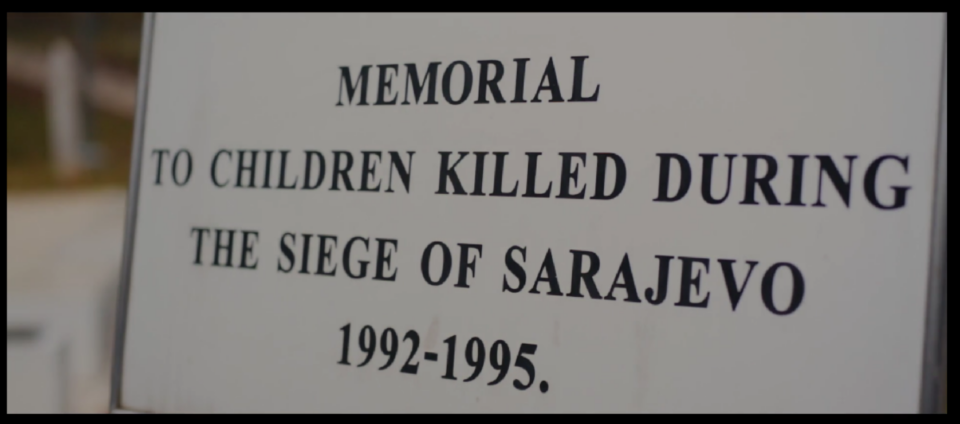
A. Musić, responding to a questionnaire issued by the Sarajevo Department for Urban Planning and Housing Affairs, stated: “The memorial has a clear and simple symbolism and message. It is made of reinforced concrete in a circular shape on which a bronze ring is placed as the upper surface covering. The circular bronze ring with children’s footprints speaks of the eternal presence of the killed children and of the environment in which the children lived during the aggression. The glass sculpture in the middle of the fountain symbolizes the castles that children usually make from sand. This form also represents a flame, frozen in time, and the light that is trapped within it. The water in the fountain that unobtrusively springs up and splashes the footprints symbolizes life and movement in nature.”
The memorial was erected by the Sarajevo City Council, which formed the Organizing Committee for the erection of the memorial, comprising city representatives, cantonal ministers, mayors from all canton municipalities, and representatives of the Association of Parents of Children Killed in Besieged Sarajevo. The construction was financed by the Sarajevo Canton, the City of Sarajevo, and all municipalities.
Near the memorial is a memorial room also dedicated to the memory of the 1,601 child victims of the Sarajevo siege. Together, these structures represent a unique place of remembrance and warning. The memorial room displays photographs, drawings, toys, and traces of childhood, each carrying a poignant story and truth in its own right.
In addition to this monument, there are dozens of individual memorial plaques in Sarajevo at places where children were killed by shells or snipers, including at playgrounds, schools, and in front of buildings. The Day of Remembrance for the Murdered Children of Sarajevo is observed annually on May 5th.
Amel was playing outside with his brother Džemil Hodžić on May 3rd, 1995, when a sniper shot him in the chest. At the age of 16, he died in his mother’s arms. From that moment on, Džemil’s childhood was inevitably interrupted. Today, Džemil runs the project “Sniper Alley Photo,” which he started a little over six years ago. He produced a documentary film about the project, Sniper Alley – To My Brother, which tells the story of his efforts to collect photographs taken by renowned war reporters during the siege of Sarajevo from 1992 to 1996.
“I remember when the memorial to the murdered children of besieged Sarajevo was built and when I saw the name of my brother there for the first time. It’s hard to explain the emotions, but at that moment I felt that he hadn’t been forgotten, and that his name would always be present when we talk about the aggression against our country,” said Hodžić.
He emphasized that the dead cannot speak for themselves or warn future generations. That is why, as individuals and as a society, “we must educate ourselves in their name and keep their memories alive—for the sake of the living.”
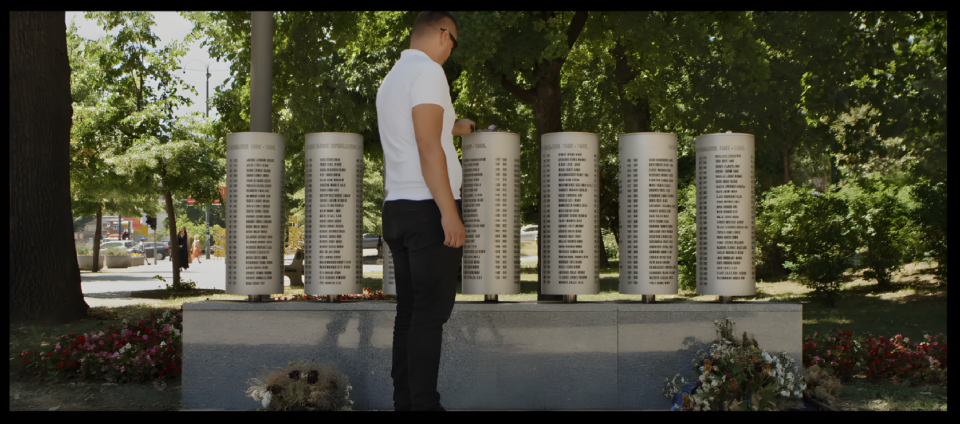
Fikret Grabovica, president of the Association of Parents of the Children Killed in the Siege of Sarajevo, said that “for society, the memorial to the murdered children means more than it does for us – the parents.” He described it as a “confirmation, evidence that will remind young, future generations of what happened in that period in the 1990s, so that it will be a lesson to them on how important peace and freedom are.” Only peace and freedom, he emphasized, can give them the future they want and imagine.
In East Sarajevo, a memorial dedicated to the Serb children killed between 1992 and 1995 was erected in the courtyard of Sveti Sava Elementary School in 2018. It commemorates the deaths of 118 children, six of whom were students at the school. The memorial is engraved with verses from the poem Sumrak [Dusk] by Goran Vračar, dedicated to the killed children. The Day of Remembrance for the Killed and Victimized Children of Serb Sarajevo (today, East Sarajevo) is observed on March 11, the anniversary of the deaths of ten-year-old Nataša Učur and 11-year-old Milica Lalović, whose tragic fates have become a symbol of the suffering of children in the Sarajevo-Romanija region.
This memorial was erected at the initiative of the school board and the Organization of Families of Captured and Killed Fighters and Missing Civilians of East Sarajevo in order to cherish the memory of the killed children in Serb Sarajevo. According to media reports, the funds for the construction of the monument were provided by the cabinet of the President of Republika Srpska.
During this year’s Memorial Day, the principal of Sveti Sava Elementary School, Željka Topalić, said that she continues to impress upon her students the value of every human life, the importance of honesty and fairness, and the imperative of prioritizing peace for every member of society. At the same time, she also encourages love for those who live for the Republika Srpska, concern for the well-being of the Serbian people, and sympathy for the suffering of Serbian victims. She emphasized that students should understand that the freedom and dignity of the Serbian people are St. Sava’s vow.
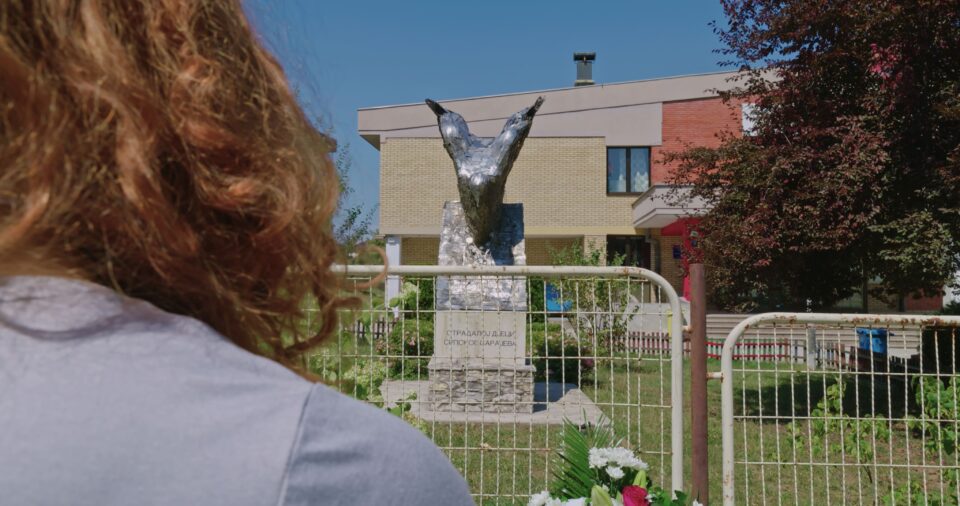
In Banja Luka, a sculpture called “Life” by Maja Milić-Aleksić stands in remembrance of 12 infants who perished at a local hospital in May and June of 1992 due to insufficient oxygen. The monument symbolizes the mother’s womb and the tragically interrupted lives of these infants.
The Osmica Memorial was erected in Vitez with the aim of preserving the memory of eight Croat children who died in this region during the war. The memorial, in the shape of the number 8, was created at the initiative of the children’s families two years after their deaths. Several years later, a cross on a pedestal was added with images of the murdered children and information about their deaths.
The Osmica Memorial features a basketball hoop with a suspended ball, symbolizing interrupted childhood. A book was placed at a crater from a shell, below a small cross and a guardian angel. A concrete bench and a table with eight vases of flowers are also present.
Ivan Garić, president of the Osmica Association, explained that the monument is a place of warning and conveys the message that such violence must never again be permitted against anyone and must never be forgotten. Every year on June 10 at 6 p.m., a memorial mass is held for the slain children.
Shared Places of Remembrance
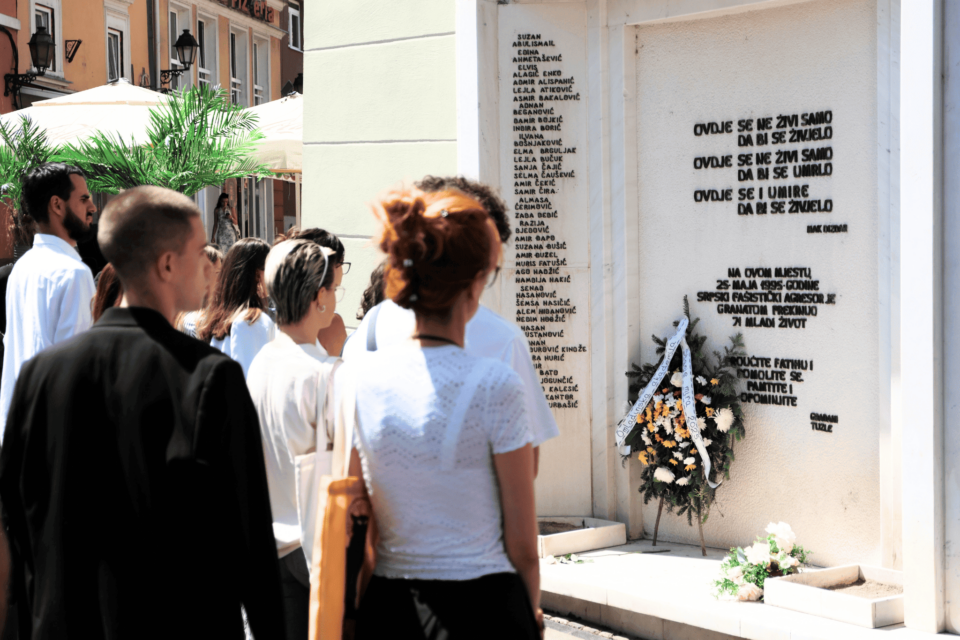
In some places in Bosnia and Herzegovina, there are no separate monuments or memorials dedicated to children; instead, they are part of the broader culture of remembrance alongside those who were killed with them. One example is the Tuzla Kapija, where a heinous crime was committed against the youth of Tuzla on May 25, 1995. In the very center of the city, 71 people, with an average age of 21, were killed. The youngest victim was Sandro Kalesić, who was only two years old when he was killed in his father’s arms. His name is engraved on the Kapija memorial.
The name of Mladenka Zadro, who was only four years old when she was killed in her mother’s arms, is likewise inconspicuously engraved on the memorial in Grabovica, north of Mostar. Shortly after Mladenka was killed, her parents and 33 close relatives were killed in September 1993.
Neither Sandro nor Mladenka received a special memorial recognizing them as the youngest victims of the crimes at Kapija and Grabovica, respectively. The question remains whether this diminishes the warning that their deaths carry and whether such places of remembrance are sufficient for this type of memorialization.
Systematic Silence
In some areas in Bosnia and Herzegovina, memorials to child victims are completely absent from public spaces. In front of Major Zoran Karlica Square and the city administration building in Prijedor, there is a fountain, buildings, and green spaces, but no monument to the 102 children murdered in Prijedor.
Among these victims were two children of Fikret Bačić, who lost a total of 29 family members during the war. Bačić has been fighting to build a memorial for 102 children since 2014, when an initiative was launched that collected more than a thousand signatures, exceeding the number required by the statute of the City of Prijedor. Bačić believes the memorial should include a plaque inscribed with the children’s names and ages at the time of their deaths. For him, such a memorial would express “that the city of Prijedor has paid tribute, that is, has recognized the crime committed against the murdered children of the city of Prijedor.”
Despite being thwarted for more than a decade, he still hasn’t given up on this effort.
“In 11 years, the Parliament has never put an initiative to build a memorial to the murdered children on the agenda,” Bačić adds. Instead of solutions, local authorities offered compromises to cover up the truth. He recalled an offer by the former chief to build a memorial to all children murdered in the 20th century: “I said I had nothing against it, but that there needs to be a separate monument to the children killed between 1992 and 1995. He wanted there to be no mention on the memorial of who was killed. He wanted to overshadow the number of some thousand killed, to overshadow these 102 children,” said Bačić.
He added that the city authorities do not want there to be a place where people could gather and pay their respects in their own way. For parents, he added, these actions have a deeper meaning than any marking itself. “They are killing our murdered children again,” Bačić said.
While the fight for a memorial to the murdered children of Prijedor continues, and a call for proposals has been issued, Grabovica points out the state’s attitude toward the youngest of victims is deplorable.
“Institutions speak very little when it comes to the suffering of children during the siege. All activities, everything that happens on any basis—awareness, remembrance, commemoration, memorialization—the main bearer of all activities is the Association of Parents of Murdered Children,” Grabovica explained.
According to him, those who should be working on memorialization either make only modest, meager efforts, or only take action when forced to do so.
The Need to Include Children in All Aspects of Transitional Justice
The attitude towards monuments and memorials to child victims extends to child survivors of war, who are not recognized as a separate category of victims. Most often, child survivors are treated through the legal framework that includes civilian victims of war, while the specificity of their trauma and childhood deprivation remains on the margins.
The Forgotten Children of War Association advocates for children born of wartime rape, who are today left to fend for themselves. “They have largely remained insufficiently recognized in institutional policies of memory,” the association stated.
A particular problem facing these children is the stigma and social silence that has persisted over the past 30 years. Regarding memorialization, the Forgotten Children of War Association is of the opinion that it is often “fragmented and driven by local or political contexts.”
The visibility of children in memory politics, according to Akbaš from the WCM, is selective and instrumentalized. “War is most deeply inscribed in people’s lives, especially the lives of children,” stressed Akbaš, warning of the potential for manipulation.

Unlike monuments and memorials, which coney a their own symbolic message, the Museum relies on individual experiences. “Personal stories and objects are a material remnant that carries a weight that traditional symbolic forms of memorialization can hardly achieve,” explains Akbaš, adding that such exhibits “restore authorship over their own experience to collection contributors.”
With this approach, the WCM poses a question to society as a whole that they themselves are constantly guided by: “What is memorialization without responsibility and what will we, as a society, do with these testimonies?”
Alma Begičević, an expert in transitional justice, sociology, and human rights who teaches at Chicago’s Loyola University, explains that memorialization falls into the category of reparations, that is, measures aimed at acknowledging suffering and restoring dignity to victims. She cites the work of the WCM as an excellent starting point and model for the rest of Bosnia and Herzegovina.
“Although memorials are primarily symbolic measures, they can have significant legal implications within the framework of reparations,” Begičević asserts, adding that such measures fall into the category of satisfaction, which includes public recognition of the suffering of victims, memorialization, and the preservation of historical memory. In this context, the absence of memorials signifies not only an absence of physical markers but also a lack of institutional recognition for victims.
In order to adequately pay tribute to victims, she says, specific legal measures are needed that should include “a national registry of war victims: those killed and wounded, and those children who did not have a childhood because of the war.” She added that remembrance must be inclusive and based on verified data that will serve generations to come.
“For commemorative projects, data should be collected with the names of survivors and those who died, and educational programs should be included in school courses so that respect is paid to the victims and their families,” explained Dr. Begičević.
She highlighted the experience of child soldiers, who often remain invisible in public narratives. She believes they need to be respected, their lives followed and supported today, and that a program should be developed to provide them with reparative assistance. According to her, it is also necessary to introduce additional measures to strengthen the culture of remembrance, including memorial museums and memorial spaces for child victims as well as broader social recognition through “symbolic reparations such as national memorials.” In order for such projects to be sustainable, she adds that they must include private, social, and international foundations and artistic groups in their financing.
Behind all aspects of transitional justice owed to child victims and survivors, there is the same need: to ensure that they are not forgotten, and their stories serve as a lasting lesson in Bosnia and Herzegovina and beyond.
This article was created within the project “Generation Memory”, which is carried out by the Post-Conflict Research Center (PCRC), with the aim of developing inclusive, local peace-building practices and a culture of memory that encourage work on understanding, empathy and critical reflection among young people. The project is financed by UK International Development and is implemented in partnership with the British Council.