Ask people who work on violence prevention in Bosnia and Herzegovina what the word means, and you rarely get a single answer.
Over the last few months, we spoke with civil society organisations across the country: journalists, lawyers, memory activists, educators, and groups working with survivors of wartime sexual violence. They work in very different ways, but their answers share a thread. Prevention is the daily work of countering denial, documenting what courts have established, teaching young people, marking places of suffering, and keeping watch for warning signs.
Several insights stand out.
The law is rarely the problem. Implementation is. Bosnia and Herzegovina has signed the treaties, passed the laws and received the court judgments. What people describe is a gap between what is on paper and what happens in practice, with obligations that go unenforced, decisions that go unimplemented, and accountability that depends on political will.
Denial is a symptom. Many of those we spoke with see denial and glorification of war criminals as the late stage of a longer process, one that begins with dehumanizing language, selective memory and unaddressed transgenerational trauma. This is why prevention work must include both looking at the root causes, as we as prosecution of crimes.
Education is where it matters most. In many schools, the 1990s war gets only a short slice of one class year, and children often learn about it through family stories rather than established facts. Bosnia’s education system with its 13 different education ministries and curricula constructs highly different narratives about Bosnia’s past and present. The classroom can be a crucial center for reconciliation, but only if challenging topics are directly faced, as young people wish.
Memory is part of prevention. Unmarked mass graves, memorials that honour some victims and not others, and crime sites built over without acknowledgment are all read by practitioners as warning signs. So is the continued silence about some groups of victims, including survivors of sexual violence.
That is the gap we want to help close.
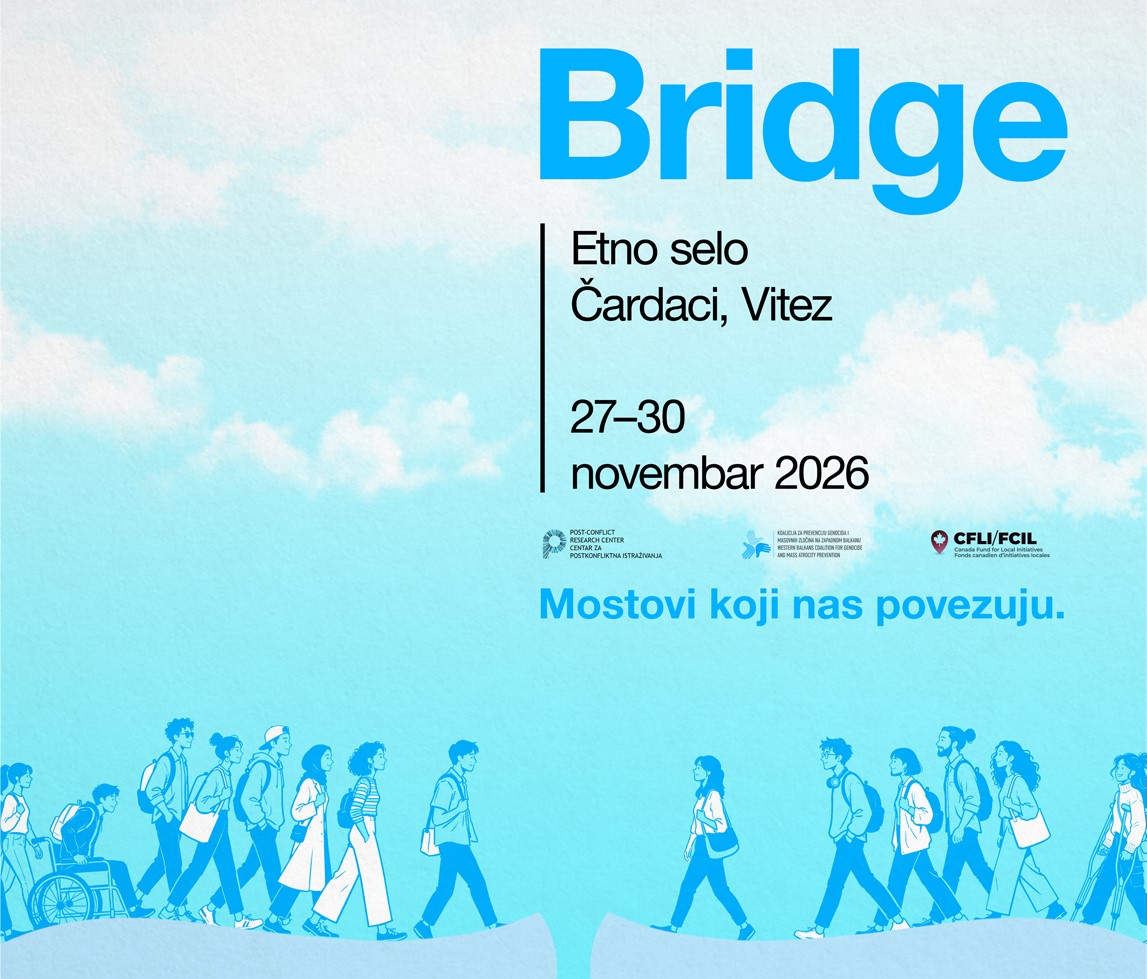
By the end of November, Post-Conflict Research Center (PCRC) and the Western Balkans Coalition for Genocide and Mass Atrocity Crimes Prevention (CGMAP) will bring together educators, civil society representatives, and young people from across BiH for a dedicated atrocity prevention program through PCRC’s latest BRIDGE project.
Days 1–2: CGMAP BiH Coalition Strategic Convening. Leading civil society organisations will assess current risk in BiH using the UN Framework of Analysis for Atrocity Crimes, discuss gender and atrocity prevention, and agree on joint advocacy priorities for 2027.
Days 3–5: Capacity-building workshops for CSO staff and young people:
- Applying the UN Framework of Analysis: conflict mapping, risk indicators and early warning documentation.
- Gender dimensions of atrocity crimes and prevention.
- Advocacy and communication: writing policy briefs, engaging government and international actors, and using digital media.
Follow us on social media (@pcrcbih) to stay up to date with the project!
_______
This article is part of the BRIDGE project, implemented by Post-Conflict Research Center and supported by the Canada Fund for Local Initiatives. The opinions contained in this article do not necessarily reflect those of the Government of Canada.