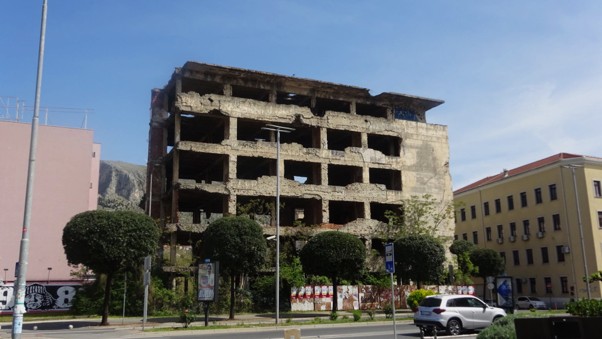
Three decades after the end of the Bosnian War, damaged buildings remain scattered throughout Mostar’s eastern city center.
In her master’s thesis in Urban and Regional Planning from Stockholm University, Nejla Kukrica, the author of this article, examined what these ruins mean to the people who live among them and why they have remained untouched.
The ruins are more than abandoned structures: they are reminders of the past, part of everyday life, and a question about the city’s future. Mostar has been rebuilt enormously since the war, but thousands of physical traces of the conflict remain embedded in the everyday urban landscape. So, what does it mean to live among them, and why haven’t they disappeared?
“I thought I knew the city of Mostar, having visited from Sweden throughout my life, but it was not until conducting this research that I could put words to the feeling of being haunted by a past I did not experience myself,” said the author. The legacy of war is very much alive in the present and is visible in Mostar’s everyday urban landscape, on almost every corner. She said that walking through the streets, she felt haunted when she encountered these ruins as she attempted to reckon with them. The skeletal structures of bygone buildings told unfolding stories, expressing a yearning for forgiveness amid a long wait for change.
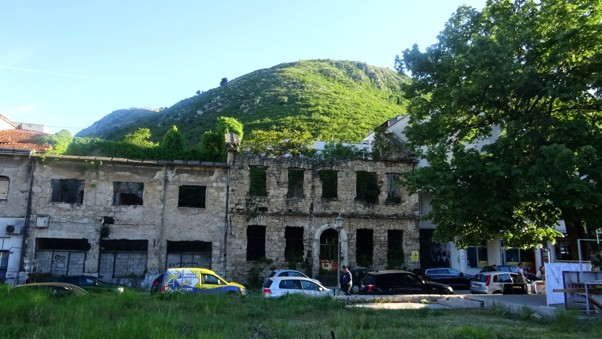
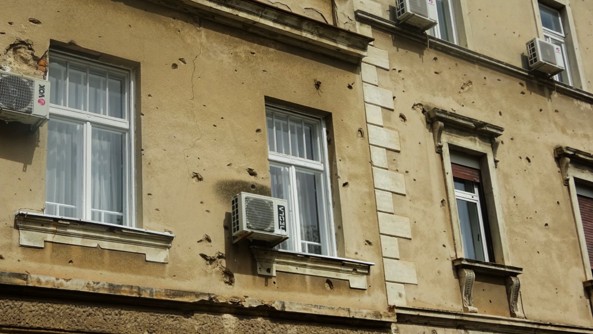
Far too many war ruins remain today in the cityscape of eastern Mostar, the part of the city that saw the most urbicide during the 1992–1995 war. Indeed, in 2022, it was estimated that 1,300 war ruins were still unreconstructed in the city. Damaged buildings stand between renovated houses, businesses, roads, and parks. Some are concrete shells, while others still retain parts of their original facades, yet are marked by bullet holes, artillery damage, and vegetation growing through window and door frames. These ruins are part of the everyday landscape.
“I wanted to understand not only the physical composition of the ruins, but what they mean to the people who encounter them every day and why, more than thirty years after the war, so many remain unreconstructed,” said Kukrica.
Walking Through a City Marked by War
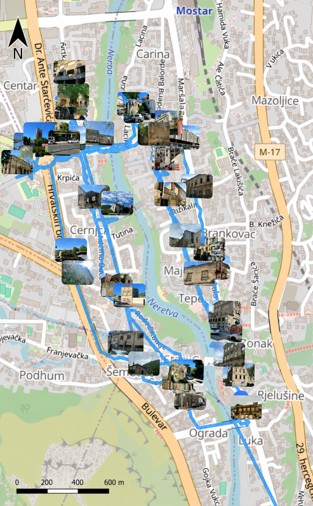
“Rather than studying the ruins only from documents or photographs, I walked through the city and documented what I encountered,” she said.
“I photographed the remaining structures, observed how people moved around them, and created a mapped inventory of the ruins in the study area. The resulting map offers a visual representation of how frequently these remnants occur in the urban landscape. Such representation is significant because although Mostar’s war ruins have been discussed in previous research, there is no comprehensive or up-to-date cartographical record of the remaining ruins in eastern Mostar. The inventory that I created therefore provides a snapshot of the city’s ruins as of spring 2026,” Kukrica added.
The past is still present
A map can only tell where a ruin is; it cannot reveal what it feels like to live beside it. To understand this, she conducted walking interviews with Mostar residents, as well as interviews with experts familiar with the city’s planning and governance. In the course of 14 interviews, she discovered that the ruins are much more than abandoned buildings; they have become part of how people experience life in Mostar.
One of the clearest findings from the research is that the ruins are traumatic reminders of the war for many inhabitants.
“Painful wounds for all of us who watched those buildings burn and who pulled the dead and wounded from these very ruins. Thousands of us in Mostar still carry terrible war traumas, and those ruins remind us every day of what we went through in those 90s years during the attack on Mostar and Bosnia,” one participant described the ruins as such.
This kind of everyday meaning-making in relation to the past clearly underscores that the ruins are interpreted as projections of active memories of war. As another participant stated, “everyone here is just trying to move past the war, even though they are surrounded by those memories constantly.” As a result, the remaining war ruins create an unusual relationship between past and present. Everyday life continues, but the material traces of war remain and evoke trauma, essentially collapsing temporalities.
Every interviewee, regardless of age, characterized the ruins as projectors of traumatic memories. Several were born after the war and thus did not experience its hardships firsthand but still described the ruins as vessels of transgenerational trauma.
“Living testament to the people in my family, my parents and grandparents, who were affected. You see here every hole that the shell has made; you see every damage and trace caused by bombing. So, even though I may not have experienced the war myself, I can vividly visualize how it was,” one participant in their twenties said.
This connection to the past challenges the idea that the passage of time makes the physical remnants of war less meaningful. The legacy of the past lives on with younger generations through space in the present. At the same time, the ruins have become normalized. People walk past them on their way to work, sit near them in parks, and recreate in their presence.
“I no longer pay attention to them. Because they have been like that for years and are an integral part of the city, I don’t even notice them that much. I mean, you only notice them because of the fear of them collapsing,” another participant said.
Evidently, the ruins become almost invisible as part of the ordinary cityscape. There were also elements of desensitization, melancholia, and dissociation present in participants’ accounts of their relationships to the ruins, creating detached urban identities. Ruination should not be accepted or normalized. It creates a subconscious emotional burden of grief and anger toward the state of dereliction.
Why Are the Ruins Still There?
The ruins in Mostar are seen as part of the lasting problems of economic stagnation, unsafety, and trauma. Nejla’s research identified three interconnected obstacles to removing the ruins: political neglect, unresolved property rights issues, and complex post-war governance structures. Evidently, the ruins’ presence 30 years after the war reflects a difficult combination of questions over property ownership, institutional responsibility, and the authority to intervene. In some cases, for example, individual ruins were collectively owned before the war, leaving their current ownership unclear. Because resolving shares of tenure is a slow legal process, according to one of Mostar’s building directors:
“Everything is at a standstill. Not even private investors can buy ruins without clear property rights. Politics cannot just give orders, buy the ruins, and demolish them. After all, it’s someone’s property. You need to have an official resolution to resolve this legally and correctly,” he said.
There is public desire for further reconstruction of the ruins, to steer Mostar on a path of modernity and erase the urban scars of war. However, reconstruction is highly complicated and inefficient in the politically segregated city. The ethnically divided political climate and political unwillingness for urban change driven by private gain and corruption are highly problematic and signal a lack of care for both the environment and inhabitants’ well-being, according to an interviewed politician.
Nevertheless, Mostar residents hope for a different future. Rehabilitating the scarred urban landscape is directly connected with economic development, safety, well-being, revitalization, and modernization. The interviewees imagined reconstructed buildings becoming hotels, restaurants, schools, libraries, and clinics.
“Somehow, when you see what could be done here, you think, well, maybe one day there will be something here, something with a function, so that it doesn’t just become an old ruin waiting to fall, waiting to be destroyed, waiting for life to be lost,” one participant on Mostar’s potential said.
Looking Forward
This research sends an urgent message to the officials and politicians in Mostar that the ruins create unhealthy living conditions and that change is needed in the very near future. If more than 30 years have already passed with reconstruction at a standstill, how many more will pass before all of Mostar’s ruins are reconstructed?
“Anything is better than ruins from which stones are falling. Anything is better than ruins that pose a danger to the elderly in Mostar, to the residents, to local guests, to tourists. Anything is better than these terrible war scars that still remind us of that awful period of Mostar’s destruction. Anything is better than that, yet it remains stuck in a deadlock,” one participant underlined the importance of change.
Today, walking through Mostar means moving between different moments in time: encountering a modern building beside a ruin, everyday life unfolding against crumbling facades frozen in time. Mostar has rebuilt much of what was destroyed, but not everything.
“God willing, things will turn around for the better. It would be better for the future of the youth, for the future of children, for the future of all of us, if we have as many job prospects, work opportunities, schools, and everything else as possible,” said one of the participants, hoping for a better future.
The ruins have become ordinary enough to disappear into everyday life, yet powerful enough to bring the past back into the present. Perhaps this is what makes them so difficult to resolve. They are not simply buildings waiting to be reconstructed. They are reminders of a history that has not disappeared, even as Mostar continues to build its future.
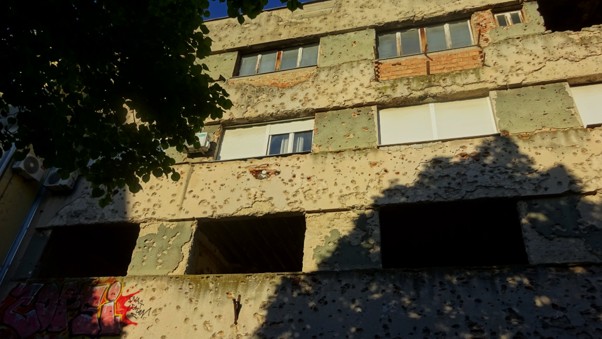
From the master’s thesis “Dealing with ruins in the post-war city: The case of Mostar, Bosnia and Herzegovina” by Nejla Kukrica, from Stockholm University, department of Human Geography, Urban and Regional Planning
Access the full thesis here.