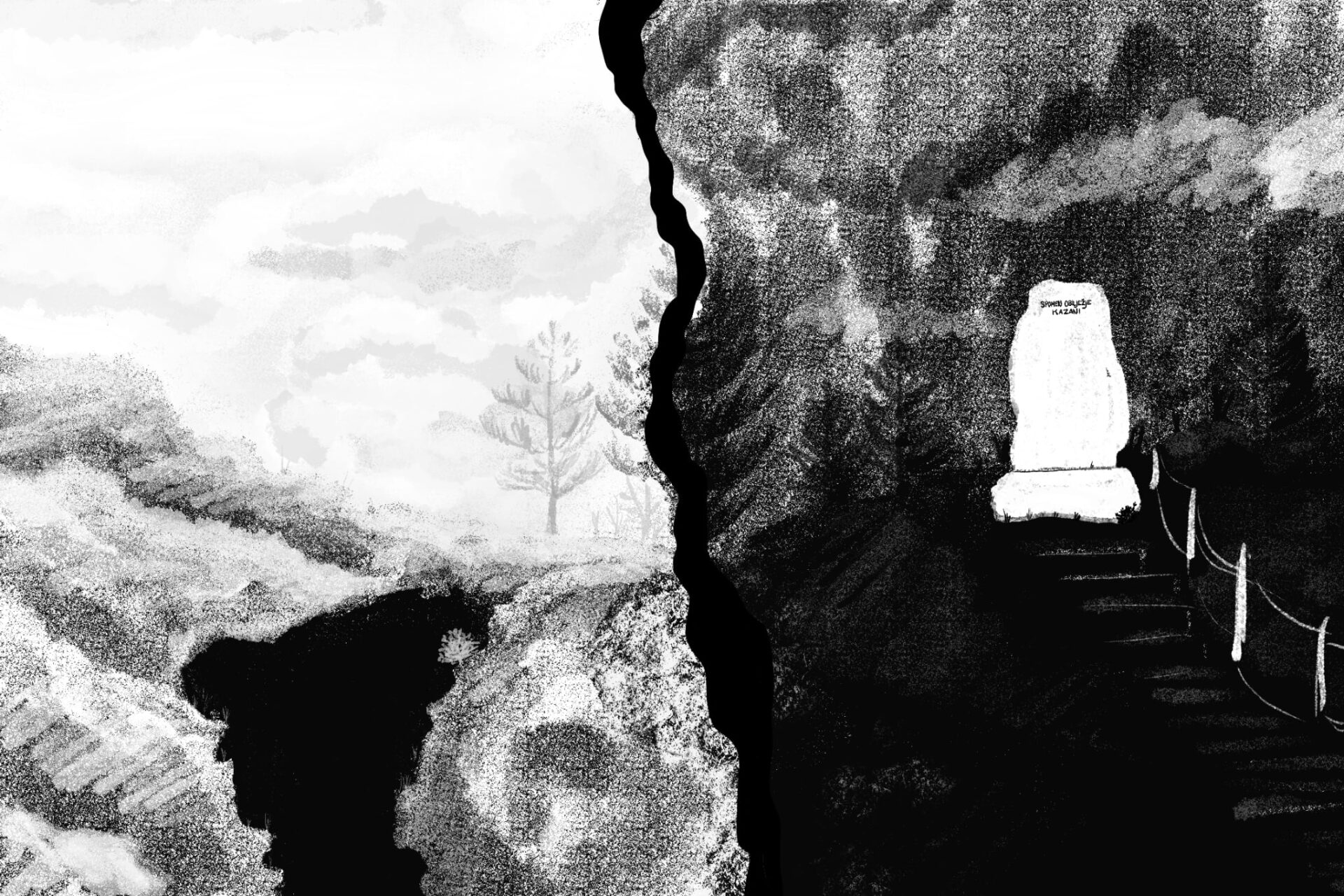
Sarajevo is a well-known example of multiculturalism and a symbol of coexistence and understanding. However, when it comes to the culture of remembrance, Sarajevo must confront its “dark side” on the slopes of Mount Trebević: the Kazani Pit.
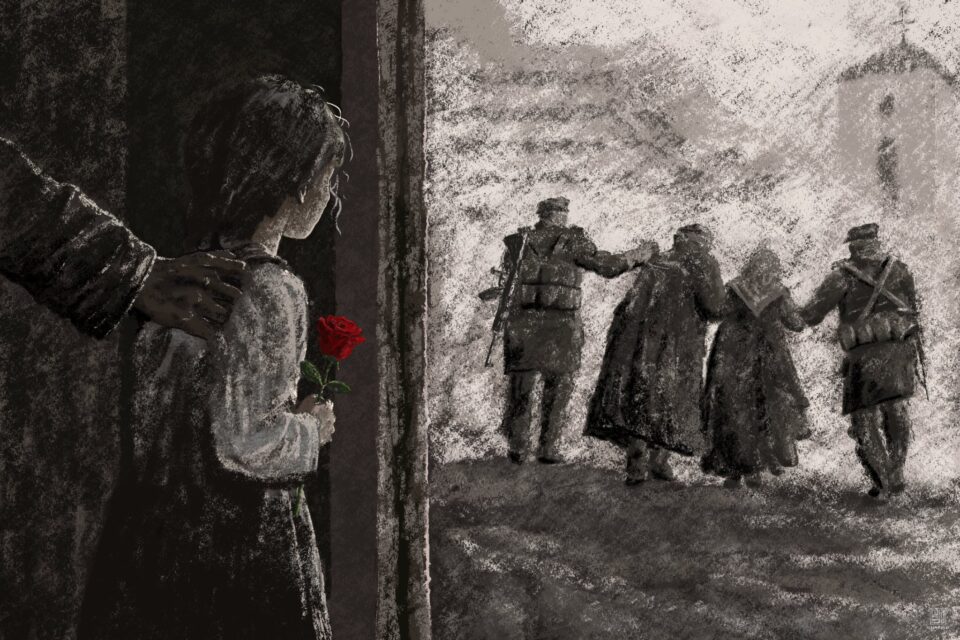
During the siege of Sarajevo—the longest siege of a capital city in the modern history of warfare—the Tenth Mountain Brigade of the Army of the Republic of Bosnia and Herzegovina (ARBiH) was deployed to guard one of the main communication routes along the road between Lukavica and Pale. Under the command of Mušan “Caco” Topalović, members of this unit killed dozens of Sarajevans, mostly of Serbian ethnicity, and tossed their bodies into the Kazani Pit. Even 33 years later, the exact number of those killed is unknown. Although a memorial has been erected to the victims, many are dissatisfied with its design, textual interpretation, and accessibility, which undermines the memorial’s role as a form of transitional justice.
Topalović was killed in an operation called Trebević 2 on October 26th, 1993, reportedly a few hours after an escape attempt, and was buried in an unknown location. Three years later, a funeral was held and his remains were buried in a place of honor at the Kovači Cemetery.
In legal terms, the Kazani killings were not adjudicated as a war crime. Samir Bejtić was the only person who was prosecuted for the crime as a war crime, but he was acquitted by a final verdict. According to data from the Association for Social Research and Communications (UDIK), four people were sentenced to six years in prison for the murders (Esad Tucaković, Zijo Kubat, Refik Čolak, Mevludin Selak), Asif Alibašić to eight years in prison, and Suad Omanović to ten years in prison. Eight people were convicted for failing to report the crime and the perpetrators (Senad Hasić, Sabahudin Žiga, Samir Seferović, Omer Tendžo, Esad Raonić, Samir Ljubović, Senad Haračić, and Armin Hodžić).
The Memorial Controversy
Several Sarajevo NGOs launched an initiative to build a memorial for the victims in Kazani in 2020. The initiative met with mixed reactions from the public, but with Benjamina Karić’s arrival as mayor in 2021, this issue was once again brought to the fore.
The Sarajevo City Council’s decision to erect a memorial was accompanied by a heated media and public debate about the details of the memorial itself, such as the text it will feature, the religious symbolism, and its concealment of the perpetrators of the crime.
Despite the controversy, the memorial was unveiled on November 15th, 2021, after its final design was adopted at the October 27 session of the City Council.
UDIK has invested considerable effort on the topic of Kazani, including commemorating the suffering that occurred there. It was this organization that collected five conceptual designs for the monument that were submitted to the City of Sarajevo.
“The exhibition of conceptual solutions was UDIK’s way of introducing the public to five proposals for commemorating the victims of Kazani that the city government rejected. That exhibition was shown several times in Sarajevo and once in Brčko,” said Edvin Kanka Ćudić, founder of UDIK.
He explained that in partnership with the daily newspaper Oslobođenje, they tried to present these designs to the public in order to highlight the shortcomings of the city government’s construction on Trebević.
“Actually, the idea of our objection was that it’s necessary not only to erect a memorial, but something that will arouse compassion, responsibility, and solidarity with those killed. Only in such an atmosphere could the Kazani Memorial serve its function of ensuring that such an evil is never repeated anywhere. The memorial plaque’s function seemed to be more about scoring political points than healing the community. In other words, the memorials that had been proposed to the city had a high artistic value,” Ćudić explained.
He added that the main problems are a one-sided view of the past, insufficient cooperation with civil society, and disregard for the opinions of those who have been dealing with this topic for many years:
“UDIK had objections to three points regarding the proposal to erect a memorial. Only one was approved, and we were never officially informed about it. Originally, the memorial was supposed to say 1992-1994, and we asked for it to read 1992-1993 instead. The other two points, which concerned the number of people killed and the list of perpetrators of the crimes at Kazani, were never accepted. For this reason, starting in 2022, UDIK will publish an obituary in Oslobođenje on October 26th, offering information that should actually have been on the monument. It serves to educate the public and provide facts to researchers that will encourage them to continue investigating the memorialization of Kazani,” says Ćudić.
Similar criticisms of the details of the monument are shared by Adi Škaljić, a city councilor at the time the memorial was erected: “If we already have the verdicts of the Cantonal Court from 1996, we should state who the perpetrators were because as it is, practically speaking, we could say that there were no perpetrators, which could mean figuratively that everyone is guilty. We already have the verdicts of the domestic court that precisely list the persons who were convicted under the command responsibility of the commander of that brigade, Mušan ‘Caco’ Topalović.”
“When they erected the Kazani Memorial, the City of Sarajevo consulted the state institutions in charge of dealing with the killed and missing persons from the past war, such as the Institute for Missing Persons of Bosnia and Herzegovina, which is the only institution charged with researching mass graves and missing persons and maintains the Central Register of Missing Persons for Bosnia and Herzegovina. Other entities that could contribute to the relevance of the data were also consulted, and a broad public debate was conducted. Given the above, the City of Sarajevo believes that the Kazani Memorial was created in an objective manner, presenting true and complete data on the suffering of our fellow citizens at this location,” the City of Sarajevo stated in a letter.
A Protected Natural Area
The Kazani massacre is commemorated every year on November 9th. However, inclement weather at this time of year often complicates access to the site, which is difficult to access even under normal conditions.
In an email received from the City of Sarajevo office, they cited a plan to build an access road to the site: “When erecting the Kazani memorial, the City of Sarajevo also intended to build a quality access road for vehicles and pedestrians. However, given that the site is located in a protected natural area where no new construction is allowed, the Cantonal Institute for the Protection of Cultural, Historical and Natural Heritage did not grant permission for these activities.”
However, many of the criticisms directed at the memorial go beyond its accessibility and appearance.
“I think it’s an attempt to cleanse the conscience and whitewash what happened there and nothing else. It’s manipulation of both the number of victims and the victims who ended up there, and in this way no respect was paid to the victims and the criminals were also rewarded,” says Simo Tuševljak, a former police officer.
Post-War Memorialization in Bosnia and Herzegovina
The problem of memorialization in BiH is connected to the different understandings of the past that have arisen from the activities of ethno-political groups. The frequent dominance of politics at events that are supposed to commemorate suffering is just one of the factors that are undermining the culture of remembrance.
“It’s clear to me that, in our country, the conscious political abuse of pain in the presence of cameras and the media has become a morbid everyday occurrence. Every discussion we have about the dead in the war consciously and insidiously serves to make life miserable for the living and to produce hatred and a desire for revenge. Those who build up the state never do such things, only those who dismantle it. And the state falls apart when you divide the population. That’s why the best name for this phenomenon is the ‘non-culture of remembrance,’” emphasizes Slobodan Šoja, historian and diplomat.
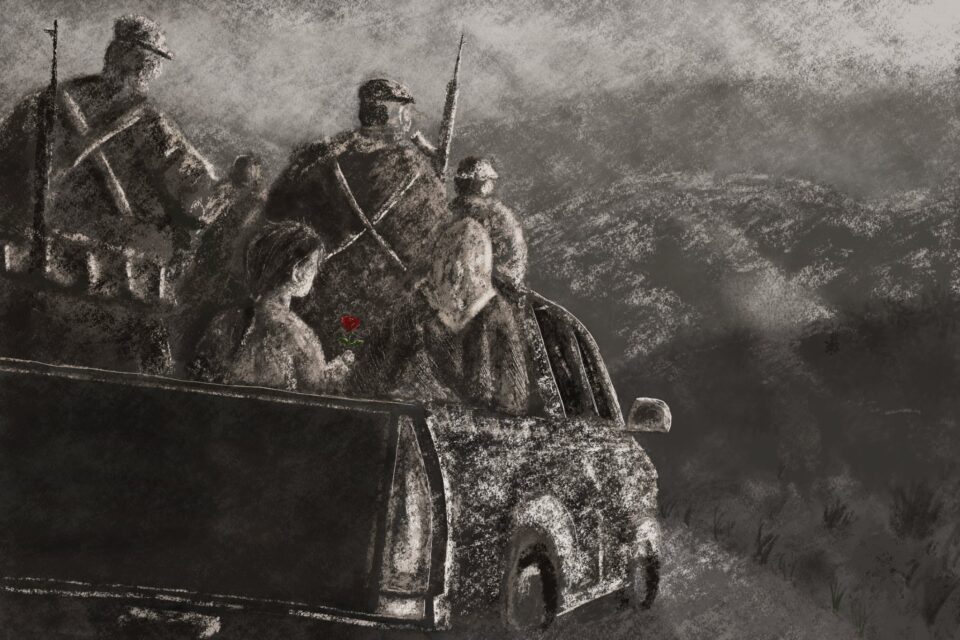
The denial of war crimes is the main factor behind the “non-culture of remembrance,” which creates fertile ground for misunderstanding and division. Nedžad Novalić from the Center for Nonviolent Action expertly explained denial, referencing sociologist Stanley Cohen:
“This isn’t a phenomenon exclusive to this region; it’s something encountered in all cultures, in all societies, especially post-war ones. Questioning exactly why people deny atrocities committed in their name, Stanley Cohen wrote about how all people have a need to maintain a positive image of themselves and their group. Furthermore, as humans we have a need to be part of a community, and by admitting guilt, we almost always step forward and often become a target. There is also a fear of harming ourselves and our community, of betraying the victims.”
Breaking the Cycle of Denial
However, among all the divisive discourses that emerged in the region after the war, positive examples can also be found that show how to build a culture of remembrance.
“It should be noted as a positive example that in late 2025, the Sarajevo Canton Ministry of Education offered teachers new teaching materials regarding the study of the war in Bosnia and Herzegovina from 1992 to 1995, in which Kazani is explicitly recognized as a war crime, with a clear list of the responsible units and all relevant data. This is a positive step forward. With all the objections and criticisms about the monument itself and its text, the very existence of any monument is still a step forward,” Novalić points out.
The role of the media in building a culture of remembrance is critical and includes shifting public focus away from politicians and toward answering the right questions regarding responsibility.
“What we would have to do if we want to save the country is to draw from the fine examples of ethnic and religious cooperation in the past. These examples should be mediatized as much as possible so as to restore the entire public’s faith in the love and unity that we must build in the country. As for examples of the opposite, of the harm we’ve done to one another, the most important thing is to preserve reverence for victims in commemorations and not call for revenge,” says Šoja.
The erection of the Kazani Memorial was accompanied by harsh criticism, which undoubtedly reflects a wider social problem in BiH that society is still dealing with. Building a culture of memory is a process that the country still needs to work on, despite certain positive developments.
“Although there is still discomfort today, although even today you will meet some people who will deny the Kazani massacre, I would say that the majority of people in Sarajevo have no difficulty in clearly defining and condemning this crime,” concludes Novalić.
This article was created within the project “Generation Memory”, which is carried out by the Post-Conflict Research Center (PCRC), with the aim of developing inclusive, local peace-building practices and a culture of memory that encourage work on understanding, empathy and critical reflection among young people.