The liberation of Sarajevo on April 6, 1945, left behind numerous photographs: Partisan units on the city streets, crowds of gathered citizens, and celebrations—but also quieter scenes of people, buildings, and institutions.
At first glance, some of these may appear to be mere fragments of a well-known event. Yet, behind each frame lies much more than the photograph itself can reveal.
Who are the people we see? What were they doing just before the photographer captured them? What was happening outside the frame, and what changed after the image was taken? Several photographs from the collection of the History Museum of Bosnia and Herzegovina offer glimpses into different facets of the same story—Sarajevo in the spring of 1945: the final battles and the arrival of Partisan units, daily life in the city toward the end of the occupation, the underground resistance movement, and those whose wartime paths converged once again on the streets of Sarajevo following the liberation.
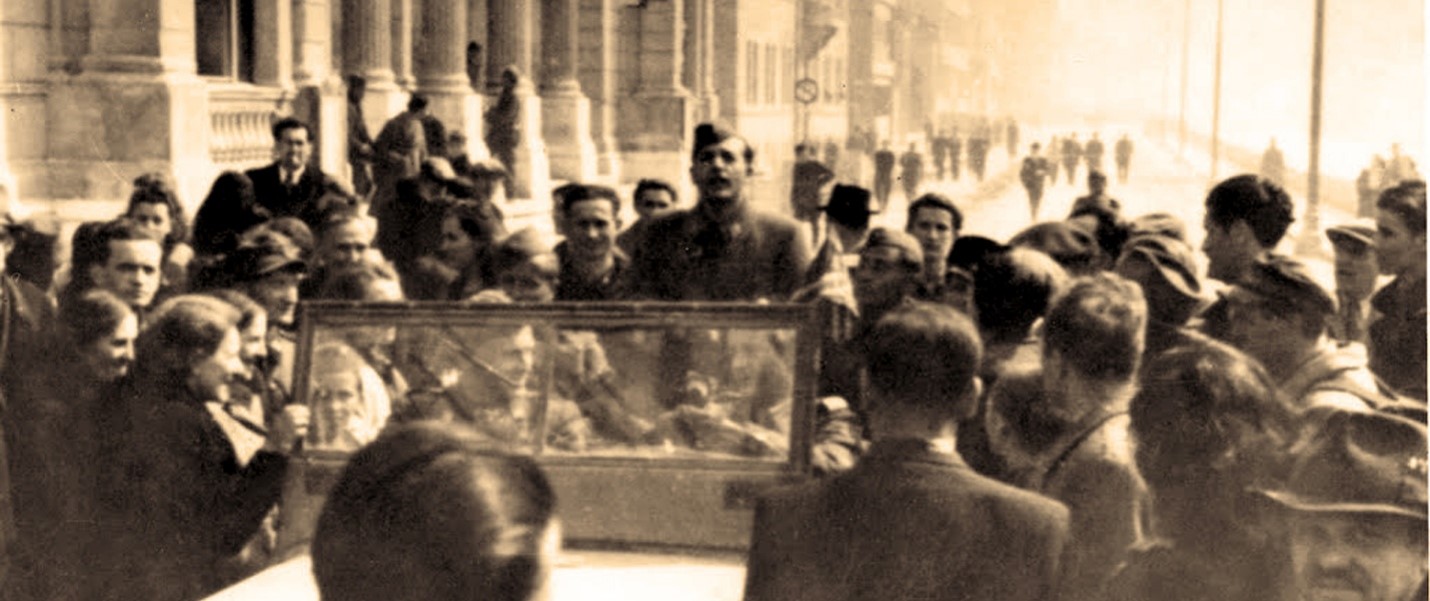
In April 1945, Salomon Moni Finci—a prominent cultural figure and publicist—was once again able to walk freely through the streets of Sarajevo. A photograph from the History Museum of Bosnia and Herzegovina’s collection shows him in a jeep in the newly liberated city. This marked his return to Sarajevo, which he had left in November 1941 to join the Partisans, following his involvement in the underground resistance. Over the next four years, he served on various battlefields and in different roles; from 1944, he served with the 18th Croatian East Bosnian Brigade, one of the units that took part in the Sarajevo Operation. He returned to the city alongside the Partisan units in April 1945.
Finci’s photograph thus leads directly to the final hours of the occupation. The Sarajevo Operation reached its climax in early April, as units from the 2nd, 3rd, and 5th Corps of the Yugoslav Army closed the ring around the city. On the afternoon of April 5th, elements of the 16th Muslim Brigade descended via Vratnik toward Baščaršija, while fighting continued near the City Hall and other strongholds within the city. Other units soon arrived, while German and Ustasha-defense forces retreated northward. The fighting, the retreat, and the emergence of the population onto the streets all unfolded almost simultaneously; by the morning of April 6th, Sarajevo had been liberated.
Finci’s photograph belongs to that very brief period when streets, which until the day before had been under occupation, became thoroughfares for Partisan units and the sites of the first public gatherings. As early as April 8th, a large rally was held to mark the liberation, and less than a month later, Finci was among the organizers of the Labor Day celebrations in the city. His return, therefore, is significant not merely as the conclusion of his personal wartime journey; through it, one can also trace how rapidly the city’s streets transformed from a theater of conflict into a space for public celebration and the political life of the new order.
This same moment of transition can also be observed in a strikingly different photograph. While Partisan units moved through the streets and citizens gathered, a sign reading “Municipal Supply Office” [Gradski obskrbni ured] still remained on the façade of a building in Sarajevo. Behind those closed doors lingered the name of an institution that, during the occupation, had been tasked with addressing one of the most fundamental challenges of daily life: how to feed the city.
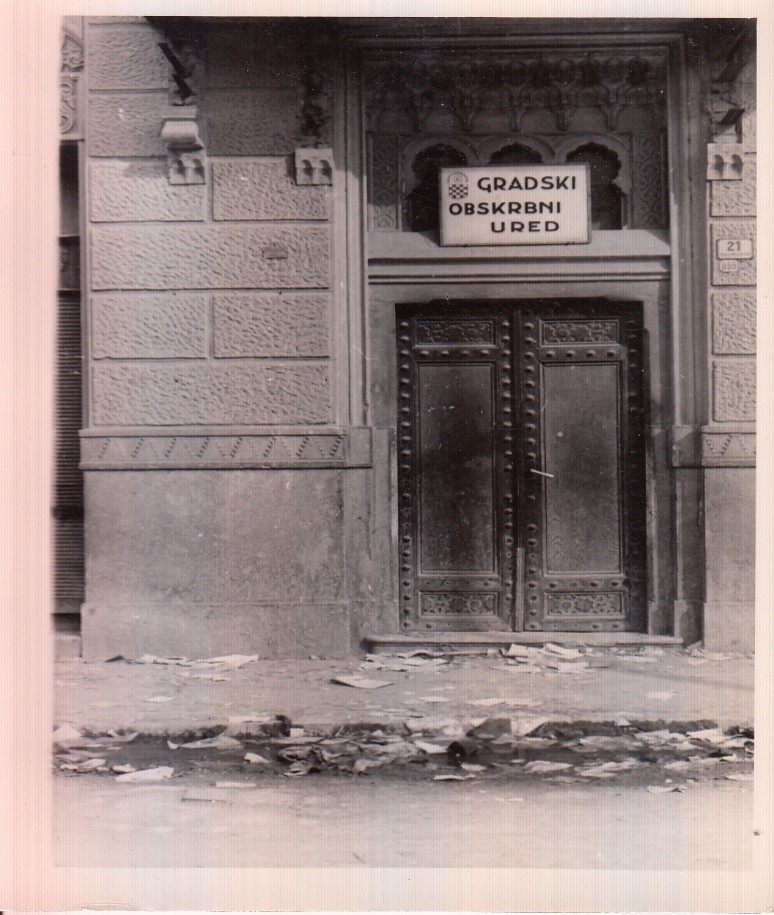
The City’s Supply Office organized rationed food for the population and distributed groceries through a network of approximately 250 small retailers. As the Second World War dragged on, the situation became increasingly difficult. Already at the end of 1943, the state of nutrition in Sarajevo was described as catastrophic. Out of approximately 100,000 inhabitants, the office was supposed to supply about 70,000, while the necessary quantities of food did not arrive. In November of the same year, Mayor Mustafa Softić concluded that the City Supply Office had become “the irony of its own name.” During 1944 and early 1945, the system almost collapsed, and the population became increasingly dependent on private traders, resellers, and the black market.
In this context, the photo of the office taken after the liberation takes on a different meaning. In contrast to Finci’s scene, filled with the movement and return of people to the city streets, here remain the closed doors and the board of the institutional order that no longer exists. The photograph does not tell us what exactly happened to the office, its employees, or the documentation, but it captures the physical trace of the old administration in a city where the government had already changed.
However, the change in government did not eliminate the problem that caused the office to exist overnight. Already on April 19th, the City People’s Liberation Committee of Sarajevo was formed, and trade and supply were once again among the tasks of the new city administration. The government changed in a few days; the city’s need to feed itself did not.
The photo of three women passing by today’s Tito Street originates from that city, which has just begun to return to public life. According to the note on the museum card, Zora Nikolić is in the middle. Nearby are gathered citizens, a balcony, and a large image of Josip Broz Tito – the scene of a public celebration of liberation. However, Zora’s presence in that frame opens a story that begins long before April 1945.
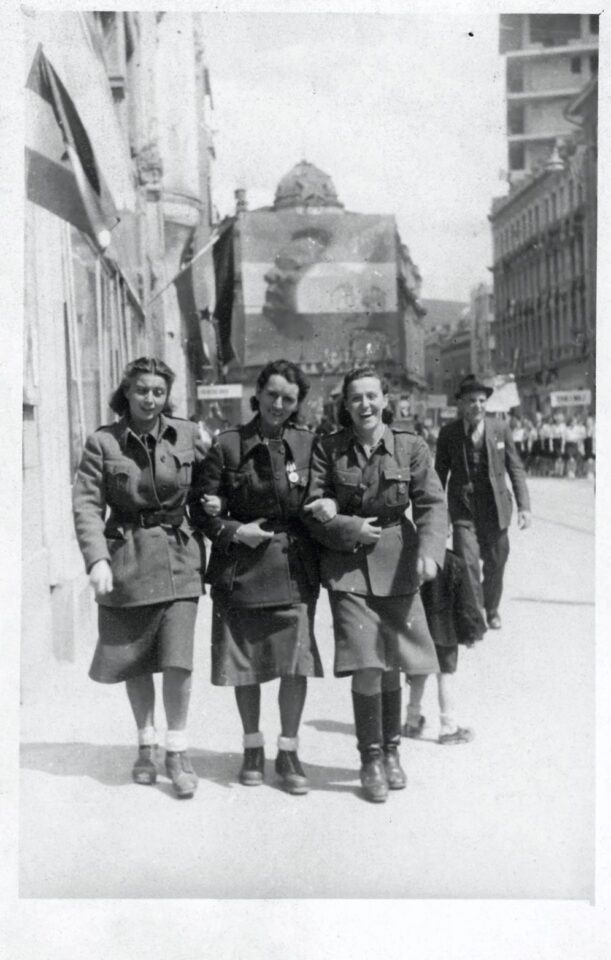
She belonged to the pre-war generation of communists and had been a member of the Communist Party of Yugoslavia (CPY) since 1923. During the first months of the occupation, she operated underground in Sarajevo, assisting with the forging of documents, the distribution of leaflets, and the concealment of Partisans and Party members living illegally in the city. She was soon arrested and interned in the Jasenovac camp, and later in Loborgrad. Following her release, she joined the Partisan movement, where she quickly became involved in the work of the Anti-Fascist Front of Women (AFW) and was elected a member of ZAVNOBiH.
A photograph from April 1945 thus captures her return to Sarajevo. Just a few years earlier, she had been active in the same city in secret, utilizing clandestine networks and forged documents to assist individuals forced to hide from the occupying authorities. After her arrest, time spent in camps, and her wartime journey, she found herself once again on the streets of Sarajevo—this time among those participating in the public celebration of the city’s liberation.
Her story, however, did not end with the victory in 1945. In the immediate postwar years, she continued her political and social engagement, and in 1948, she served as secretary of the Main Board of the Trade Unions of Bosnia and Herzegovina. Following the Cominform Resolution, she found herself among its supporters. She was arrested in April 1949 and subsequently sent to Sveti Grgur, from which she was released in August 1951.
Thus, the photograph of Zora Nikolić in liberated Sarajevo captures only a single moment in a much longer life journey: her return to the city where she had previously operated underground, situated between the experience of occupation and the new political conflicts that would emerge just a few years later.
While Zora’s photograph captures the return of an underground resistance member to the liberated city, another photograph from the same period points to a man who did not live to see that moment. Just a few days after the liberation of Sarajevo, a large funeral procession for Vladimir “Valter” Perić made its way through the city streets. As the city experienced its first days after occupation, thousands of people gathered to bid farewell to one of the most prominent organizers of the underground resistance movement in Sarajevo. According to surviving records, approximately 15,000 people attended the funeral. Valter was killed during the night of April 5th, in the final stages of the battle for Sarajevo.
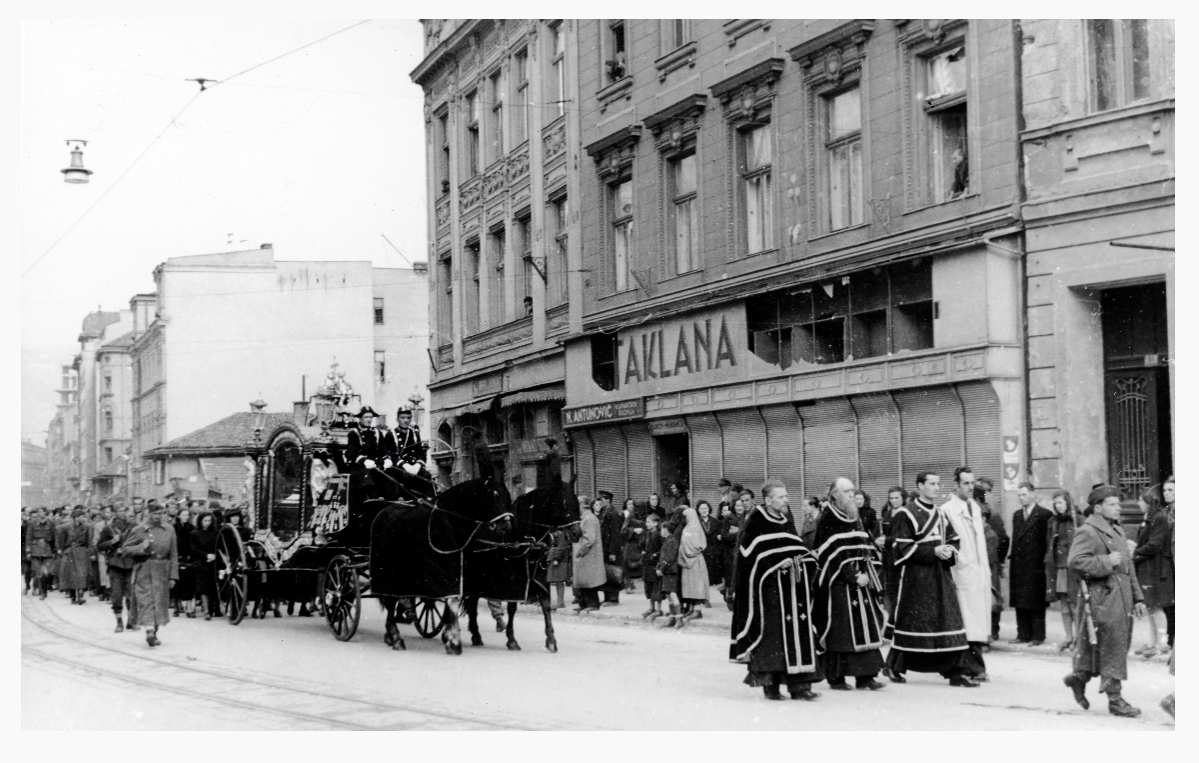
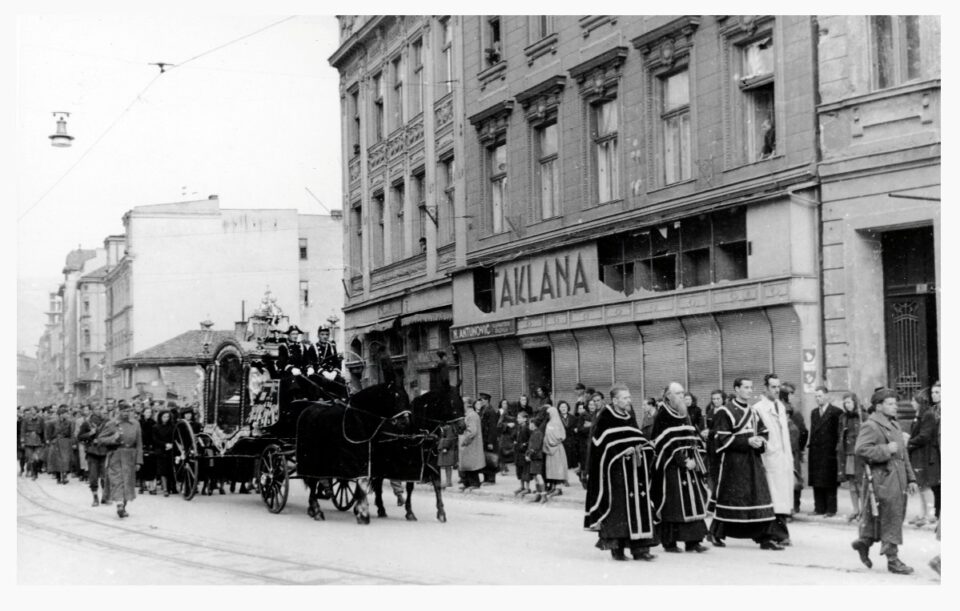
The photograph of his funeral, therefore, points beyond the mere scene of a farewell. It directs the narrative back to the struggle that unfolded within the city during the occupation—to a network of people whose efforts are rarely visible in photographs showing the entry of Partisan units into Sarajevo.
Early in the war, Valter participated in organizing the resistance in Sarajevo, using various aliases to conceal his identity. In the spring of 1942, he crossed into liberated territory and assumed the role of deputy political commissar for the Third Assault Battalion. He served in the Majevica region with the Sixth Proletarian Brigade, and in October 1942, he was sent to occupied Tuzla to serve as a Party instructor. There, operating under the clandestine name Braco, he worked to rebuild the weakened resistance movement, organize intelligence operations, and even establish a workshop for repairing weapons. He remained in Tuzla until the summer of 1943. This experience, gained both within Partisan units and inside an occupied city, led to his return to Sarajevo in September 1943, with the mission of rebuilding the city’s organizational structure, which had been severely crippled by earlier arrests.
The condition he found himself in is also evidenced by his letters preserved in the Archive Collection of the History Museum of Bosnia and Herzegovina. In November 1943, he wrote about distrust among illegals and people whom he believed “will bark out everything they know at the first slap.” Nevertheless, after several months of work, he reports that the organization is on “more solid and permanent foundations.” By May 1944, the problem of radio communication was also solved, so the Meho station could “do all the work,” while at the same time propaganda activities and connections through which confidential information was obtained were spread. Such short notes show what the renewal of the movement meant in practice: to re-establish broken ties, to find reliable people, to connect different groups within the city, and to enable safer communication with the free territory.
Rebuilding the organization involved much more than holding party meetings. The illegal network connected people in the city with partisan units outside it, transferred people to free territory, distributed propaganda material, used falsified documents, and collected intelligence data. Contacts were also established with individuals within the city and police structures, through whom information was obtained on the disposition, movement, and activities of enemy forces. As the spring of 1945 approached, such work became more and more directly connected with preparations for liberation. According to the later reconstruction, the illegal network managed to reach the German plans for the defense of Sarajevo, kept in the vault of Hipotekarna Bank.
The case of Zvonko “Putnik” Grbac, one of Valter’s close associates who was arrested in 1944, illustrates the extensive reach of this network. Leveraging connections within the hospital, Dr. Artur Horvat orchestrated a ruse to make it appear as though Grbac had died; subsequently, both men were transported via Ilidža to liberated territory. This example demonstrates that resistance in the city was not limited to spectacular operations, but also encompassed a series of smaller, interconnected tasks that enabled the organization to survive under the constant pressure of the police and the Gestapo.
During the final hours of the fighting, clandestine operations transitioned into direct combat on the city streets. On the night of April 5th, Valter sought assistance from Partisan units to support the armed workers at the power plant—a vital urban facility that needed to be preserved. While en route to them, he was killed by a mortar shell on Brankova Street.
The funeral procession that passed through liberated Sarajevo a few days later brought people together around a man whose final wartime mission was tied to the city where he had operated clandestinely for years. His death coincided almost exactly with the moment the Sarajevo resistance movement no longer needed to operate in secret. Thus, the photograph of the funeral tells us more than just the story of Valter; it reveals a facet of the liberation that is not captured in footage of military columns or public celebrations.
Photographs of liberated Sarajevo do not present a single, cohesive picture of April 6th. In one, people and military units return to the city streets; in another, behind closed doors, traces remain of an administration that is vanishing; in a third, behind the scenes of a celebration or a funeral, entire wartime biographies are laid bare. When examined alongside documents and other sources, these images reveal that the liberation was more than just the military end of the occupation. It was a moment of returns, ruptures, and continuities—a moment in which the city was changing faster than any photograph could capture.
The development of this article was funded by the European Union. Views and opinions expressed are however those of the authors only and do not necessarily reflect those of the European Union or EACEA. Neither the European Union nor EACEA can be held responsible for them.