In Sarajevo, the remnants of war are not only remembered, but they are also repurposed, sold, and carried away as souvenirs, raising questions about where memory ends and consumption begins.
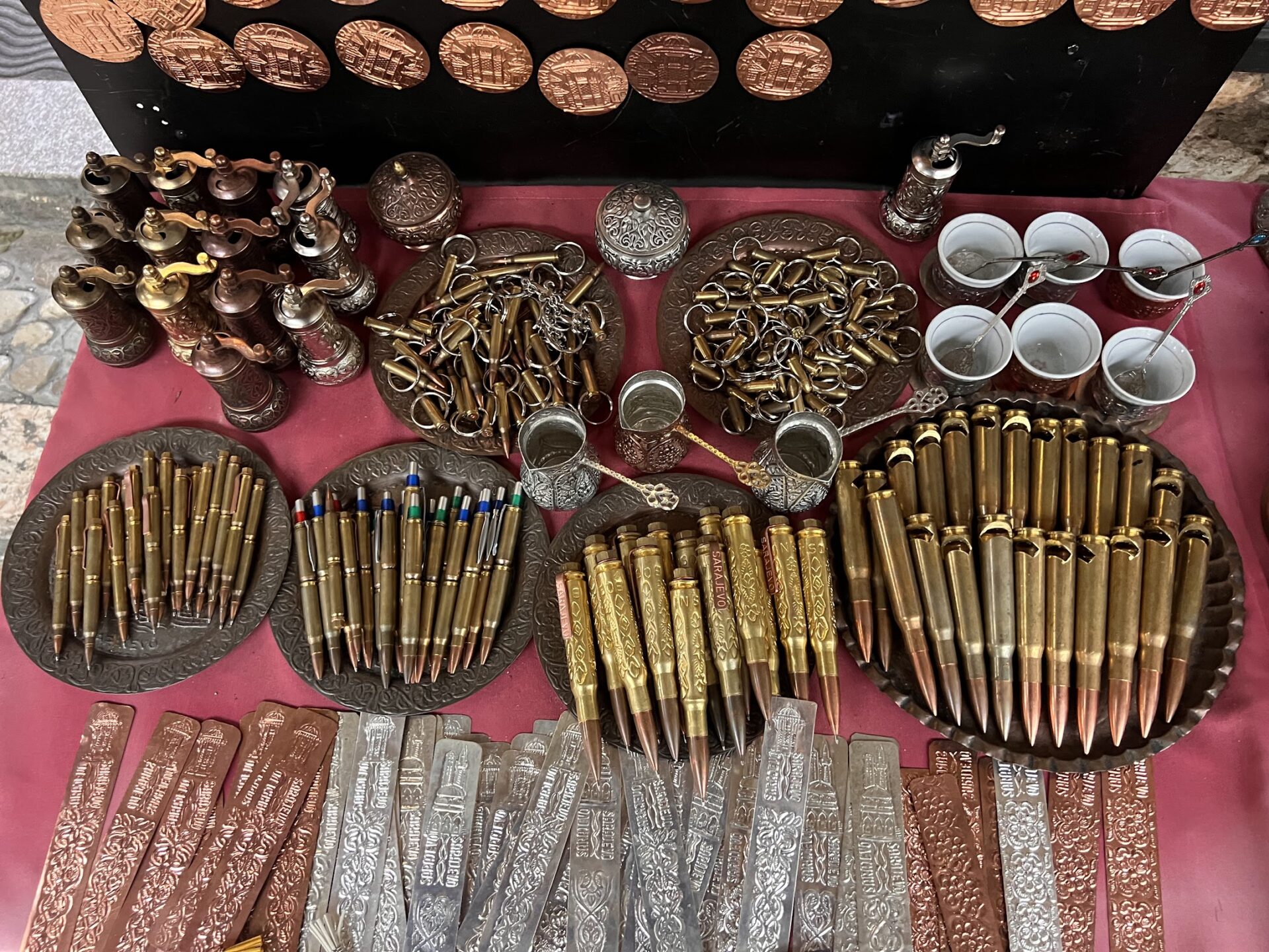
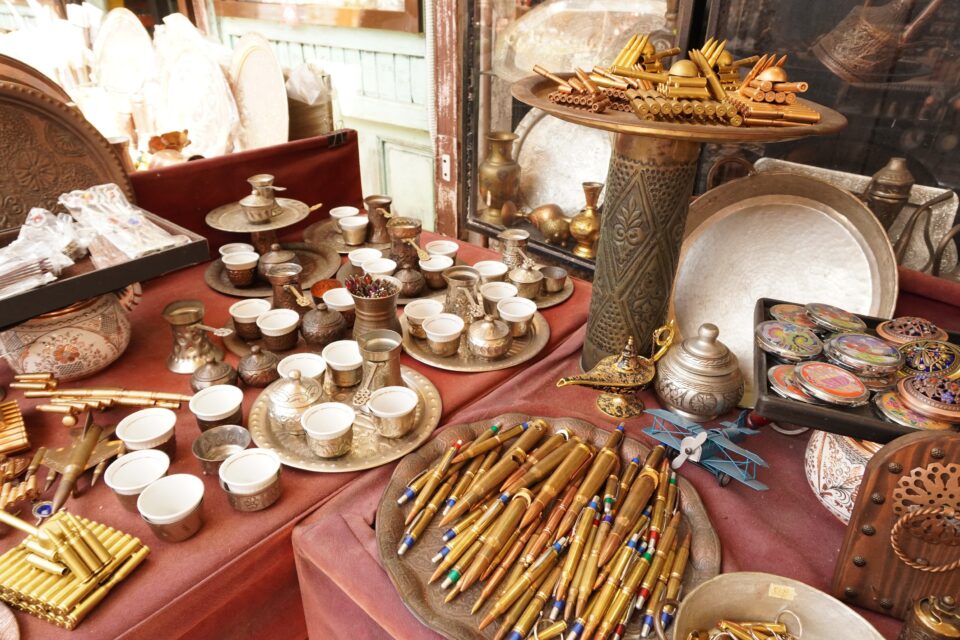
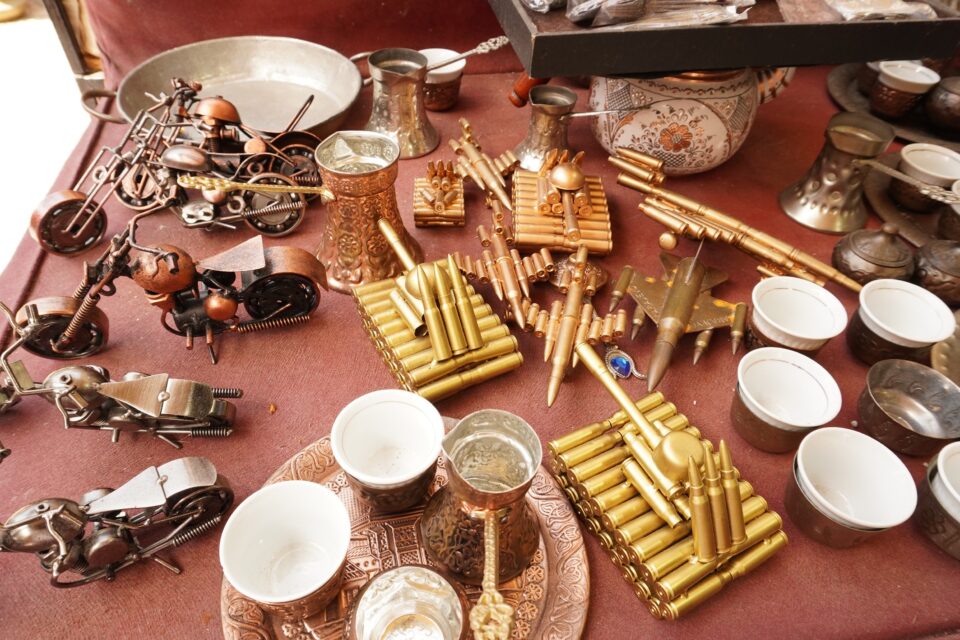
Walking through Sarajevo’s Baščaršija (Old Town), visitors are surrounded by reminders of the city’s centuries-old tradition of metal craftsmanship. Copper coffee sets, engraved trays, and handmade jewelry fill storefronts lining Kazandžiluk, or “Copper Street.” Mixed among these traditional crafts, however, are objects that carry a far more recent history: ballpoint pens made from bullet casings, miniature airplanes and tanks crafted from ammunition, and flowerpots fashioned from artillery shells.
For tourists, these objects are simply unusual keepsakes from Bosnia and Herzegovina. For many Bosnians, however, they represent something more complicated.
During the nearly four-year Siege of Sarajevo, thousands of shells and bullets rained down on the city, killing civilians and permanently altering the landscape. Today, decades later, some of those remnants, or replicas inspired by them, have become souvenirs sold in the city’s historic center. Their transformation raises difficult questions: Can objects once intended to kill become symbols of resilience? Or does selling them risk commercializing one of the darkest chapters in Bosnia and Herzegovina’s history?
Sarajevo’s tradition of metalworking dates back centuries. Long before the 1992-1995 Bosnian War, generations of coppersmiths crafted household goods for local families, passing their skills from one generation to the next. After the war ended, the abundance of spent shell casings and military scraps created an unexpected source of raw material. Some artisans began incorporating these remnants into decorative and functional objects, blending a centuries-old craft with the material legacy of conflict.
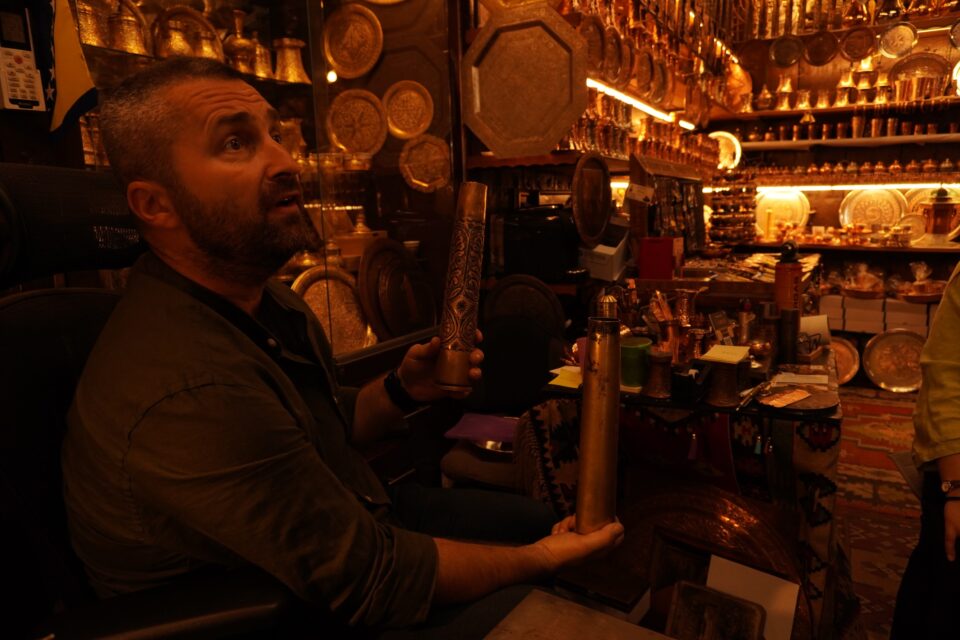
One shop owner in Baščaršija – from Kazandžijska radnja Hidić – described this transformation as an intentional act of reclaiming violence: “Transforming something negative into something positive like a flowerpot.”
To him, the symbolism matters as much as the object itself.
“It’s powerful how you can turn something dangerous like a bullet into something like a pen”, he said.
He explained that immediately after the war, many shops used original shell casings collected from around Sarajevo. But today, many of the objects sold are imported, he said.
He added that after the war ended, they used original bullet shells to create objects. But now everything is imported from a manufactured company, not original remnants.
He also noted that these items are purchased almost exclusively by visitors.
“Locals don’t really come here…this is for tourists.”
Just around the block, another shop owner offered a different perspective shaped by personal experience. In 1992, when he was ten years old, he was shot three times in the leg during the war. Despite surviving the violence that these bullets represent, he now sells original siege-era bullet casings transformed into pens, keychains, and model airplanes and tanks. Some visitors question whether such items should be sold at all.
“People tell me it’s weird to sell them,” he said.
“But a wealthy person coming here and paying to shoot at us is weird,” he stated, referencing the Sarajevo Safari case.
For him, the objects are not celebrations of war but symbols of survival.
“This is a message of rebuilding from something bad into something good”, he added.
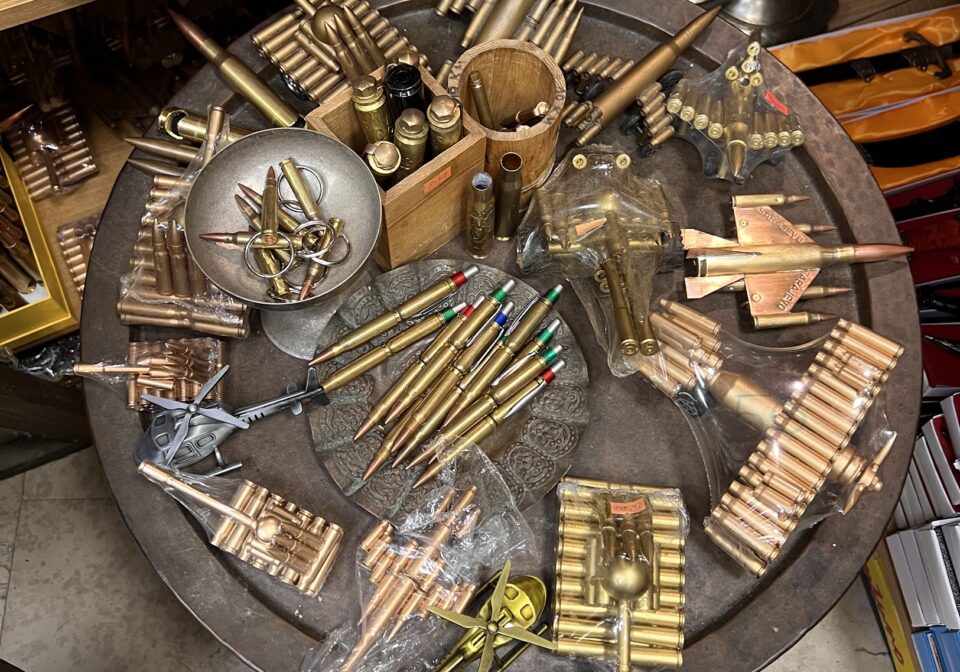
According to him, buyers often come from the United States, Italy, and the United Kingdom. Their questions are rarely about craftsmanship alone: “People ask if the bullets are original, what the story is behind them.”
The conversations suggest that many visitors are seeking not only an unusual souvenir but a tangible connection to Sarajevo’s history.
Meanwhile, for many young Bosnians, the war was not a lived experience but an inheritance.
Twenty-four-year-old Amar Gradišić grew up in Switzerland before moving to Bosnia and Herzegovina as a teenager. Although he never experienced the siege himself, both of his parents were displaced by the war. Their stories shaped his understanding of the conflict long before he began studying political science and international relations.
The first time he encountered bullet souvenirs in Sarajevo’s Old Town, he wasn’t sure how to react. “The first time seeing those souvenirs being sold in the Old Town was a bit confusing to me. I asked myself all the time: Why would you sell something that could have killed you years ago?”, he wonders.
Over time, his perspective became more nuanced:
“I realized that it can be seen as a form of resilience”, he added.
Still, he believes the meaning depends entirely on context.
“If the souvenirs are being sold with a message or information about the Siege of Sarajevo, it can enlighten tourists… But if that’s not the case, in my opinion the suffering becomes commercialized, and the essence of the message gets lost.”
Not everyone shares that interpretation.
Nora Haverić, who was born after the war but whose parents lived through it as teenagers, had never heard that bullet casings were sold as souvenirs until being asked about the topic: “Finding out about this, I was taken aback and shocked”, he said.
While she understands that shop owners may rely on tourism for income, she struggles to see artistic value in the objects. “I do not own any bullet shells or souvenirs made out of them, because I do not see anything artistic in items used to kill people.”
She also worries that international visitors may view them simply as unusual collectibles.
“If they are buying the souvenirs as a way of showing respect and understanding of our recent history, I can appreciate that. However, if it’s only [about buying] a rare and hard to find piece of a weapon… I do not”, Nora explained.
Ajna Lačević, whose mother fled Sarajevo during the war before eventually settling in Australia, expressed similar concerns.
“I feel that selling bullet castings as souvenirs undermines the experience [of] what the citizens felt during the war”, said Lačević.
To her, souvenirs are typically associated with positive memories and gifts shared with family and friends:
“It is an incredibly sensitive item to be selling to visitors”, added Ajla.
Yet she also recognizes that some tourists may purchase them with sincere intentions to learn and educate others.
The debate surrounding Sarajevo’s bullet souvenirs ultimately reflects a larger question about how societies remember conflict. This includes those who lived through the war and continue to live in Sarajevo, diaspora communities who left and carried inherited memory, and younger generations born after the war both inside and outside Bosnia and Herzegovina.
For some artisans, transforming ammunition into household and everyday objects symbolizes resilience and renewal. A shell that once represented destruction can become a flowerpot, a pen, or another object of everyday life – a physical reminder that violence does not have to define the future.
For others, no amount of craftsmanship can separate the material from its history. The objects remain inseparable from the civilians who lived under the Siege of Sarajevo, making their sales feel uncomfortably close to commercializing suffering.
In Sarajevo’s Old Town, bullet casings occupy a space somewhere between artifact, artwork, and commodity. Whether they represent remembrance, resilience, or commercialization depends not only on the people who make and sell them, but also on those who choose to take them home.