In a region where history is so often told as competing, mutually exclusive stories, the fourth “State of Peace” Youth Academy set out to test a different premise: that different experiences of the past don’t have to produce separate futures.
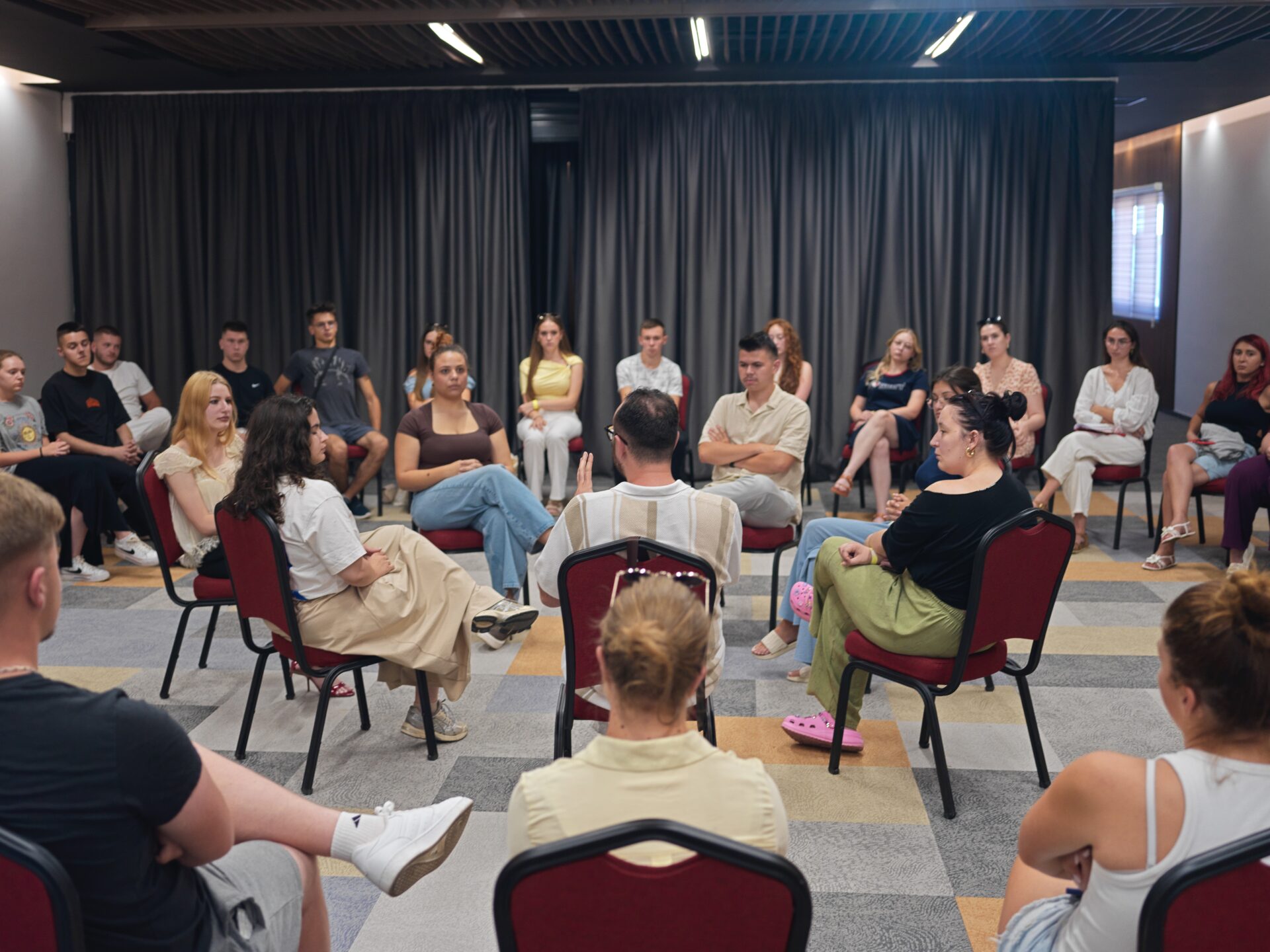
Organized by the European Union in Bosnia and Herzegovina in cooperation with the Post-Conflict Research Center, the program brought together more than 45 young people from Bosnia and Herzegovina, Croatia, Serbia, and Montenegro for films, workshops, and conversations built around one idea – that inclusive memorialization, and the deliberate telling of positive stories, can do something exclusive narratives never could.
Heroes, Not Sides
That idea found its main interperetation in Ordinary Heroes, a documentary series by PCRC and Pinch Media screened for participants in Vitez, followed by a discussion with the director Mirko Pincelli himself. The films tell the true stories of Bosnian citizens who, during the war, chose to save “the other” – becoming heroes in a moment when much of their society was collapsing into division.
For Amila, from Montenegro, the film and the idea of the “ordinary hero” reshaped how she thinks about heroism itself. “Heroes aren’t just people in certain positions, with certain opportunities,” she said. “Heroism can belong to any of us.”
One story from the Academy stayed with her in particular: that of Tomo, a man of Croatian background who, amid the crimes committed in Ahmići, saved a young Muslim boy – proof, she said, of just how far that kind of heroism can reach.
Veterans, Twenty-Five Years Later
If the “Ordinary Heroes” sessions asked what courage looks like in the past, the next day’s program asked what reckoning looks like decades later. Documentary A Testament to a Time gathers testimonies from veterans of three different armies that fought in Bosnia and Herzegovina, reflecting after 25 years on their roles as soldiers in the past war.
The film was followed by a conversation with Spasoje Kulaga, a former veteran turned peace activist, who founded “Pravi Požar,” an organization that supports veterans, families, and victims of the war regardless of which side they came from.
For Sami, from Bosnia and Herzegovina, the work of supporting all veterans and victims left a lasting impression. “That’s the only way we in Bosnia and Herzegovina can reconcile and move forward,” he said, “if all three conflict sides sit at the same table, talk together about what happened, understand why, and look for a way forward.”
Passing the Torch
That same instinct – to hold onto complexity rather than pick a side – carried into the Academy’s discussion on youth activism. For Nina, from Serbia, the line between activism and being an engaged citizen isn’t always clear – but within the Academy’s themes, she pointed to conflicting narratives and interpretations as especially urgent.
“Our societies are deeply fragmented and polarized,” Nina said, “so controlling the narrative around what’s actually true matters enormously.” Asked whether her generation carries a different responsibility toward history, she located it less in grand gestures than daily conduct: speaking up when something isn’t right, since major divisions rarely start with big scandals – they start with the normalization of small things, a slur, a look, left unchallenged.
Love as Counter-Narrative
Later in the week, participants encountered a different register of storytelling – Love Tales: a photography exhibition documenting relationships and marriages between people of different ethnic backgrounds in Bosnia and Herzegovina – created explicitly to challenge the narrative that such relationships are rare or unsustainable.
For Ivan, from Bosnia and Herzegovina, it wasn’t abstract. He comes from an ethnically mixed marriage himself, and knows how others often view it as anything but normal. “That’s actually the only way Bosnia and Herzegovina can move forward normally,” he said.
Asked to sum up the Academy in one image, Ivan didn’t choose a memorial or a film. He chose a moment after one of the workshops – everyone sitting together, laughing. “Because in that moment, we all see that we’re different,” he said, “but we also know that we’re so similar.”
As this year’s participants move on to their final days, they carry with them something close to what Ivan described: a room full of people who are all unique and different, and who know it – and who, for two weeks, chose to sit at the same table anyway.