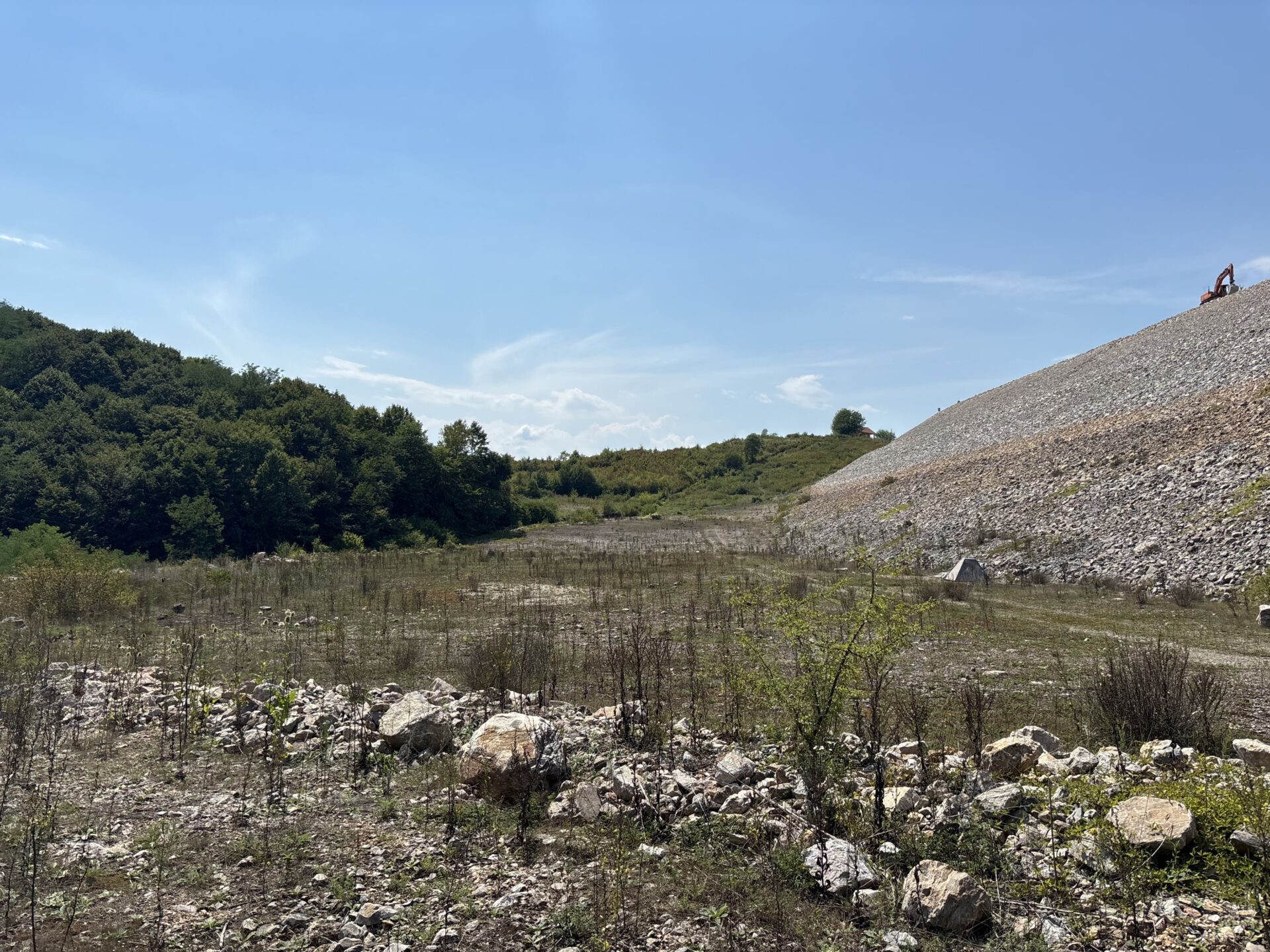
Near the town of Petkovci in eastern Bosnia and Herzegovina, an unkept rocky road allows visitors to take a detour to a local dam.
After arriving at the site and jumping over a metal barricade, one arrives at a gravel plateau covered in wildflowers that extends as far as the eye can see. A rich forest borders this field to the left. And on the right, the earth sharply rises into the sky to form a flank of the Petkovci Dam, known for its red waters.
Besides withering bouquets and assorted pieces of trash, one can find few manmade markers there, making the space appear almost irrelevant—an inconsequential result of a larger engineering project with little purpose today.
Yet that assumption belies the site’s true history. During the Bosnian war, soldiers from the Army of Republika Srpska used the Petkovci Dam as a central staging ground for the Srebrenica genocide. Across a few weeks in July 1995, as the ICTY’s Judgment in Prosecutor v. Radovan Karadžić outlines, they took at least 800 Bosniak men and boys imprisoned nearby to the area, blindfolded them, stripped them of their identifying documents, and shot them—making those individuals part of Srebrenica’s over 8,000 victims.
In the months that followed, local officials reburied their bodies, often disarticulated, within various nearby mass graves. Today, however, little if anything exists around the formation as a reminder of that past. Rather than a memorial plaque or statute, rocks—the same as those bloodied three decades ago—mark where slaughter occurred.
Of course, the Petkovci Dam constitutes just one of the major execution sites of the Srebrenica genocide. Others include fields near the towns of Orahovac, Kozluk, Cerska, and Tišca, alongside the Kravica Warehouse, Pilića Cultural Center, and Branjevo Military Farm. Related sites include holding centers for men captured from Srebrenica, like schools in Grbavci and Petkovci. A similar state of neglect accompanies all these places, with few hosting memorials or comparable fixtures that mark their status as places of immense violence.
Such limited memorialization does not arise from a lack of knowledge or effort. Judicial verdicts from the ICTY, including in the Mladić case, General of the Army of Republika Srpska convicted of genocide, acknowledged the role these spots played in the Srebrenica genocide and tied their use to its execution. Survivor groups and the families of Srebrenica’s victims have long pushed for monuments at these execution sites to honor their loved ones and ensure, especially for those who have yet to find their relatives’ bodies, that they have a setting to properly mourn.
The Mothers of Srebrenica, for example, Balkan Insight has covered, participate in a procession every year after the official commemoration of the genocide on July 11th at the Srebrenica-Potočari Memorial Center. They travel to the primary execution and holding sites, including the Petkovci Dam, to lay flowers and call for their preservation.
“The importance of preserving these places,” Ahmed Kulanić, Director of the Sarajevo Memorial Center, avers, “is really reflected in the fact that they represent permanent witnesses of the suffering of Bosniaks.”
But their calls have faced significant resistance from regional officials serving in the government of the Republika Srpska. Due to complicated land laws in the area and the former status of many structures as government-run institutions, ownership of the sites linked to the Srebrenica genocide has predominantly fallen to municipal authorities or the Republika Srpska itself, along with the authority to allow their memorialization, whether through visits or monuments.
Under these circumstances, visitors also often face arbitrary restrictions on their access to the sites. For instance, the Mothers of Srebrenica, local victims association, and staff from the Srebrenica-Potočari Memorial Center, as the Center revealed, have all been denied entry into the Pilica Cultural Center on the order of state entities.
Local communities have placed fixtures commemorating VRS soldiers next to unmemorialized execution sites. Additionally, as the Anadolu Agency reports, elected authorities renovated the Kravica Warehouse, removing bullet holes from its facade while denying attempts at turning it into a memorial. Indeed, Srebrenica’s Bosnian Serb mayor has discussed renting the site out to “entrepreneurs.”
David Pettigrew, a professor at Southern Connecticut State University and renowned scholar on Bosnia, describes, it “astonishing” that “survivors have been prohibited from installing memorials for the victims in places where the atrocities were part of the Srebrenica genocide, including Kravica, Pilica, Petkovci, and Branjevo Farm.”
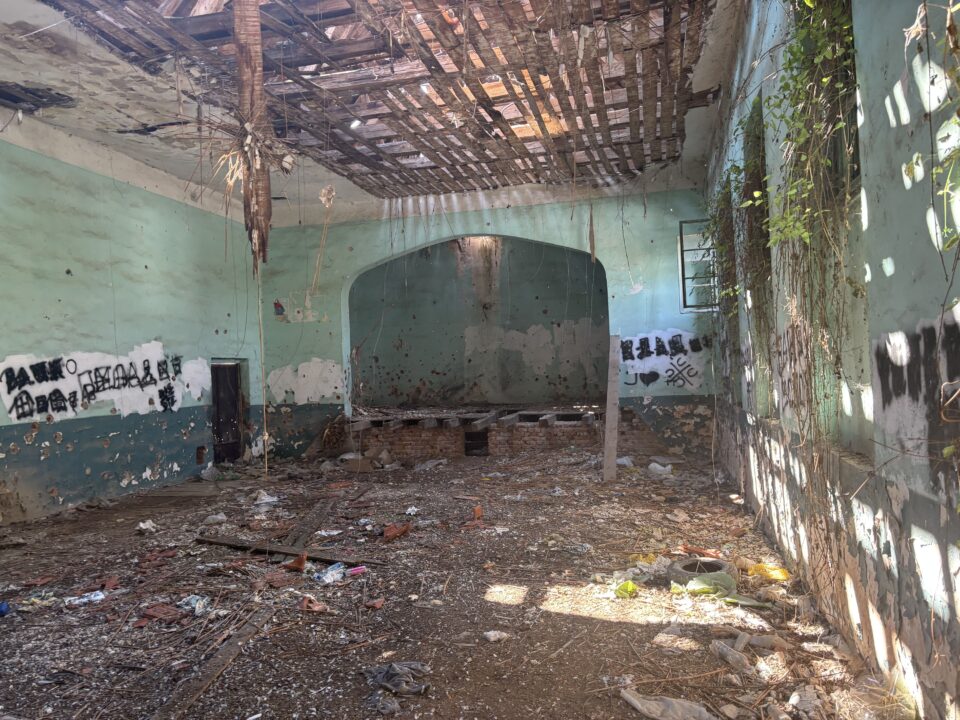
Left without official recognition, some of these sites face accelerating dilapidation and the threat of eventual erasure. A visit to the Pilica Cultural Center on behalf of the Post-Conflict Research Center, for instance, revealed a site that was falling apart. Trash littered the ground, from the building’s entrance to its interior, joined by the rusting remains of old furniture, debris, and pigeon carcasses. Bullet holes still covered the walls—particularly in the area where men and boys from Srebrenica were crammed in and then shot—though now, they are surrounded by graffiti, including Serb nationalist symbols and slogans.
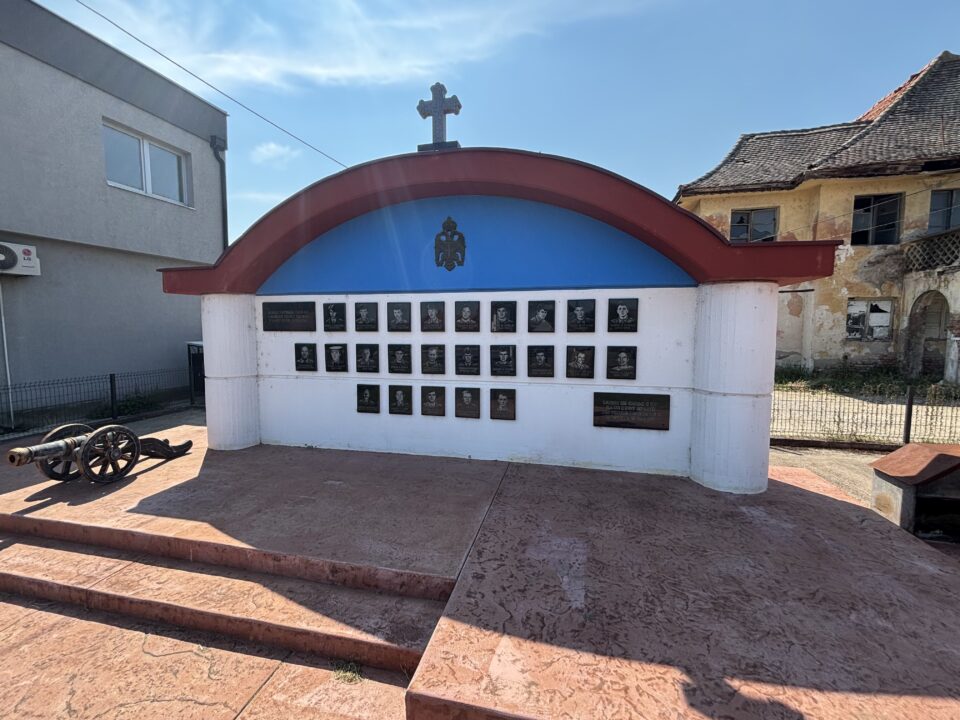
Sunlight filters inside from the roof, now disintegrating into pieces and leaving planks of wood hanging precariously from the ceiling or heaped on the floor. Meanwhile, the Center’s exterior exhibits similar neglect, with chipping paint, smashed windows, and unkempt weeds only emphasizing its abandonment. What’s more, a few feet from the edifice stands a memorial to VRS soldiers who died during the Bosnian war, a reminder of the ongoing effort to obscure its past.
The condition of the Pilica Cultural Center, and other execution sites linked to Srebrenica genocide thus symbolizes a wider problem facing Bosnian society as it works to recover from its wartime legacy. Sites of war crimes and other atrocities remain unmarked, left to rot or replaced by other structures even as survivors clamor for their preservation. One can find such spaces across the country, from Vilina Vlas in Višegrad—a hotel used as a rape camp that, as the New York Times details, currently accommodates patrons—to the Partizan Sports Hall in Foča, another detention facility used for sexual violence.
The mistreatment of these sites stymies efforts to produce meaningful reconciliation within Bosnia, to enable those affected by the war and genocide to grieve properly, and to ensure that history is told as it occurred. David Pettigrew notes that “[i]n response to the limits to the judicial process it is important to implement a comprehensive policy of transitional justice mechanisms, including the human right to commemoration and memorialization.”
“Survivors have the right to commemoration and memorialization. If done right, the comprehensive implementation of transitional justice initiatives in support of memorialization and against denial and the glorification of war criminals would hold out promise for the transformation of the culture, fostering an inclusive democratic society with respect for human rights”, he said.
Regardless of the breadth of this issue, however, advocates persevere in their fight to conserve such sites and guarantee that the difficult pasts they contain are not forgotten. While Bosnia has made significant strides in memorialization since the 1990s, those advancements should not blind the public and international observers to the continued denial of remembrance for survivors, families, and communities across the country. For it is only through such commemoration that the ghosts that haunt Petkovci, Pilica, and countless other sites can be properly laid to rest, and some sense of closure can begin to accompany the mourning that transpires in these spaces.
Bilal Memišević, a member of Višegrad’s town council, commented about local efforts to commemorate Vilina Vlas.
“We understand that the spa was and will be a magnet for tourists and are not asking for it to be shut down … All we want is a single sentence on the wall saying ‘At this site war crimes were committed between this date and that date’”, said Memišević.