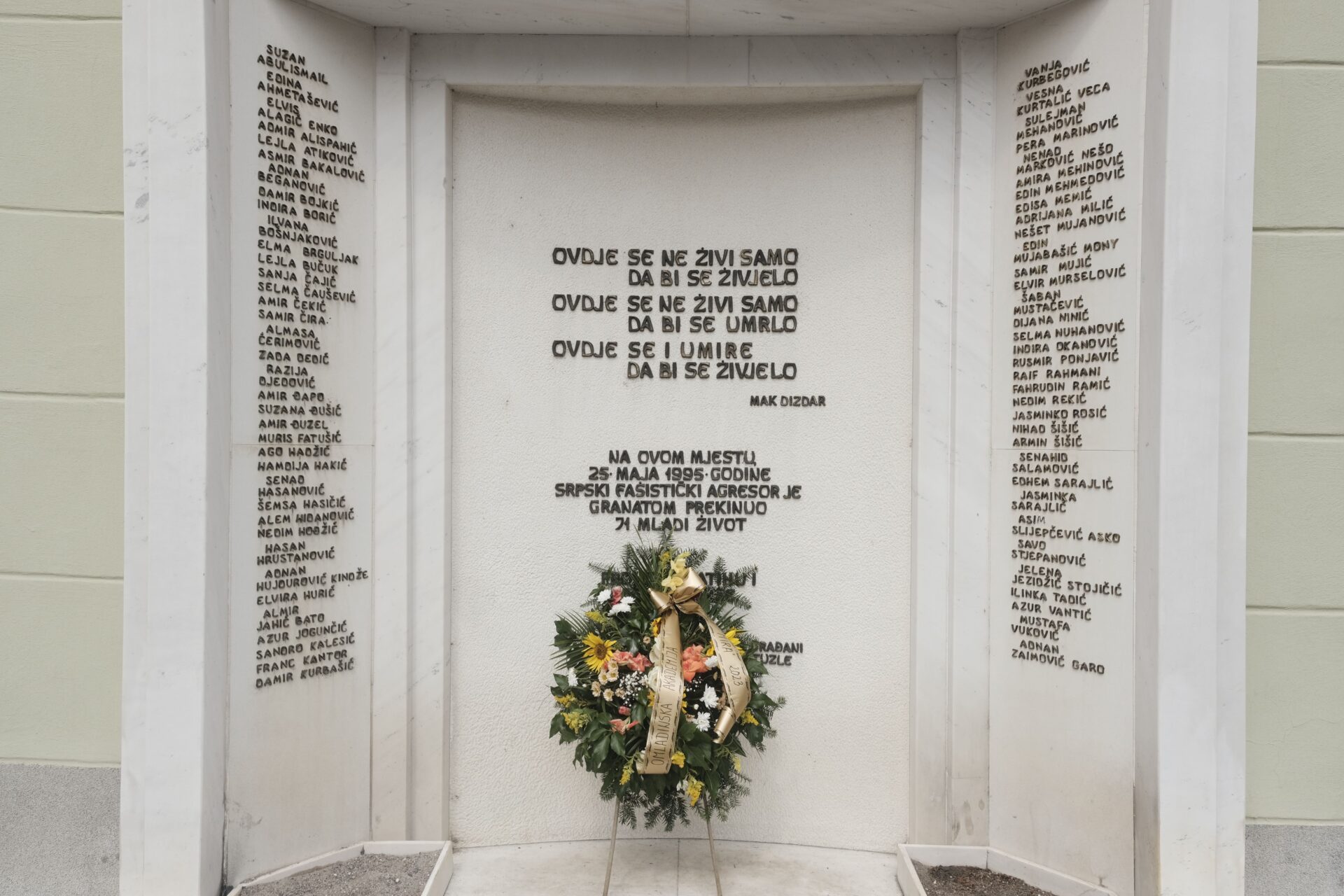
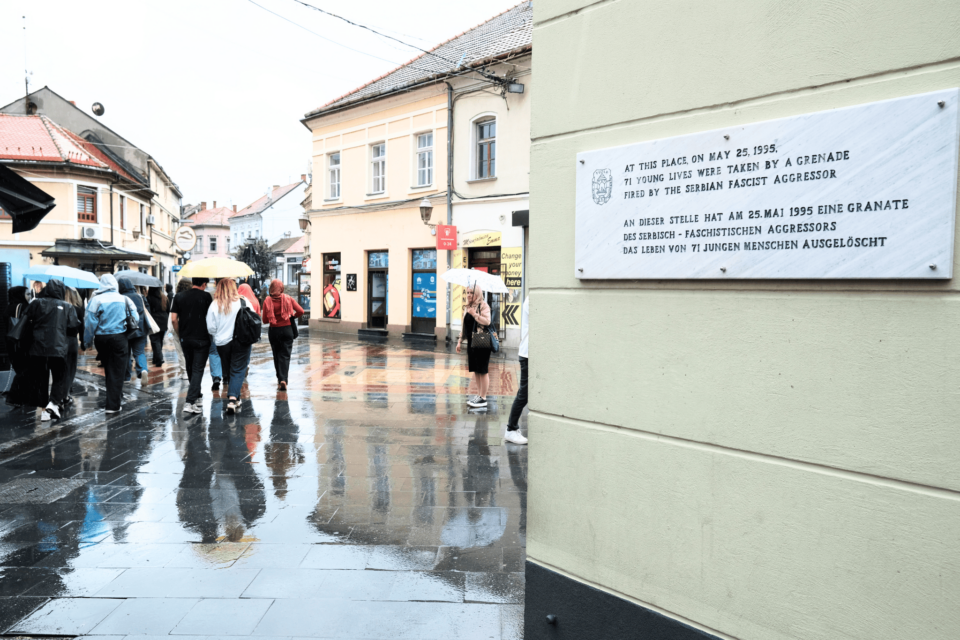
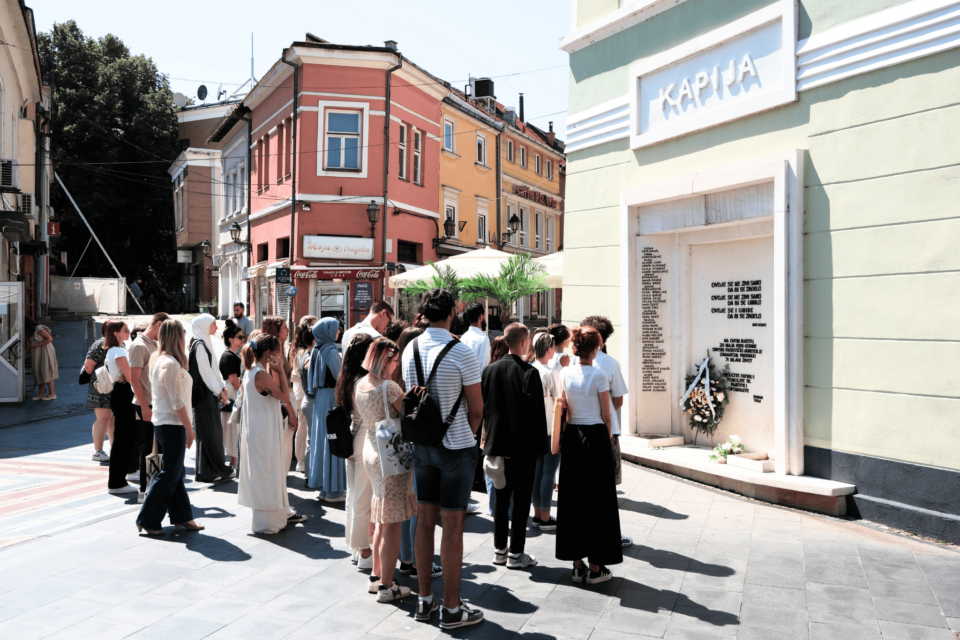
Powerful verses are engraved at the Kapija Memorial, where, on Youth Day, May 25th, 1995, a massacre was committed against the young people of Tuzla.
Here one does not live just to live
Here one does not live just to die
Here one also dies to live
—Mak Dizdar
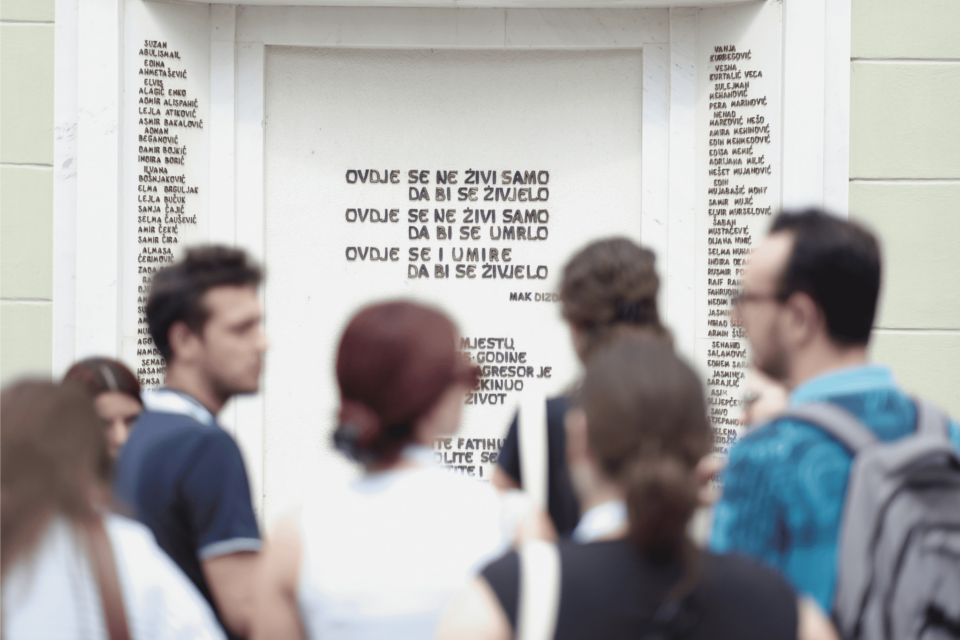
Seventy-one people were killed and 175 were wounded. “Let us pray, remember, and warn,” say Tuzla citizens at the Kapija Memorial, on which the names of the murdered are written.
The Kapija Memorial Center, located near the historic gate, contains personal belongings of victims as eternal testaments to their memory. Documentaries and informative materials about the atrocity are available, conveying the full account of what happened on that fateful May 25th. One thing visitors cannot learn here, however, is when and whether convicted war criminal Novak Đukić, who is in Serbia, will serve his sentence—that is, whether the families of those killed will ever receive justice.
Admir Ikinić and his friends were walking along the promenade with other young people on Thursday, May 25th, 1995, heading towards the city center. At 8:55 p.m., a grenade struck. After the explosion, Ikinić describes the thick smoke, the smell of gunpowder, the ringing in his ears, and the sight of the bodies of those killed.
“I was clinging to the people who had died. I was looking for shelter, but I couldn’t find any,” said Ikinić, explaining that he had been with Alen Hidanović and Ago Hadžić, who died on the spot, and Nešo Mahović, who succumbed to his injuries shortly after the attack.
Ikinić underwent surgery early in the morning, then was evacuated to Zagreb for treatment. The physical injuries healed over the years, but the psychological ones did not. “I have PTSD [Post-Traumatic Stress Disorder] and was hospitalized twice because of it. There was no psychological support,” said Ikinić.
Šemsudin Alagić was at a military post on Majevica that day. When he was told to call home and check on his son, he waved it way, saying his son wasn’t out and there was nothing to check. When he returned home, however, he found a lot of people, which is when he realized that his 17-year-old son Emko—who was supposed to represent Bosnia and Herzegovina in table tennis at the European Championship in the Hague, Netherlands, that July—was among those killed.
“My wife didn’t recover for a long, long time,” Alagić says in a low voice, adding, “You think it will get easier with time, but as you get older, it gets harder and harder.”
Journalist and editor Dino Kalesić’s son Sandro, who was just two and a half years old, was the youngest victim of the Kapija massacre. He was killed in his father’s arms in the very center of the city. “After being in all the battlefields around Tuzla, I went out into the city,” he recalls Kalesić, adding that he blames himself for this mistake.
Kalesić shows photos and videos of the crimes at Kapija to his second son who was born after the war, because he doesn’t want to create the counter-effect that all should be hated for the crime. When he tells him of his lost brother, he kisses the picture of him every time. The only way forward, according to Kalesić, is without hatred but with facts.
“All three sides must admit their own crimes. There were crimes on all sides,” Kalesić adds.
A Memorial Commemorating the Murdered
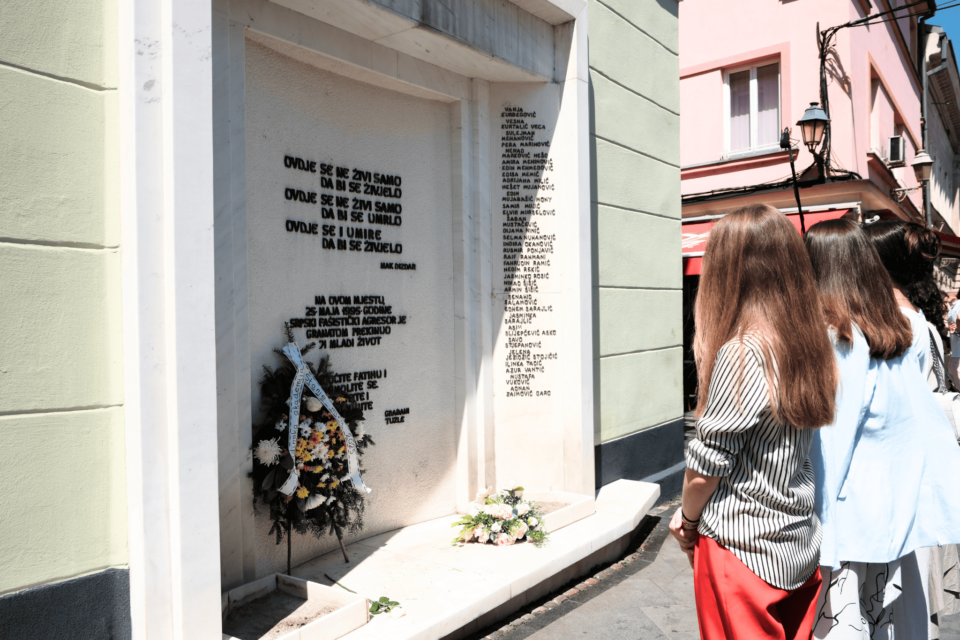
Today, a memorial stands on the very spot where the shell fell. A stone sculpture with the names of all 71 victims was built immediately after the war, at the initiative of the 25th May Citizens Association and the City of Tuzla.
Alagić believes that the City of Tuzla did what needed to be done. The families of those killed were involved at every stage of the memorial’s construction.
“We were asked about it, and at the very beginning we had a committee,” explains Alagić. He points out that today the mayor and his team have asked if there are any objections, and none have been raised. While it could always have been done better, its location and execution were done correctly.
Alagić explains that 51 of those killed at Kapija were buried on the Alley of Youth at the City Cemetery, while 20 were buried elsewhere because they were from Gračanica, Gradačac, and surrounding towns.
“They were killed together, but they were not buried together. Everyone had a choice,” he said.
Ikinić believes that a May 25th Museum should be located next to the Kapija Memorial, but although the idea was put forward, it still hasn’t been done. “Politics is also a difficult topic,” Ikinić laments when asked why there is still no Museum dedicated to this day.
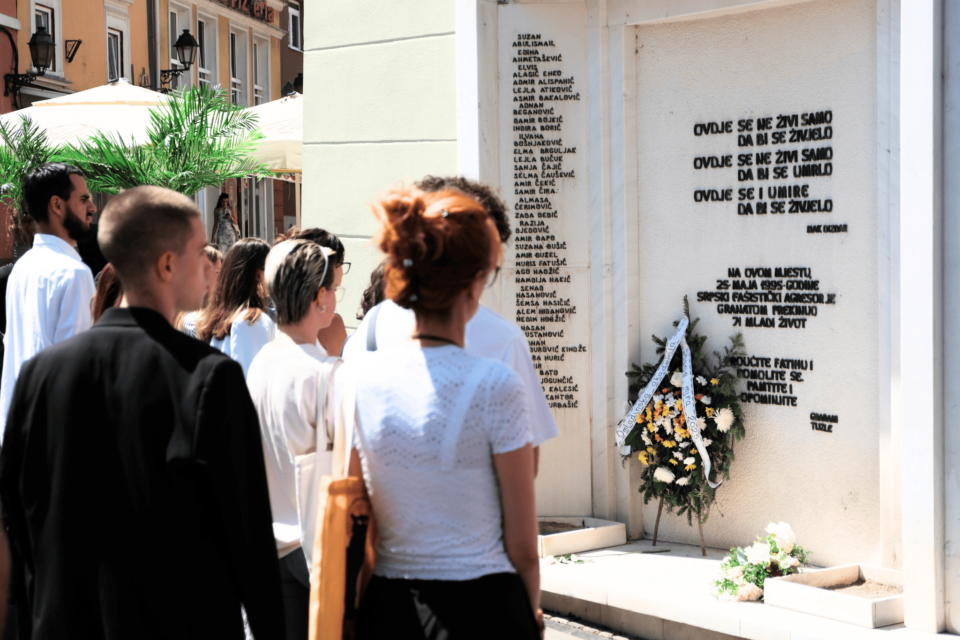
The Kapija Memorial Center was opened in 2020, ten meters from the memorial. The spaces were renovated and architecturally arranged as a permanent public exhibition within the Tuzla Culture Center. The City of Tuzla financed the project, and the logo was designed by artist Damir Sufi. The content of the installation was created in close cooperation with the families of those killed.
Senad Begović, curator of the Tuzla Cultural Center, explains the philosophy of the space: “The idea was for it to be an information-documentary center where we will collect recordings, witness statements, and material evidence that can be used by journalists, researchers, and students.”
There is space on the wall for 71 boxes, one for each victim, and part of the wall is covered with the front pages of the daily press from May 26th and 27th, 1995, so that visitors can experience the message the public was reading on those days. Medina Lolić, an employee of the center, explains, “There are portraits of 71 victims, and along with the portraits are personal items donated by their parents. We have a little girl, Lejla, whose pencil case is next to her. Enko with his table tennis racket. Ilvana with her scrapbook. Zada Sjedić was a victim who was supposed to get married that day. Her mother brought us a watch that she cleaned and asked us to clean it often.”
Two documentaries about May 25th are available for viewing at the center—one by the Balkan Research Network of Bosnia and Herzegovina (BIRN BiH), and the other jointly created by the Post-Conflict Research Center and the Srebrenica Memorial Center. There are also expert reports from the trial of Novak Đukić, the commander of the Orzen Tactical Group of the Army of the Republic of Srpska, who ordered his units on Mount Ozren’s Cerovo Hill in the village of Panjik to shell Tuzla and the nearby area of Kapija with artillery.
Đukić was sentenced to 20 years in prison. However, due to a wrongful application of the law, he was temporarily released, which he took advantage of in 2014 to flee to Serbia. While Serbia was supposed to impose his sentence, the hearings were postponed due to the alleged poor health of the convict. Đukić has not started serving his sentence even 12 years later.
In the Kapija Memorial Center, there are also archival recordings that are preserved but not publicly exhibited, as they are not suitable for younger audiences.
Alagić has been collecting material for the center for years. “Everything about Enko has been preserved. For years we have been expanding it, asking for pictures from others in order to complete the memories of Enko. I even had a problem finding a picture for the monument itself, but others gave us photos of him.” He pointed out that in memory of his son, the table tennis club Kreka organizes a memorial tournament named after him every year.
Begović emphasizes that the center is not only a place of sadness, but also an institution that actively opposes the revision of history. “There are political reinterpretations of that event. This is a place that preserves the truth about May 25th,” he pointed out.
Last year, the center signed an agreement with the Tuzla Canton Ministry of Education that introduced a mandatory visit to the center as part of the cantonal curriculum.
Day of Mourning and Moment of Silence for the Youth at the Gate
Every year on the anniversary of the crime against the youth of Tuzla, a day of mourning is observed across the city, including a moment of silence at the time when the shell struck. In the morning, wreaths are laid in Youth Alley, in the presence of delegations, citizens, and public representatives, followed by another laying of flowers at the Kapija Memorial at noon. At 8:55 p.m., a siren sounds, and young people gathered in the square pause to pay their respects to the victims in silence.
“The fact that the youth come of their own accord and organize around Kapija is something deserving of high praise,” said Alagić, adding that “no one is forcing them. The young people come themselves. That’s Tuzla.”
The city of Tuzla was the first to declare May 25th a Day of Mourning, followed by Tuzla Canton and the Federation of Bosnia and Herzegovina. At the national level, however, this designation has never been officially declared.
Kalesić believes that this is not a coincidence, but a reflection of deep disinterest in the truth about Kapija. “The Kapija atrocity is being swept aside. After 30 years, it can be concluded that those who’ve led this country in various post-war periods, regardless of which party they’re in, are not particularly interested in the truth about it. Even as all politicians are using tragedies to their advantage, no one uses the Kapija massacre. Everyone is focused oin other crimes,” Kalesić believes.
Dr. Semir Hadžimusić, a historian at the Tuzla Canton Institute for the Protection of Cultural-Historical and Natural Heritage, believes that these commemorations need a substantive upgrade. “The anniversaries of the Kapija war crimes should be marked commemoratively as before, but with more participation from professional historians, through history classes with the survivors attended by students. Over time, it will be clear that it shouldn’t just be a laying of flowers but should have higher quality program,” said Hadžimusić.
Kalesić is bothered by the fact that neither Kapija nor other tragedies like Srebrenica or Markale are included in all textbooks throughout Bosnia and Herzegovina. He believes that only through systematic education can memories be preserved and future generations be given a picture of facts untainted by hatred.
Novak Đukić was the only person convicted for the Kapija massacre, which indicates the long path from the final verdict to its execution. He was sentenced to 25 years in prison for the atrocity by a first-instance verdict in 2009 and was in custody. A year later, the verdict was confirmed and became final. However, in February 2014, the Constitutional Court of Bosnia and Herzegovina ruled that accused’s rights had been violated due to a misapplication of the law and ordered the lower court to issue another decision urgently.
The Court of Bosnia and Herzegovina revoked Đukić’s sentence and released him pending a final decision. His sentence was reduced to 20 years in prison, according to the criminal law provisions in force at the time of the crime’s commission. Đukić took advantaged of his release to flee to Serbia, where, according to the agreement on the execution of criminal legal sanctions between Serbia and Bosnia and Herzegovina, Serbia should have accepted the verdict and carried out Đukić’s sentence. However, Đukić did not attend the hearings in Serbia, citing the excuse that he was in poor health. Although a warrant was issued, Đukić was never arrested and thus has yet to serve his sentence.
Kalesić was a witness at the trial before the Court of Bosnia and Herzegovina. He recalls Đukić’s blank stare, and says that nothing moved him. He believes that the sentence given Đukić was insufficient from the very beginning, dividing the number of years of the sentence by the number of deaths. He also points out that Đukić alone could not made the decision to shell Kapija, and that there were people above and below him who should also have been prosecuted.
Alagić also remarks on the injustice: “We warned them not to let Đukić go. When he went out to the parking lot, they should have arrested him immediately and brought him back, but they didn’t.”
“Our task is to keep talking about Kapija”
Young people from Serbia also come to mark the anniversary of the Kapija massacre and sit with the parents of those murdered. Lolić considers this very important: “They want to talk to the parents of the murdered children. They want to show that not everyone thinks the same way and that there are people in Serbia who know what happened and who is to blame.”
Begović believes that Tuzla, viewed as a whole, has a built culture of memory that is rare in the region. The city has protected national monuments of different peoples, equally valued mosques and churches, and established the International Portrait Gallery, among other achievements.
“All are equal. We have a continuity that goes back to the period of socialism, but which continues even today,” said Begović.
He notes that the Kapija Memorial Center cooperates with the Srebrenica Memorial Center on documentary films and exhibitions, and feels that they should expand their networking with institutions and individuals who have suffered similar war crimes.
Kalesić, on the other hand, acknowledges the difficulty of this when concerts and events are held in other cities on May 25th. While he’s sure that Tuzla feels solidarity with Srebrenica, Markale, Ahmici, and other places where crimes were committed, he isn’t sure that the rest of Bosnia and Herzegovina feels the same about Kapija.
According to Hadžimusić, the Srebrenica, Kapija memorials, as well as other memorial centers worldwide, are guided by the principles that such atrocities must never be repeated against anyone and that history must serve as a teacher. However, in order for these messages to be communicated effectively, institutions must also be guided by proven methods, and not only formally.
When it comes to institutions, Ikinić feels that they have not fulfilled their obligations to survivors, which include helping them to find a jobs, finish school, or even providing short term assistance. Emotionally, he adds that he only feels sorry for his friends.
Whenever Alagić is upset, he visits the cemetery to pray, which gives him a sense of relief and peace. He says that he can imagine what it would be like if his son had not been killed. He refuses to give up on the idea of creating a museum alongside the memorial. Kalesić emphasizes the imperative to never stop talking about Kapija.
Unfortunately for survivors, victims’ families, and the memory of those killed at Kapija, it’s still impossible to say, 31 years later, whether Đukić will ever serve his sentence, whether other perpetrators will be held accountable, whether a national Day of Mourning will be declared, or whether the education system will allow young people the opportunity to remember their peers, whose average age was 21, who were killed on May 25th, 1995.
This article was created within the project “Generation Memory”, which is carried out by the Post-Conflict Research Center (PCRC), with the aim of developing inclusive, local peace-building practices and a culture of memory that encourage work on understanding, empathy and critical reflection among young people. The project is financed by UK International Development and is implemented in partnership with the British Council.