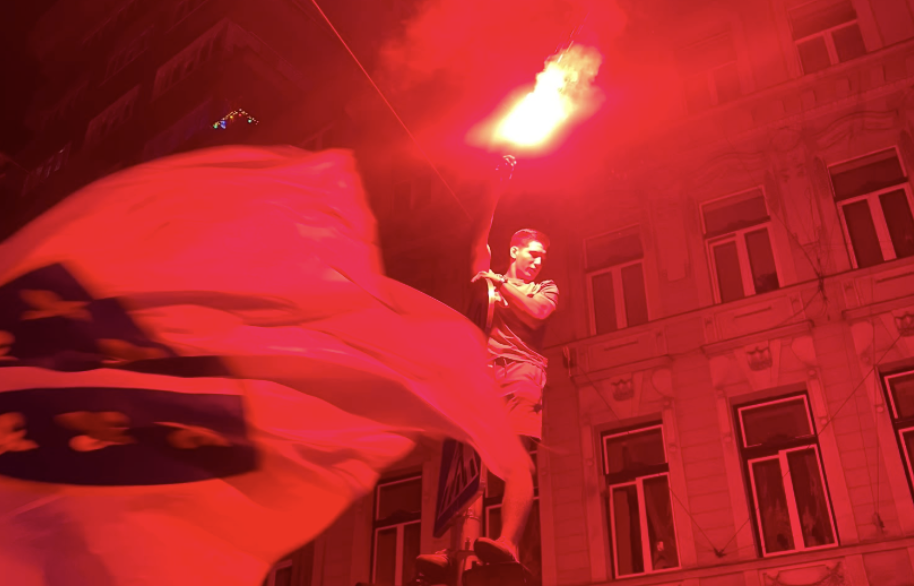
When Bosnia and Herzegovina qualified for the 2026 World Cup in the USA, Mexico and Canada, celebrations erupted across the country and throughout Bosnian communities around the world.
Streets filled with blue and yellow flags, cars honked through city centers, and social media became flooded with videos of fans embracing one another. The last time this occurred was in 2014, when the national football team qualified for the World Cup in Brazil.
Thirty years after the Bosnian War scattered families across the region and globe, many of the players who secured Bosnia and Herzegovina’s place on football’s biggest stage are the children of those who fled the conflict. Others, like captain Edin Džeko, survived the war themselves. Together, the team represents a generation whose lives have been shaped by displacement, resilience, and an enduring connection to a homeland that many know through both memory and inheritance.
The country’s journey to the 2026 World Cup was anything but expected. After years of disappointing results, frequent coaching changes, and internal instability within the national football program, few predicted the team would qualify. Between 2022 and 2024, Bosnia cycled through five different head coaches while struggling through consecutive qualification campaigns.
Everything changed when former national team captain Sergej Barbarez took over in 2024. Although he arrived with no prior coaching experience, with the help of Bosnia and Herzegovina national team director Emir Spahić, Barbarez rebuilt the squad around a younger generation, introducing sixteen new players and reshaping the team’s identity. Although few people believed in the new head coach, the gamble paid off. Bosnia stunned Wales before defeating Italy in a playoff, securing the country’s second-ever appearance at a FIFA World Cup.
The decisive penalty against Italy came from 21-year-old Esmir Bajraktarević, born in Wisconsin to parents who survived the genocide in Srebrenica. Eligible to represent the United States after progressing through its youth national teams, Bajraktarević instead chose Bosnia and Herzegovina when selecting his senior international career.
“The decision for me was very easy,” he explained to the media after qualifying. “It was something I knew I wanted to do since I was little… There was no dilemma: It had to be Bosnia,” said Bajraktarević.
His story mirrors that of many players on the current squad. Raised in countries like the United States, Germany, Austria, Sweden, and Denmark, they grew up speaking multiple languages and navigating multiple identities. Yet when given the opportunity to represent a nation, they chose the country their families were once forced to leave.
Bajraktarević shares similar emotions with another rising star of Bosnian football, Kerim Alajbegović. Although the 19-year-old was born in the German city of Cologne, his parents fled Bugojno during the war in Bosnia and Herzegovina in the 1990s.
“I went to the World Cup with Bosnian national team. But what has remained the same, and what always will, is my love for my country. Wherever I go, no matter what path life takes me on, I carry this country in my heart and soul. Its rivers, mountains, people, and resilience are all a part of who I am. They shaped me and gave me the strength to keep moving forward,” said Alajbegović.
For many Bosnians, that choice carries emotional significance.
Following Bosnia’s qualification, Emir Suljagić, director of the Srebrenica Memorial Center, reflected on Bajraktarević’s achievement with a message that resonated far beyond football.
“There was a plan for this boy never to be born, for my own children never to be born, for any of our children never to be born. Their laughter is our greatest revenge”, said Suljagić.
His words captured what makes this team unique. The Bosnian War sought not only to destroy communities, but to erase futures. Three decades later, those futures are returning, not as victims or refugees, but as elite athletes wearing Bosnia and Herzegovina’s crest on the world’s biggest sporting stage.
No player embodies that journey more than Edin Džeko.
At just six years old, Džeko experienced the Siege of Sarajevo firsthand. In “A Letter to the Children of Bosnia,” he recalls hiding behind a shoe cabinet with his mother as the first sirens sounded, spending years sharing a small apartment with extended family, and risking his life simply to play football outside. On one occasion, his mother refused to let him leave the house to join friends. Minutes later, a shell struck the place where his friends had been playing football, killing them.
“I don’t like to talk about the Siege of Sarajevo,” Džeko wrote. “But it’s important for you to understand what it was really like.”
Today, he captains one of the youngest squads in the tournament, and for many, he is more than Bosnia’s greatest footballer; he is the bridge between the generation that lived through the conflict and the one determined to write a different future.
Yet while the stories of these players are deeply personal, their significance extends beyond the football pitch. In a country where political institutions often reinforce ethnic divisions, the national team has become one of the few spaces where Bosniaks, Bosnian-Serbs, and Bosnian-Croats, both at home and across the diaspora, can momentarily rally around a shared symbol.
In Bosnia and Herzegovina, football has never really existed in isolation from politics. Like many aspects of public life, the sport reflects the country’s complex post-war reality, where institutions, identities, and even supporter cultures have often been shaped by ethnonational divisions.
Yet the national team occupies a unique space.
While political disagreements continue, international matches have offered a rare moment when many citizens choose to focus on a shared achievement rather than the divisions that dominate everyday life. Bosnia’s qualification for the 2026 FIFA World Cup has, once again, demonstrated that, despite competing political narratives, there remains a desire to celebrate something collectively.
Professor Dino Abazović, a sociologist at the University of Sarajevo, argues that the significance of the national team depends on how Bosnians understand the idea of “national” identity itself “if understood exclusively as ethno-national identity.”
“It is part of the problem leading to divisions and the creation of the significant ‘other.’ If understood as a supra-identity—as an inclusive identity—it is part of overcoming everyday realpolitik and space of mutual recognition despite differences,” he added.
In that sense, the Bosnian national team represents something larger than football. Rather than asking supporters to abandon their individual identities, it offers an opportunity to share another one.
However, Abazović cautions against romanticizing sport as a solution to political conflict. Instead, he describes sporting success as a “positive field of shared force”; a space where people can briefly recognize one another through collective achievement instead of political disagreement.
That distinction is important.
Football cannot resolve Bosnia and Herzegovina’s constitutional challenges, erase memories of war, or undo decades of political polarization. But, it can create something equally meaningful: shared experiences, explained Abazović.
For Nikola Kandić of the Regional Youth Cooperation Office (RYCO), those shared experiences are central to peacebuilding itself.
“Major sporting events can create rare moments when people experience a shared sense of pride and optimism,” Kandić said, adding:
“While these moments should not be overstated or presented as evidence that divisions have disappeared, they can remind people that there are still experiences capable of bringing citizens together across social, ethnic, and political lines.”
Through youth exchanges across the Western Balkans, RYCO has long used sport as a tool for reconciliation. Unlike formal dialogue sessions, Kandić explains, sport creates cooperation naturally.
“Sport creates opportunities for cooperation through shared goals, teamwork, and mutual respect. When young people train together, travel to competitions, spend time in locker rooms, or work toward a common goal, they get to know each other as individuals before seeing each other through the lens of ethnicity, nationality, or political narratives. This human connection is particularly valuable in post-conflict societies, where stereotypes are often formed without personal interaction,” he said.
Trust, in other words, comes before conversation.
This same philosophy underpins the work of PLAY International, which uses sport to promote social cohesion across the Western Balkans and other post-conflict regions.
“Sport reaches people in a place words can’t get to,” said Vlorian Molliqaj of PLAY International.
“In our region, agreement about the past is exactly what we don’t have, but you don’t need to agree about the war to pass someone a ball. Cooperation can begin before reconciliation does, and it happens in the body rather than in argument. In a society where even the language and the history are still contested, that’s a real opening,” he explained.
He described that tt PLAY International, they use our method, where the game deliberately brings a behaviour to the surface (someone gets left out or stereotyped) and a guided conversation afterwards turns that moment into something the group can actually talk about.
“Sport opens the door, and the reflection walks people through it…I see it in Kosovo, BiH, Serbia, and across the Western Balkans wherever we run activities with young people. When children play together first and talk afterwards, you reach places that years of speeches and formal dialogue never could. That, to me, is the real strength of sport in a post-conflict setting: it starts with people, not with positions,” said Molliqaj.
His observation captures something fundamental about Bosnia’s World Cup team. The players do not erase the country’s difficult history; nor do they ask supporters to forget it. Instead, they offer a different point of connection, particularly one rooted in the shared experience of the present.
For Molliqaj, that is where reconciliation begins.
“Reconciliation isn’t just the silence after the shooting stops. It’s the slow building of fair, trusting relationships, and that relational layer is exactly what sport is unusually good at creating. It works best as part of something bigger, alongside justice and opportunity, but the human bonds that make peace imaginable in the first place, sport builds those better than almost anything I know,” he explained.
Many of Bosnia’s current players grew up outside Bosnia after their parents fled the war. Some, like Esmir Bajraktarević, could have represented other countries internationally. Instead, they chose Bosnia and Herzegovina.
“The diaspora story moves me most. When players whose families were driven out by the war choose to represent the country their parents had to leave, the message is that belonging survives displacement. The war tried to erase where people came from, and pulling on that shirt on the world’s biggest stage is a way of taking it back,” Molliqaj reflected.
Kandić sees those stories as especially important for younger generations.
“Many players representing Bosnia and Herzegovina today come from families whose lives were shaped by war, displacement, or migration. Their journeys show that belonging is not defined solely by where someone was born or where they currently live. It can be shaped by family history, personal values, emotional connection, and a conscious decision to contribute to a community,” he said.
In a country where questions of identity are often filtered through political and ethnic categories, that message offers an alternative understanding of belonging, one built on commitment rather than circumstances.
For members of the diaspora community, however, the significance of this World Cup extends beyond sport. It also adds a layer of visibility, recognition, and opportunity to see their own experiences reflected on the international stage.
Lejla, a Bosnian-American and intern at Post-Conflict Research Center, grew up navigating two identities after her parents immigrated to the United States following the war.
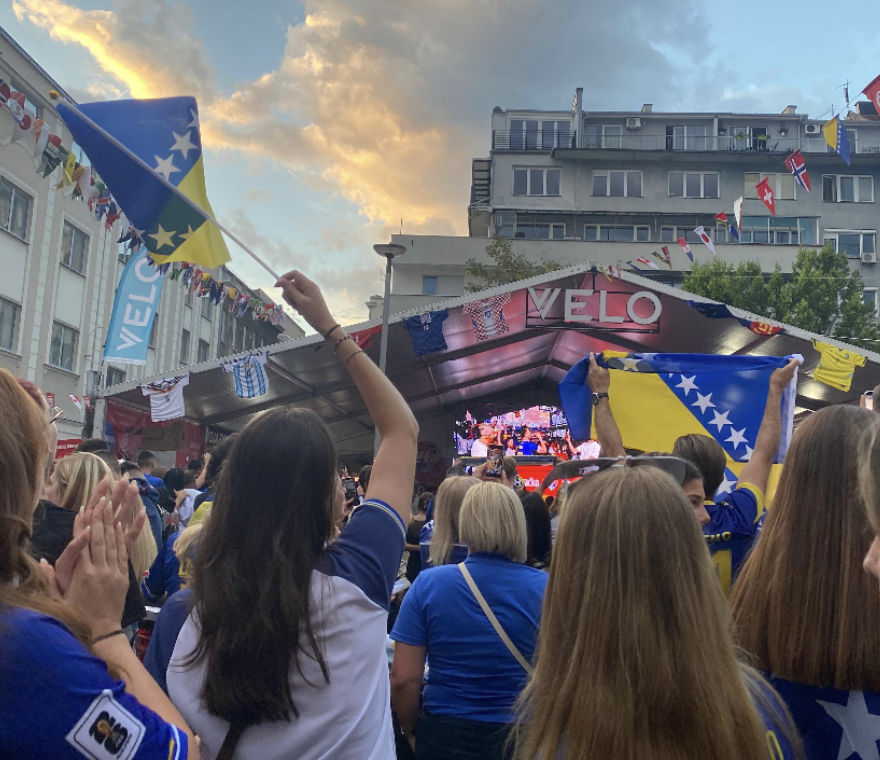
“My entire family is Bosnian. My parents were born and raised here and immigrated to the States after the War. However, the rest of my extended family still lives in BiH,” Lejla said.
Like many children of refugees, she describes growing up feeling caught between two worlds.
“Growing up abroad I was neither Bosnian nor American,” she explained. “My generation is the first generation that was born after the war. We are children of immigrants and refugees and are actively trying to come up with our own identity through our personal experiences but also a tie to a country we know very well,” Lejla explained.
For Lejla, Bosnia’s qualification for and participation in the World Cup “finally meant recognition.” She explained how “many don’t know where BiH is on a map, don’t know the things that have happened, and don’t realize it has such a rich culture and history…[BiH] deserves positive recognition because the media often discusses its faults or horrific past.”
That desire to be seen beyond the legacy of conflict is echoed throughout the current national team.
For decades, Bosnia and Herzegovina has often appeared in international headlines because of political crises, constitutional disputes, or memories of the 1992-1995 war. The World Cup offers a different image: one defined by resilience, talent, and possibility.
Lejla believes that is why this generation of players resonates with young people in the diaspora.
“Growing up, so many people across generations felt connected to Edin Džeko. He is from Sarajevo and experienced the war, so in some ways he’s a hero in showcasing BiH in a positive light. However, this new generation—my generation—we are children of those who have lived through tragic events… This team isn’t just those who have connections to the country, but it’s a way to showcase that identity and love that my generation is trying to cultivate,” she said.
She paused before adding something that captures the significance of the team perhaps better than any statistic or tournament result.
“In some ways it is as if I am seeing myself and my hopes within the national team,” she added.
That sentiment illustrates why players like Esmir Bajraktarević have become symbols beyond football. Bajraktarević grew up speaking English outside his home, yet Bosnian remained the language of his family.
“My family built a new life here, so I’m very proud to be American…But my name is Esmir, and it’s a Bosnian name… I grew up in a Bosnian family. I speak Bosnian with my parents every day. It’s my blood, it’s my roots,” said the young player.
His decision to represent Bosnia and Herzegovina reflects a broader truth shared by many members of the country’s diaspora: identity is not limited by geography.
As Professor Abazović observed, identity formation is shaped by family memories, relationships, and symbolic belonging as much as by place of birth. The stories of Bosnia’s World Cup squad suggest that displacement did not sever those ties. Instead, for many families, it transformed them.
This is why the current team carries such symbolic weight. It is a collection of talented footballers and a generation born from the consequences of war; children who inherited stories of survival, migration, and loss, yet chose to transform those histories into something hopeful. Their decision to wear Bosnia and Herzegovina’s shirt is, for many supporters, an affirmation that belonging can endure across borders and across generations.
At the same time, Bosnia’s World Cup campaign should not be romanticized.
As both Kandić and Molliqaj emphasized, football cannot resolve political polarization, replace institutional reform, or heal the wounds left by conflict. The structural challenges facing Bosnia and Herzegovina remain, and ninety minutes on a football pitch does not erase decades of division.
But perhaps that asks too much of sport. Its greatest contribution may lie elsewhere.
As Kandić observed, reconciliation is not only about confronting the past; it is also about creating new memories built on “cooperation, pride, and hope.” Every shared celebration, every child inspired by a player whose family story resembles their own, and every supporter who cheers alongside someone they might otherwise never meet becomes one small step toward imagining a shared future.
Molliqaj expressed a similar idea.
“You don’t need to agree about the war to pass someone a ball,” he said.
That sentiment captures what Bosnia’s 2026 World Cup team represents.
Although Bosnia and Herzegovina’s World Cup journey came to an end on July 2, 2026, with a defeat by the United States, reaching the knockout stages marked the country’s most successful World Cup campaign to date.