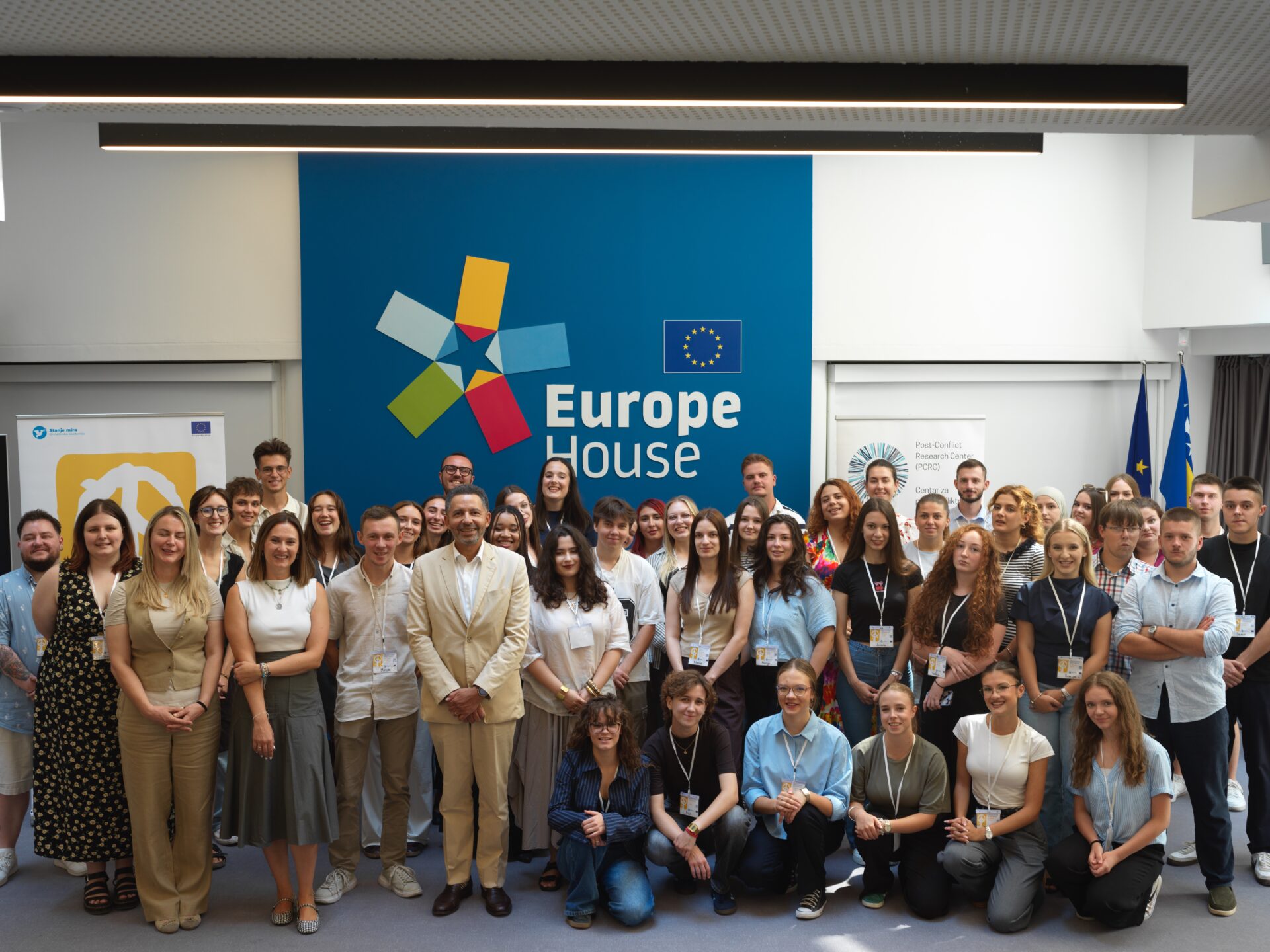
For the fourth year running, the State of Peace Youth Academy, organized by the European Union in Bosnia and Herzegovina, in cooperation with the Post-Conflict Research Center (PCRC), has brought together young people from Bosnia and Herzegovina, Serbia, Croatia and Montenegro with a goal of strengthening dialogue, mutual understanding and lasting peace.
Over a two-week program, 45 young people took part in workshops, lectures, study visits and conversations with experts, building new understanding of dealing with the past, human rights, the culture of remembrance and the role young people play in shaping a more peaceful society.
“Peace is not built only through institutions and agreements, but through people who choose to meet, listen and understand one another, even when their experiences and memories are very different. By learning together about the past and building friendships across borders, fourth year in a row, State of Peace participants are showing us that this is the right way ahead to create a more peaceful future. Their willingness to listen, question and keep the conversation going is one of the most important investments the EU can make in the future of this region”, said Luigi Soreca, Head of the EU Delegation and EU Special Representative in Bosnia and Herzegovina.
The program began in Vitez on 31 July, before taking participants to six different communities across Bosnia and Herzegovina including Travnik, Sarajevo, East Sarajevo, Brčko, Bijeljina and Tuzla.
Speaking about the significance of the Academy, Velma Šarić, President and Founder of PCRC, emphasized that its value lies not simply in teaching tolerance, but in giving young people of different backgrounds the chance to live and talk to each other.
“This is not a lecture on tolerance. These are young people from four countries, of different faiths, ethnicities and family histories tied to the past war, who spend two weeks living together, listening to each other, standing together at sites of memory that may carry entirely different meaning for each of them and who still choose to keep the conversation going”, concluded Šarić.
For many participants, it was exactly that kind of shared, everyday experience that left the deepest mark.
To Sara from Serbia, confronting the past directly, through conversations with people who lived through the war was one of the most significant experiences. She said: “It is very hard to listen to people who survived the war, and face everything they went through, but it is exactly through these experiences that I understood how important it is for us to listen to each other, learn from the past and try not to let the same mistakes happen again.”
Nađa from Montenegro, said that the most meaningful part of the Academy for her were the conversations that happened around the formal program, and added: “The Academy confirmed for me that understanding does not have to mean agreement, but rather a willingness to listen to each other and try to see the past from more than one perspective”.
Hamza from Bosnia and Herzegovina, emphasized that one of the most moving parts of the Academy was the chance to pay tribute to victims and reflect on the importance of remembrance at the sites the group visited together.
After 14 days of travel, conversations, learning and shared experience, the Academy came to an end with the program in Tuzla, showing that peacebuilding begins with an encounter, continues through conversation and finds its meaning when people from different backgrounds choose to listen to and try to understand one another.