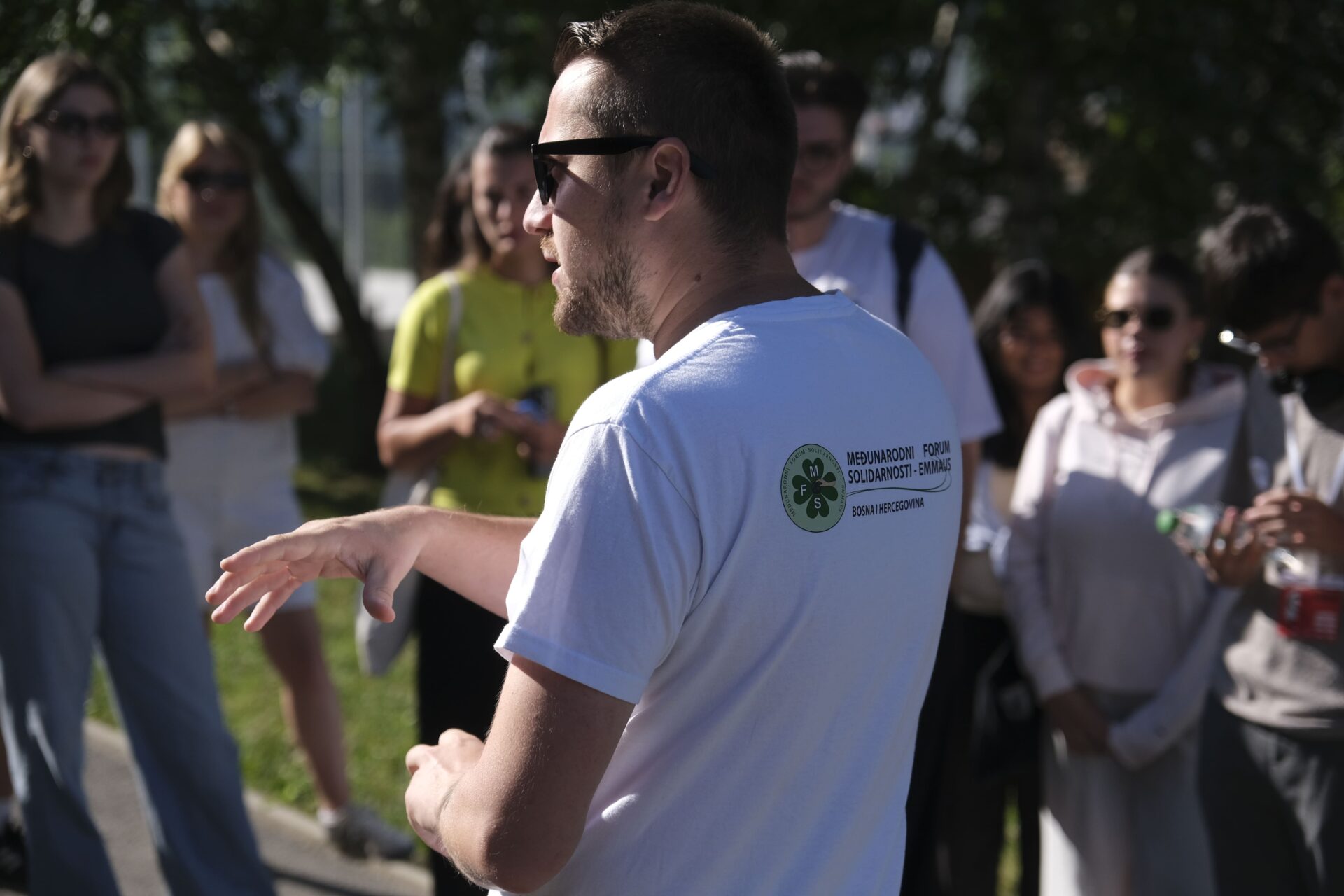
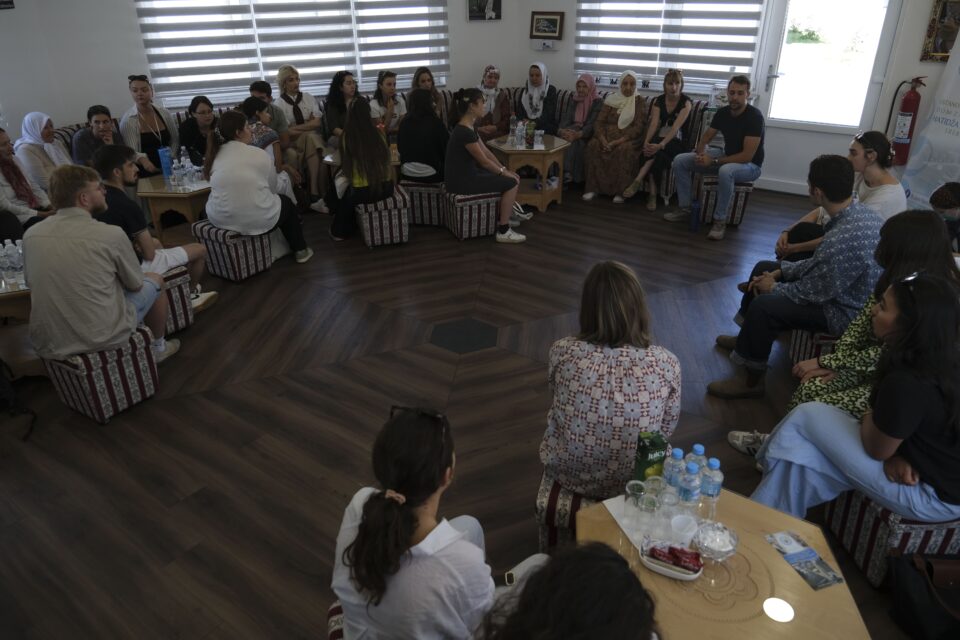
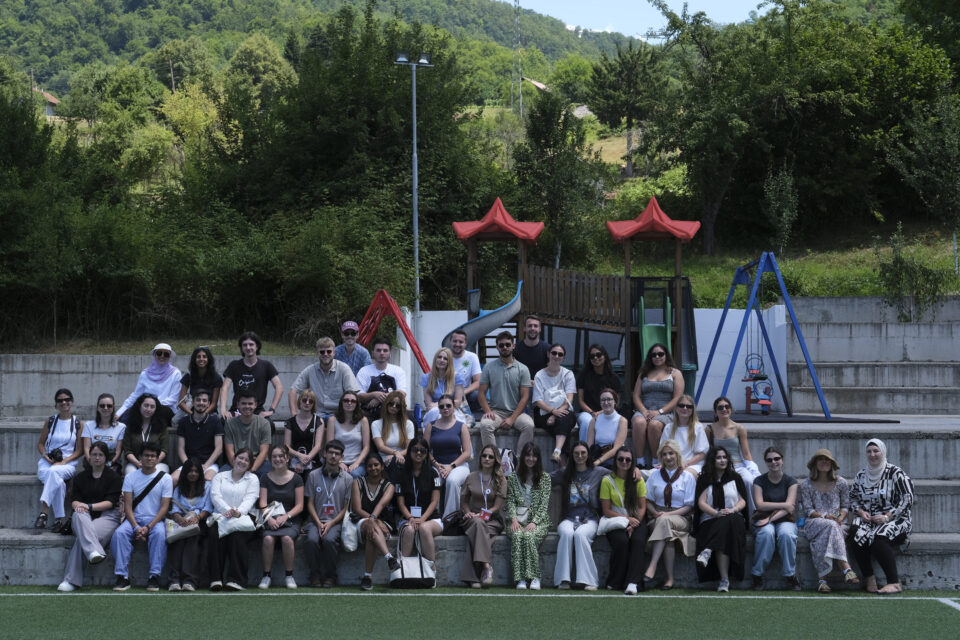
As part of the program for PCRC’s 7th annual Srebrenica Youth School, participants met with Alema Hodžić and Sabahudin Mujkić, who work for the Srebrenica regional office of the International Forum of Solidarity – EMMAUS (MFS – EMMAUS), one of the most prominent humanitarian organizations in Bosnia and Herzegovina (BiH).
The conversation focused on the current situation in Srebrenica, the everyday challenges faced by locals, and how MFS – EMMAUS responds to their needs, along with the organization’s history in the country and some of its ongoing projects.
Emmaus International is a global solidarity movement comprising more than 400 groups in over 40 countries. It supports people affected by poverty and exclusion by providing dignified work, housing, education, healthcare and other forms of assistance. Members also promote recycling, social and environmental justice, and freedom of movement, while campaigning against the structural causes of poverty.
The first EMMAUS communities arrived in Bosnia and Herzegovina in 1992, when communities from France and Italy launched initiatives to provide aid to people in need during the war.
Alema Hodžić, psychologist and project manager, told us that in 1999, EMMAUS International, led by Italian humanitarian Franco Bettoli and the Red Crescent, started providing assistance to people in need in the Tuzla canton, where a refugee camp (nowadays used as a center for people with disabilities) had been set up for internally displaced people from BiH, as well as refugees from Kosovo, Albania, and North Macedonia.
Following this, the International Forum of Solidarity – EMMAUS was established in BiH on 10 February 1999 by activists committed to assisting vulnerable individuals.
Franco Bettoli was one of the key figures behind the resumption of humanitarian assistance in the Srebrenica region. Although this initiative was initially met with skepticism, it gradually evolved into several successful projects.
The first of them was the International Youth Work Camp in Potočari, which was launched in 2006 in response to the extremely challenging circumstances experienced by local communities. At the time, many people lacked roads, electricity and running water. Between 150 and 200 volunteers would stay for between 20 and 25 days, sleeping in tents while rebuilding houses, constructing water systems, and repairing the local school. The camp has continued every year since then, and its 21st edition will take place this year, with 70 volunteers from 10 countries participating.
Mujkić explained that the lower number is not due to waning interest but rather limited funding: while more than 200 people applied, the organization could only provide free accommodation and meals for 70 volunteers.
The Summer camp was only the beginning, followed by several more successful initiatives, including a boarding accommodation program, a “One Meal a Day” program, daycare centers for children and youth, the Elderly Care Home “Hatidža Mehmedović,” and the Pale Sports and Recreation Centre.
When asked how Emmaus manages to provide all of its services for free, Hodžić and Mujkić said that many organizations came to the Srebrenica region but often only stayed for as long as they had funding. Then they left, even though the local people were still dependent on their humanitarian support.
MFS-EMMAUS tries to work differently, as explained by our interviewees. Before starting a project, the organization asks whether it can stay for as long as is needed, ensuring that vulnerable people who experienced the war and still face challenging living conditions are not abandoned again. The NGO raises a lot of funds through its employees, who try to secure support for as many initiatives as possible, not just their own projects. Everyone works towards one common goal: supporting people in need.
The organization receives its main funding from international organizations – the European Commission and foreign embassies, such as those of Sweden, Austria and the Netherlands, as well as partners from Turkey and Saudi Arabia.
The conversation then touched on the projects with the greatest impact on the community, where Hodžić and Mujkić underlined the importance of the boarding accommodation program and the home for elderly people.
“The home is particularly significant for the Mothers of Srebrenica because the residents are mainly women who survived the genocide and whose husbands, sons, and other male relatives were killed. It provides them accommodation and medical support free of charge while enabling them to reside in comfortable surroundings close to the Potočari Memorial Center, where they can visit the graves of their loved ones at any time,” explained Hodžić.
Hodžić argues that the home also has a long-term impact, creating jobs for young people and providing infrastructure to support the local community in the future.
Mujkić believes that caring for the elderly should go hand in hand with investing in the next generation, which is why he thinks it is vital to provide children with the necessary space, time, and opportunities for their future development.
“The boarding school program provides free-of-charge accommodation, three meals per day, sports, and commemorative activities, as well as additional tutoring and language courses to approximately 60 children from the region, with the capacity to host 96. This initiative is particularly important in a region where some children previously had to travel for an hour each way to go to school, or were unable to travel to school at all, before staying at the boarding accommodation complex,” said Mujkić.
Hodžić told us that the idea behind the boarding accommodation program, currently one of the most successful projects, emerged almost by coincidence. While MFS-EMMAUS workers were distributing humanitarian aid from door to door in villages around Srebrenica, they found out that a lot of children cannot write.
“The children were in good health and without any disabilities; however, they were living in remote areas and would not go to school in the winter because of the heavy snow and limited public transportation,” added Hodžić.
Later, it was found that the school knew about that but could not help its students. Teachers often excused the absences, and there was even a case of a child missing around 300 classes, reports Hodžić. Despite rarely attending school, some children were still allowed to progress to the next grade with good marks. It was decided immediately that something should be done, and the boarding accommodation program was born.
Hodžić and Mujkić are optimistic about the future of MFS-EMMAUS, with hopes for expansion in two key areas. Hodžić would like to see more funding for projects supporting disabled children and adults in Doboj, an area to which she feels a personal connection after working there for 12 years.
“Additional resources would enable the organization to improve both its reception and day care centers, providing more places for those in need,” she added.
Mujkić would like to develop job training programs for high school and university students. Drawing on his own experience of completing his education without internships or practical training, he aims to develop programs that provide young people with workplace experience and valuable skills, giving them a better chance of becoming competitive in the job market.