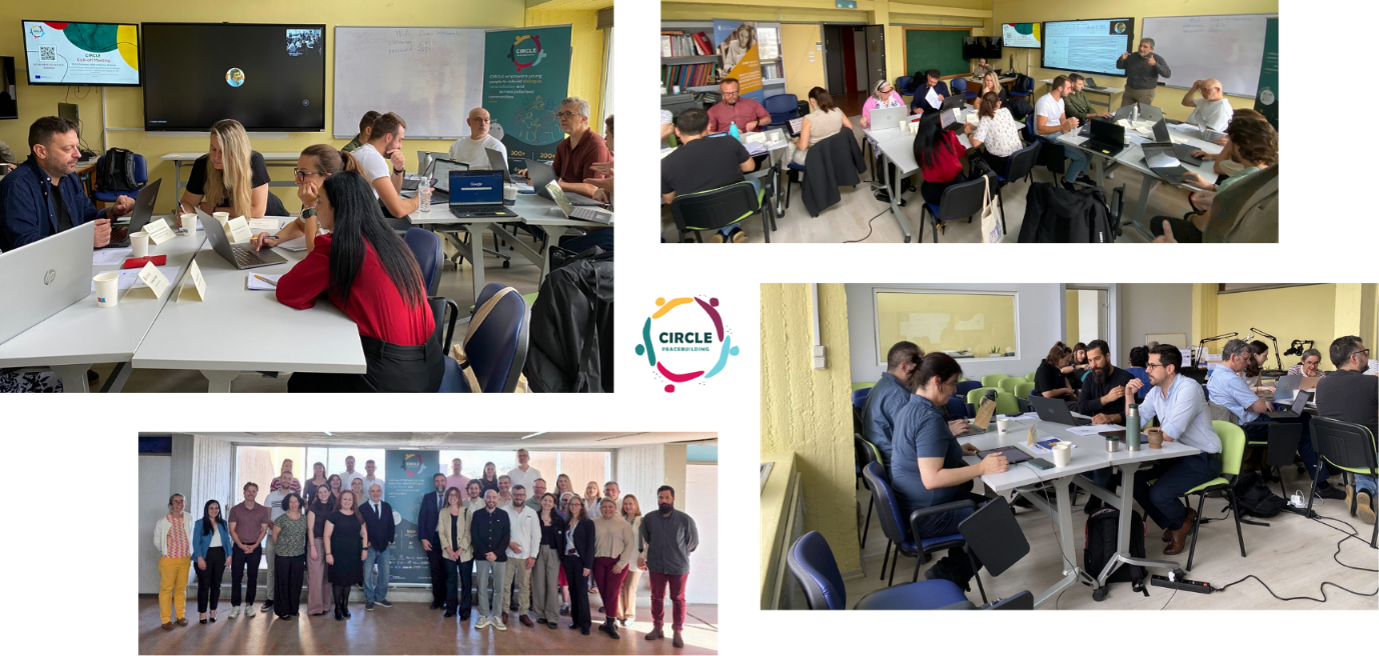
Seventeen partners from 13 countries gathered in Athens on 12–13 October to launch a 3,5-year European research initiative that will work with young people across eight settings affected by conflict and polarisation, exploring new ways to foster dialogue, mutual understanding and reconciliation.
Bringing together 17 organisations from 13 countries, CIRCLE (Creative Interfaith and Restorative peaCebuilding in artful Learning spaces and placEs) will explore how cultural and religious resources can foster dialogue, rebuild trust and support reconciliation in communities experiencing conflict, social tensions and polarisation. Partner from Bosnia and Herzegovina is Sarajevo-based Post-Conflict Research Center (PCRC).
Over the next 42 months, from October 2026 to March 2030, the project will bring together researchers, educators, artists, cultural organisations, faith leaders and local communities to develop and test participatory approaches to peacebuilding, with a particular focus on young people.
From cultural and religious differences to opportunities for dialogue
In societies marked by conflict and polarisation, cultural and religious identities can become sources of division. Yet these same identities, traditions and forms of expression can also create opportunities for connection, understanding and reconciliation.
CIRCLE builds on this potential by combining interfaith dialogue, artistic expression and restorative practices to explore new approaches to peacebuilding. Working directly with young people and local stakeholders, the project will co-design and test creative activities that encourage engagement across religious, cultural and social divides.
These approaches will be tested across eight pilot settings: Northern Ireland, Bosnia and Herzegovina, Cyprus, Ukraine, Israel/Palestine, Greece, Germany and Spain. Each setting presents different experiences of conflict or polarisation, allowing CIRCLE to explore how peacebuilding approaches can be adapted to distinct local needs.
Alongside these activities, the project will examine existing European approaches to cultural peacebuilding, develop methods to evaluate the effectiveness of its interventions, and create training resources and an immersive virtual environment to support learning and engagement.
The knowledge and experience gained will contribute to a publicly accessible toolkit and practical recommendations for policymakers, educators and organisations working in peacebuilding, cultural engagement and youth participation.
CIRCLE partners gather in Athens to lay the foundations for collaboration
The project’s Kick-off Meeting was hosted by its coordinator, the National and Kapodistrian University of Athens, at the University’s School of Theology. The two-day gathering brought the international consortium together to establish a shared understanding of CIRCLE’s objectives, clarify responsibilities and plan the first stages of implementation.
The meeting opened with a presentation of the project’s vision, objectives and expected impact by Marios Koukounaras Liagkis of NKUA, followed by an overview of the project’s structure and work plan presented by Spyros Kontosoros.
Partners were also joined by representatives of the European Research Executive Agency (REA), including Bettina Kittel, Project Adviser, and Myrofora Chatziioannidou, Financial Officer. Giuliana Defrancesco, Policy Officer at the European Commission’s Directorate-General for Research and Innovation, addressed the consortium online.
The first day focused on the project’s organisation, decision-making processes, financial management and communication strategy. Particular attention was given to research ethics, safeguarding and data protection, reflecting the importance of ensuring responsible engagement with young people and communities affected by conflict.
Professor Stephan Parmentier of KU Leuven, CIRCLE’s external Ethics Advisor, introduced his role and shared initial reflections on the ethical considerations that will guide the project’s activities.
From planning to action: co-designing CIRCLE’s first activities
The second day shifted the focus from presentations to collaborative planning. Through a series of facilitated co-design sessions, partners worked in smaller groups to translate the project’s objectives into concrete activities, responsibilities and priorities for the coming months.
Discussions covered the mapping of European cultural peacebuilding approaches, the development of evaluation methods, training and educational activities, arts-based restorative interventions, the immersive virtual environment and preparations for the eight pilot settings.
Facilitated by Marios Koukounaras Liagkis, Angelos Vallianatos and Iro Potamousi, the sessions also helped identify connections between different activities, ensuring that research findings, educational resources and local interventions can inform and reinforce one another.
An important part of the meeting was a dedicated workshop on CIRCLE’s Common Conceptual Framework, which will establish the shared concepts, theories and principles guiding the project’s work.
Bringing together partners from different disciplines and cultural contexts, the discussion explored common understandings of peacebuilding, reconciliation, interfaith dialogue and restorative practices. The aim is to develop a coherent approach that connects CIRCLE’s research and activities while remaining flexible enough to respond to the specific characteristics of each pilot setting.
The discussions initiated in Athens will continue through collaborative online work, with the framework expected to be finalised during the project’s first two months.
With its first joint plans in place, CIRCLE now moves into its initial research and preparation phase. By connecting academic knowledge with the experiences of young people and local communities, the project aims to develop practical, adaptable approaches that make dialogue and reconciliation more accessible, inclusive and responsive to local realities.
_____
Funded by the European Union. Views and opinions expressed are however those of the author(s) only and do not necessarily reflect those of the European Union or the European Research Executive Agency (REA). Neither the European Union nor the granting authority can be held responsible for them.