Bosnia and Herzegovina and especially its capital city Sarajevo are places that are rich with museums and cultural life.
Many museums approach the narratives of the 1990s Bosnian war in unique and deeply creative ways. In this article, we present three institutions at the heart of this work: Galerija 11/07/95 and the War Childhood Museum, both in Sarajevo, and the Srebrenica Memorial Center in Potočari, Srebrenica. Our conversations explored the curatorial choices behind each museum, the challenges inherent to this kind of work, and the ethical weight of portraying such a difficult past.
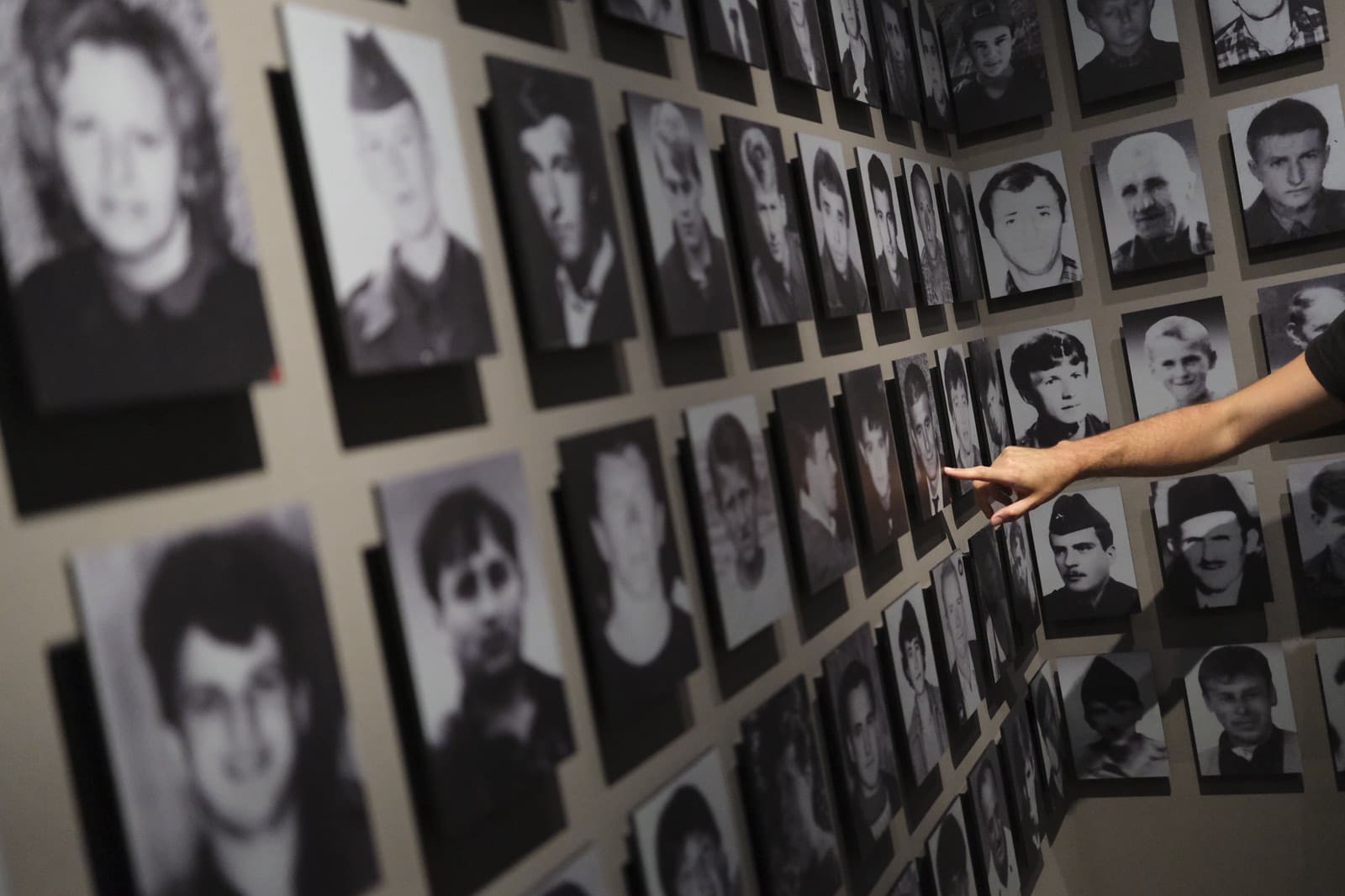
Galerija 11/07/95 is nestled in the heart of Sarajevo, across the road from the Sacred Heart Cathedral. It is the first memorial gallery in Bosnia and Herzegovina, designed to preserve and protect the memory of Srebrenica genocide. The permanent exhibition, “Srebrenica,” consists of black-and-white photographs taken by the gallery’s founder, Tarik Samarah, who based the exhibition on his book of the same name. When asked about his decision to avoid color photography, Samarah explained that he felt “color would introduce an excess of visual information into the theme.”
“This choice illustrates how museums carefully limit the information presented to viewers while still ensuring that they receive enough information to understand the subject”, explained Samarah.
Samarah further explains that “black-and-white photography emerged as a natural choice, as it allows the focus to remain on emotion and essence, without distractions.” This emphasis on emotion distinguishes the gallery from more traditional places of memory, as it focuses more on feeling than on objective facts or figures.
One of the most striking parts of the exhibition appears immediately upon entering, when visitors find themselves surrounded by 640 portraits of Srebrenica genocide victims. Each face tells a story: a cheeky smile, a moment of laughter, a serious expression, a man in uniform, or a boy in his childhood home. The decision to display this particular collection of portraits was to intended to “move beyond statistics” and “to remind viewers that behind every number stands a person with a name, a face, and a life that was violently interrupted.” The portraits cover every wall of the gallery’s first room and are arranged across the space. Visitors cannot help but feel that the subjects are looking right at them, calling upon them to study each of the 640 faces.
The gallery describes those who enter the space as “witnesses” rather than passive viewers. Samarah explains that, at the end of the exhibition, visitors are left with a parting thought: “The only thing necessary for the complete triumph of evil is for ordinary men to do nothing.” In this way, visitors leave the gallery with a call to action. The hope is that they will become “responsible witnesses — people who will not turn their heads away from injustice.”
The Srebrenica Memorial Center in Potočari is housed in the former United Nations Dutch Battalion base—a building that had served as a battery factory before the war. It stands across the road from the cemetery where victims of the Srebrenica genocide are buried every year on July 11th, the International Day of Reflection and Commemoration of the 1995 Srebrenica Genocide. Almasa Salihović of the Memorial Center explained the challenges involved in preserving and developing the memorial, as well as the ongoing intentions of this work.
The Center’s physical setting, former Dutch Battalion base, is particularly significant because thousands of Bosniak refugees sought UN protection there while the genocide was being carried out. According to Salihović, the Center has a “particular responsibility to preserve its integrity” because it is an authentic historical site. Rather than extensively transforming the interior, the Center “sought to allow the space itself to remain a witness to history.” This approach is evident when visitors walk through the building, which remains recognizable as an old factory. Photographs taken inside the base in display of July 1995 show a space that closely resembles the one that visitors encounter today.
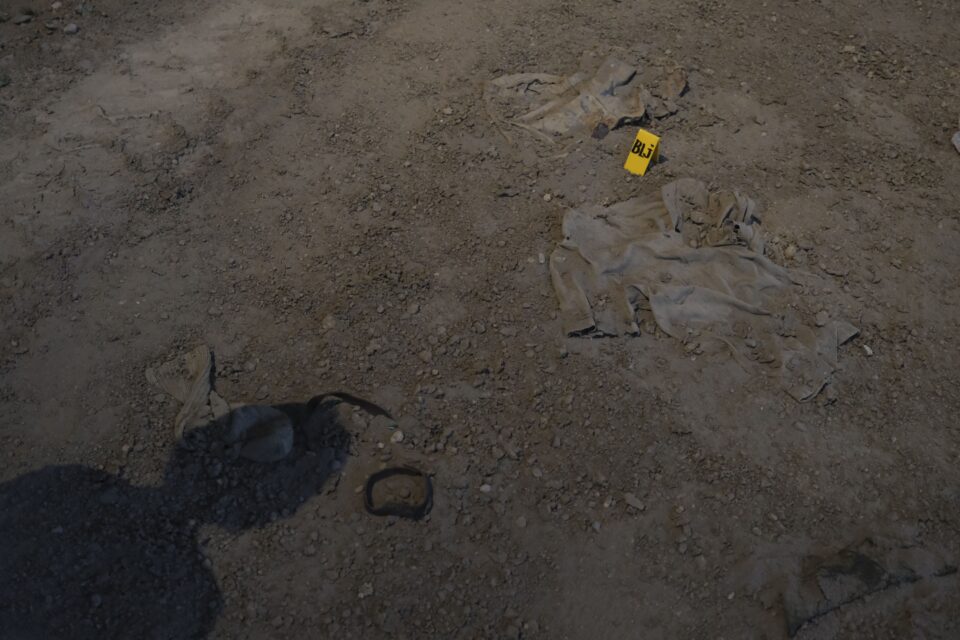
One distinctive part of the museum’s newer exhibitions is a reconstruction of a mass grave and the subsequent archeological process through which victims’ remains are located and recovered. This reconstruction connects past atrocities to present-day efforts to pursue truth and justice in the aftermath of the 1995 genocide.
Discussing its inclusion, Salihović explained that “this process helps visitors understand not only how the genocide was carried out, but also why the identification of victims has taken decades and why many families buried only partial remains of their loved ones.”
“The reconstruction demonstrates that, even 30 years after the genocide, families continue to suffer because they have been unable to properly lay their loved ones fully and properly to rest. There is also a distinctive feature of the crimes committed in Srebrenica: thousands of victims were initially buried in primary mass graves, only to be exhumed by the perpetrators and reburied in secondary and tertiary mass graves in an attempt to hide the evidence”, explained Salihović.
Salihović explained that the Center’s “guiding principle has always been dignity.” Its curators have had to strike a difficult balance, however, between remembrance and education. Honoring the victims and their families along with educating the public about the Srebrenica genocide requires a certain sensitivity. To achieve this, the Center “worked closely with survivors, victims’ families, researchers, and historians to ensure that every exhibit is historically accurate, respectful, and centered on the humanity of the victims rather than the perpetrators.” The consent and approval of victims’ families are integral in preserving the dignity of both survivors and victims while presenting the genocide and war crimes in an educational manner.
Lastly, we spoke to Maida Salkanović from the War Childhood Museum. The museum was founded by Jasminko Halilović after working on his book War Childhood: Sarajevo 1992 – 1995. For the book, he asked survivors of the siege of Sarajevo what it had been like to experience childhood during the war. Their responses included personal stories as well as discussions of meaningful objects they had owned during that period. From this project, the idea emerged to create a museum that would preserve these objects and examine the war from the perspective of children and young people.
The exhibition features 40 objects selected on a rotating basis from the museum’s archive of thousands. Initially, the collection consisted of objects from Sarajevo and other parts of Bosnia and Herzegovina, but it has since expanded to items from other conflicts in places such as Ukraine and Palestine.
Explaining how they select objects for display while seeking to avoid bias, Salkanović stated:
“We do not single out particular objects or stories over others. Every memory in our collection was entrusted to us by someone who chose to share a part of their childhood, and we approach each contribution with the same care and respect. While some stories naturally evoke stronger emotional responses because of the experiences they describe, we do not seek to elevate certain objects over others.”
Each visitor can thus connect with the objects in their own way, as they “serve as powerful entry points to empathy.”
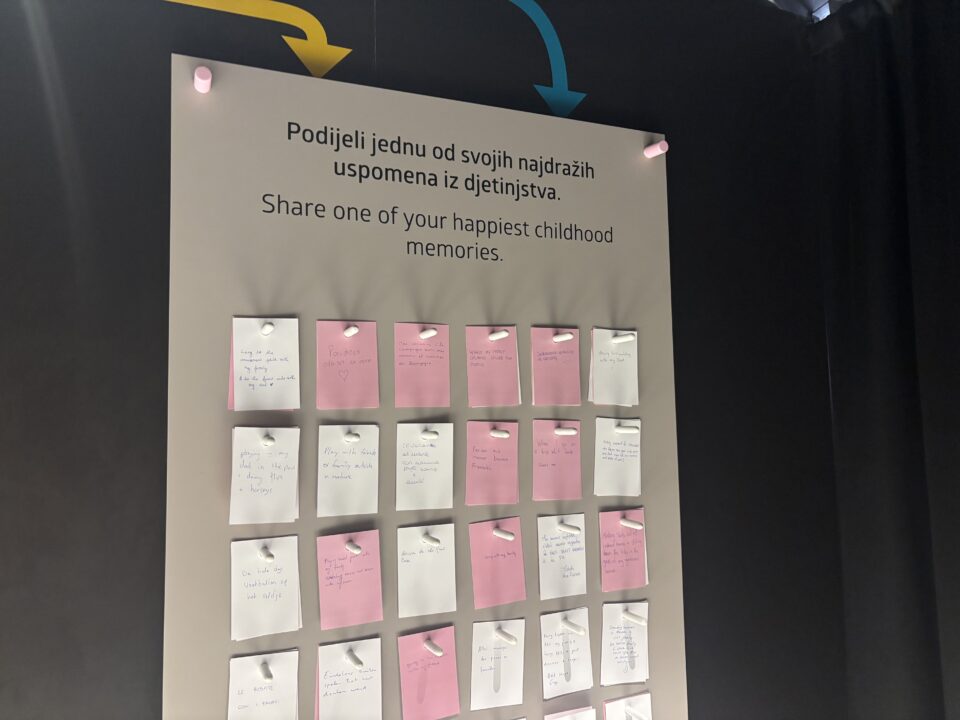
Upon entering the exhibition, visitors encounter an interactive component featuring activities such as writing down one of their happiest childhood memories. This allows them to “enter the emotional and mental space needed to engage more deeply with the Museum’s objects and personal stories.” It encourages visitors to reflect on their own childhood experiences, taking them back to their youth and inviting them to consider how they perceived the world at that age. This component also offers a moment to step back from the bustle of the city before entering a space in which sensitive stories are told.
The War Childhood Museum’s main hope is that the experience will foster empathy among visitors.
“If the exhibition encourages them to view both past and present conflicts through a more human lens, and to recognize the importance of protecting children from the consequences of war, then we have achieved our goal. The objects on display are profoundly personal, even intimate, and they convey how childhood innocence is yet another victim of war”, Salkanović explained.
Perhaps this is the thread that connects all three institutions: their insistence that visitors leave not merely as observers but as witnesses. A black-and-white portrait, a warehouse left almost untouched, a child’s drawing under glass—each is a deliberate refusal to let the war and genocide become abstractions. The past these institutions portray is heavy, but they ensure that its burden is never carried alone.