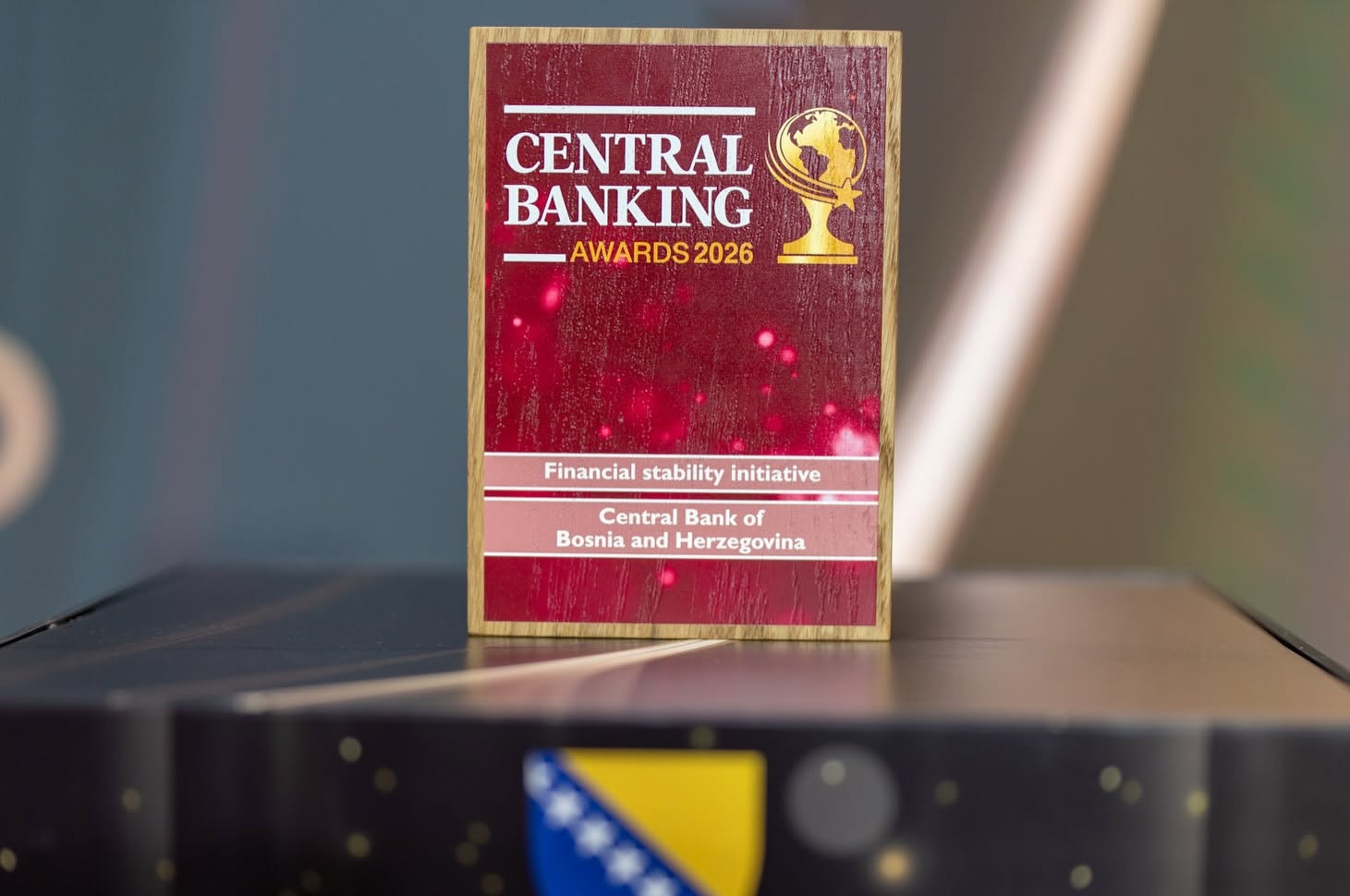
The Central Bank of Bosnia and Herzegovina (CBBH) won the Financial Stability Initiative Award at the 2026 Central Banking Awards.
Governor at CBBH, Jasmina Selimović accepted the award at the ceremony in London on June 10, 2026.
The international panel recognized CBBH for taking a holistic approach to strengthening the resilience of Bosnia and Herzegovina’s financial system and modernizing its financial infrastructure within a complex institutional environment. Many key initiatives focused on modernizing the financial system and moving closer to EU Standards. However, part of the award also recognized BiH’s efforts to expand financial literacy and gender equality programs.
In 2011, the World Bank Group found an average Financial Literacy Index average of just 39.2 out of 100 points in BiH. They found that the group with the lowest financial literacy performance (16% of the sample) was more frequently female, over 65 years of age, with low education; either retired or housewives and with below-average income. In addition, only about 15% of the population uses loans, and fewer use financial services.
Several financial literacy programs exist through universities and independent organizations in BiH. Commercial banks such as Sparkasse Bank partner with regional ministries of education to train teachers and promote financial health in schools. However, formal financial literacy education does exist outside small programs and events. The CBBH is aiming to consolidate and institutionalize these programs, launching an initiative alongside the OECD to establish a national Committee for Financial Education and Inclusion.

Professor Admir Mešković teaches financial literacy at the International University of Sarajevo. Contrary to a major misconception, he believes “financial literacy can be taught.
“People sometimes treat financial capability as if it were a personal trait that someone either has or does not have, but our experience shows that structured instruction, practical exercises, and repeated exposure can significantly improve understanding,” he said.
Mešković sees the future for financial literacy in BiH as institutionalized public-private partnership rather than short-term projects run by individual institutions. Mešković notes that “A financial-inclusion strategy cannot be fully inclusive if qualified institutions are excluded because they are privately rather than publicly established.” Without private-public partnerships, initiatives will remain fragmented and occasional, he added.
He admits, “There are valuable initiatives, but we still lack a continuous, age-appropriate system that follows people from primary and secondary school through university, employment, and retirement.”
A strong financial system would not be built overnight. Mešković outlines the steps for a public strategy that must have “defined responsibilities, stable funding, measurable targets, annual reporting, and independent evaluation.” He suggests a progressive introduction throughout the education system with content extending “beyond basic budgeting to cover debt, inflation, savings, insurance, taxes, pensions, investment, entrepreneurship, digital banking, fraud prevention, and consumer rights”.
The CBBH also received praise for progress on fighting gender inequality. The bank committed to building data infrastructure that collects and reports gender-disaggregated financial statistics. With more reliable data, central banks can address credit and banking gaps for women-led businesses in BiH. In addition, CBBH has initiated targeted financial education efforts toward women, lower-income households, and micro-entrepreneurs, explicitly linking women’s financial literacy to broader macroeconomic stability and household resilience.
However, Mešković notes that “Gender equality also needs to go beyond general declarations or isolated events for women. A serious gender-sensitive policy should collect and publish gender-disaggregated data, identify gaps in access to accounts, credit, savings, entrepreneurship, and investment, and evaluate whether programs are actually closing those gaps.”
In addition, programs must be even more targeted in order to be measurable and effective. Mešković notes that “women are not a homogeneous group: the needs of a university student, a rural entrepreneur, an unemployed mother, and a woman approaching retirement are very different.”
With the recent CBBH reforms and more consolidated foundations, there is hope of increasing financial literacy throughout BiH. To know if the CBBH has had a meaningful impact on financial literacy, the results of its initiatives need to be shown through measurable improvements in citizen’s financial literacy knowledge and behavior, coverage of vulnerable groups, digital fraud reduction, and citizens’ use of financial products and services.
Future effective financial literacy campaigns could consolidate financial education initiatives and research and standardize financial education through partnership between the CBBH, municipal governments, and private educational institutions.