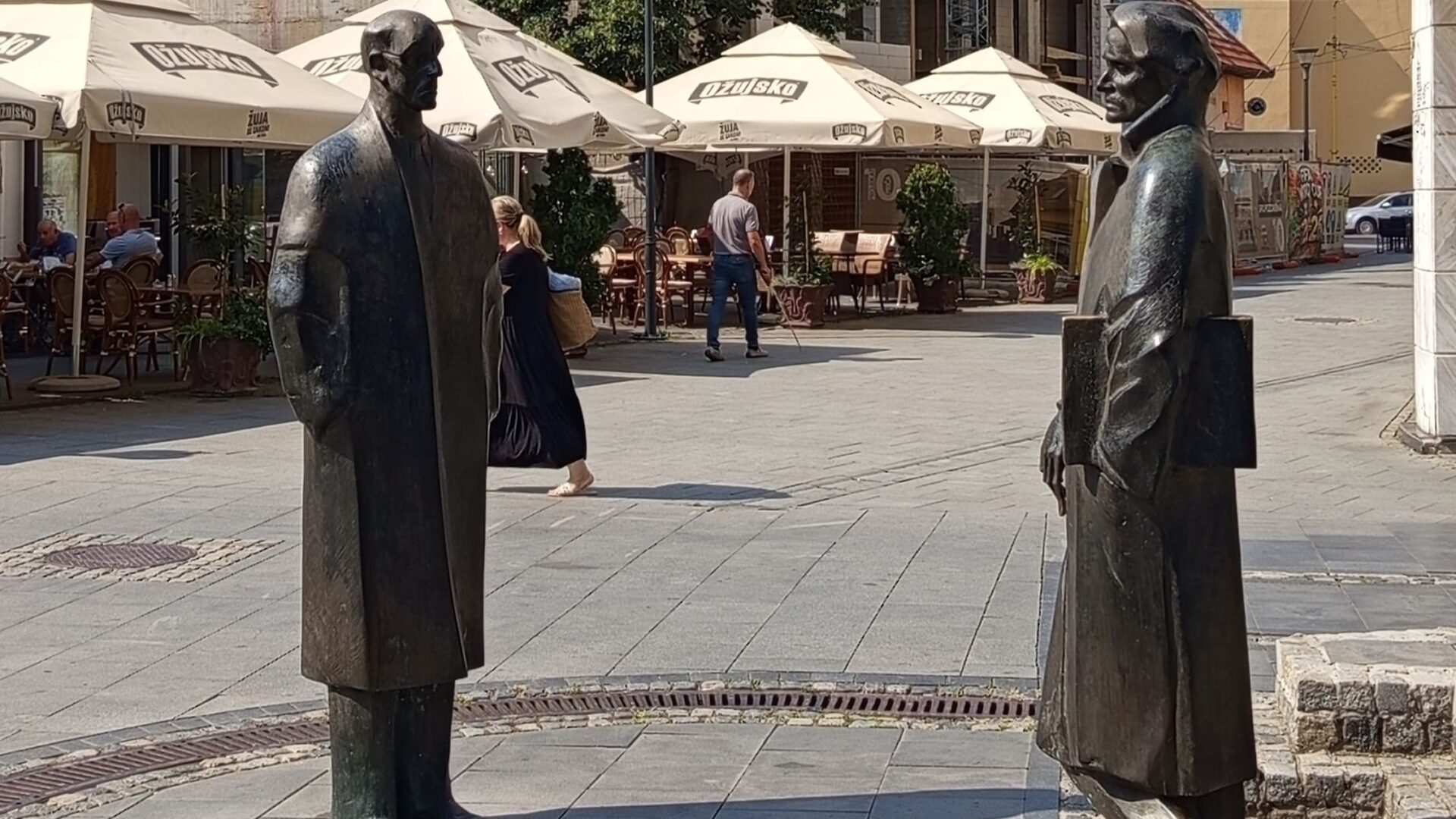
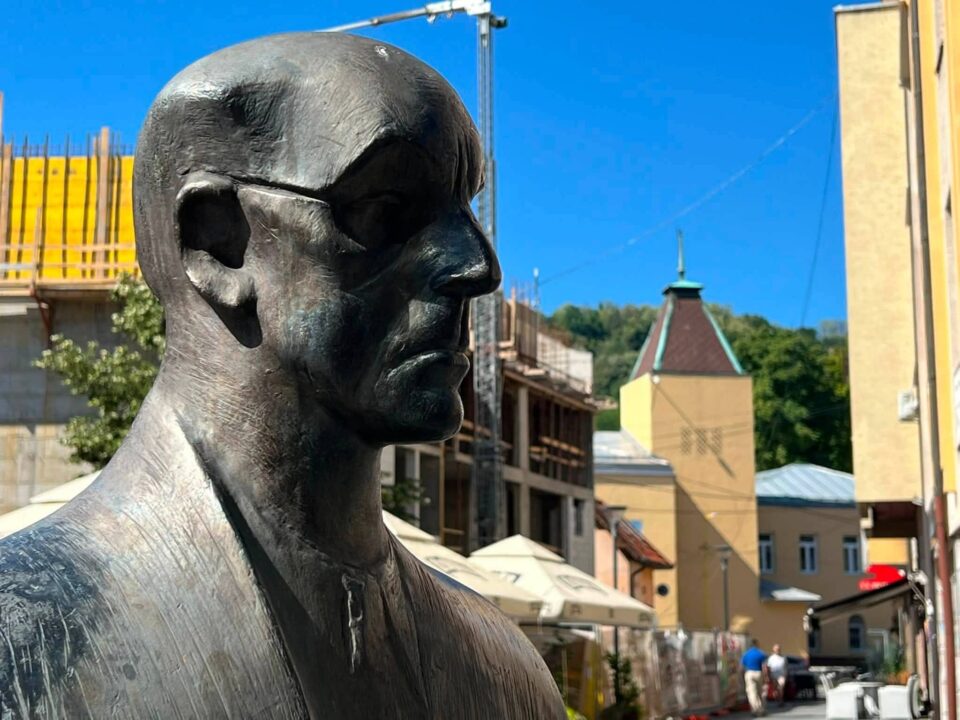
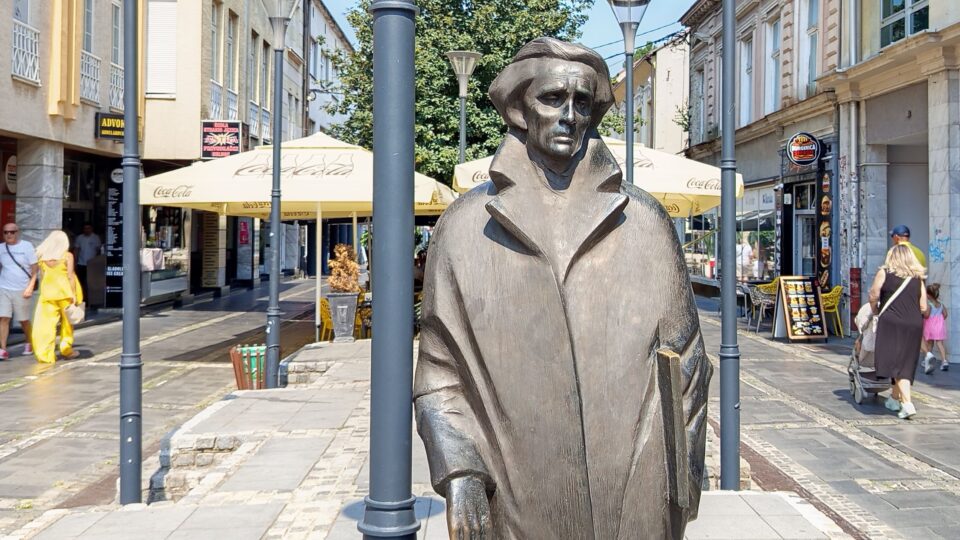
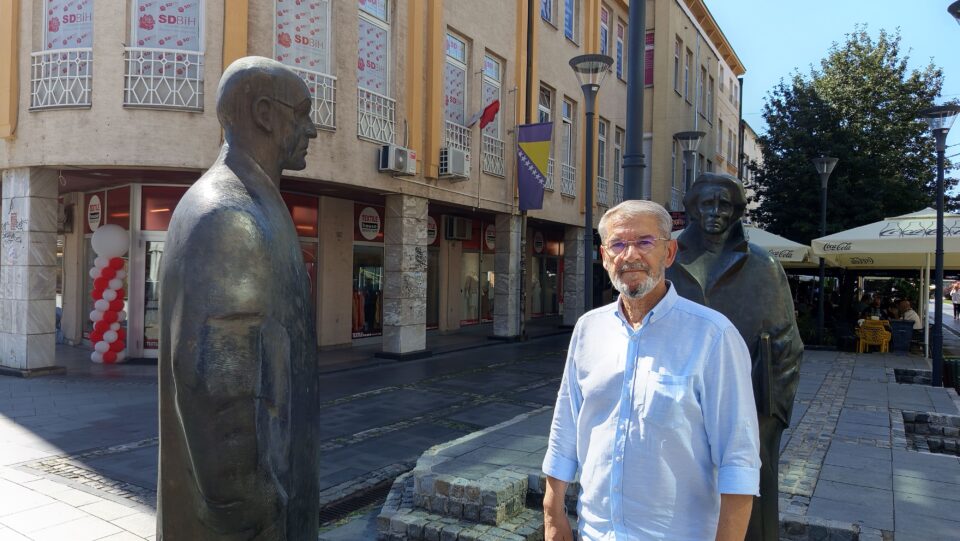
In the very center of Tuzla, in a place where thousands of people pass by every day, two artists have been part of the city’s everyday life for decades. The sculptures of the writer Meša Selimović and the painter Ismet Mujezinović are not just monuments but widely recognized symbols of the city’s identity.
See you at Meša and Ismet’s! This is a daily refrain among Tuzla residents when arranging meetings in the “salt city.” The statues of these two artists have become a landmark around which people make coffee dates, wait for friends, and offer directions. This everyday presence shows that the cultural identity of a city is made up not only of its buildings and streets, but also of the people whose words, images, and ideas have become part of collective memory.
For Tuzla, Meša Selimović and Ismet Mujezinović are much more than towering figures of literature and fine arts. With novels such as Death and the Dervish and The Fortress, Selimović raised universal questions about humankind, conscience, justice, freedom, and government. Mujezinović, meanwhile, along with his rich painting oeuvre, left a deep mark on the institutional development of culture and education. During the time of the former Yugoslavia, he painted the entire collection of portraits of former president Josip Broz Tito. Today, their heritage is not only a part of the city’s history, but also one of its most recognizable symbols.
Mirsad Kunić, a Philosophy professor at the University of Tuzla, sees the name Meša Selimović as inextricably linked with Tuzla, not only because the writer was born there but because of the way in which his work is transmitted to new generations.
“In primary and secondary education, as well as at the University, it’s clear that students know the story of Tuzla, which was the reason and motive for the creation of Death and the Dervish. In this way, the name Meša Selimović is naturally associated with Tuzla and has become part of its cultural identity,” says Kunić.
As he explains, Selimović transformed his own family tragedy into a universal literary story. Set in the Ottoman era, his novel raised questions of justice, responsibility, and the individual’s relationship to power, which is why it remains resonant with readers across time and space.
“It’s no longer just his family story. Selimović raised it to the level of universal literature, so that a reader anywhere in the world can recognize their own experience in it,” Kunić points out.
This, Kunić believes, is precisely where the greatness of Selimović’s work lies.
“Not dealing with, not remembering and not studying Meša Selimović isn’t an option. Great literary works open up space for new interpretations with each new era, and that’s how they confirm their exceptionality,” he adds.
Kunić says that Selimović is one of the rare authors who introduced Bosnian and Herzegovinian literature into the wider European cultural space, which is why his work remains the subject of new interpretations today.
In this way, Kunić believes, the culture of memory is not only created in classrooms but also in public spaces, through monuments, institutions, and places that serve as daily reminders of the people who shaped the city’s culture.
Art as Community Development
If Meša Selimović shaped the identity of Tuzla with words, Ismet Mujezinović did so with color, engagement through institutions, and the images and values embedded in his work. His oeuvre is most often associated with socialist realism, an artistic movement that played an important role in representing social changes in the post-war period. Numerous works by Mujezinović testify to the anti-fascist struggle and the solidarity and values of a society based on equality.
The head of the Tuzla International Portrait Gallery, Amra Čebić, recalls that Mujezinović’s return to Tuzla in 1953 marked the beginning of a period of intensive development in the city’s cultural life.
“Ismet Mujezinović’s return to his hometown brought many changes in the cultural and artistic field. He gathered around him Tuzla’s intellectuals, artists, and influential people, with whom he launched various initiatives, events, exhibitions, and programs of cultural, artistic, and scientific importance for the city,” says Čebić.
She notes that Mujezinović was one of the initiators behind the former Gallery of Prominent Persons, today’s International Portrait Gallery. He was also the president of the initiative committee for the establishment of the University of Tuzla and considered art an integral part of community development.
His connection with his hometown, she adds, is best reflected in his decision to donate his house and studio in Tuzla, so that the space could be preserved through art.
“It wasn’t a selfish act at all, but a sincere intention to make the studio space function as a house of culture, socializing, creativity, and inspiration,” said Čebić.
“I don’t know how to live in a big city. I was born here, wherever I go, I return to Tuzla,” is one of Mujezinović’s frequently quoted sayings.
Čebić believes that this sentiment best explains why he left his house and studio to the city. As she says, from that strong connection with his hometown came the desire for this space to remain a meeting place for art, creativity, and community even after his death.
Today, this space is not just a museum, but a place for exhibitions, book promotions, workshops, and concerts, just as Mujezinović intended.
Art, for Ismet Mujezinović, was never just a personal creative act, as his life journey shows. He helped to establish cultural institutions in various settings, and upon his return to Tuzla, he continued to invest in the development of the city to which he always returned.
Urban Potential
Ismar Mujezinović, Ismet’s son, says that his father was guided by the same ideal throughout his life.
“Promoting and affirming the environment where he lived and was active was the most important thing for Ismet,” said Ismar.
To keep this spirit alive, Ismar continues to work to preserve his father’s legacy. He is the author of his father’s biography titled Ismet Mujezinović: A Portrait with a Monument, and participated in the preparation and publication of a monograph of drawings as well as the documentary film “Ismet Mujezinović: Studio.” In these ways, he strives to keep various aspects of the artist’s life and work accessible to future generations.
Ismar sees his father’s contribution as reflected not only in his paintings, but also in his attitude towards his community. Ismet Mujezinović helped young artists find their first work opportunities, founded cultural institutions, and donated his paintings and more than a thousand drawings, as well as granting the Portrait Gallery the rights to publish part of his oeuvre.
Speaking about his father’s legacy, Ismar believes that his artwork remains his most enduring mark.
“Those are certainly his paintings and drawings, because they are signed with his name. The rest is forgotten, and often intentionally erased,” adds Ismar.
Ismar sees the effort to preserve his father’s legacy as part of a broader cultural responsibility.
“In my opinion, the most important thing is that every work of culture and art is promoted and supported, that they are exhibited in galleries, without prejudice,” concludes Ismar.
Former long-time mayor of Tuzla Jasmin Imamović believes that cultural heritage can also be offer development potential for the city, reminding us that preserving the legacy of Meša Selimović and Ismet Mujezinović was part of a broader development strategy.
“When I was mayor, we set a formula for the development of the city, cultural heritage, natural heritage, and people. Everything we did was in line with that strategy,” said Imamović.
This approach guided the creation of institutions such as the Atelje Ismet Mujezinović, the House of Literature, and the Bosnian Language House, with the aim of ensuring that cultural heritage is not relegated to the past but rather becomes part of the city’s contemporary life.
For him, cultural heritage is not a static category, but a space that needs to be constantly enriched with new content in order to remain close to new generations.
Speaking about the future of cultural heritage, Jasmin Imamović reminds us that many European cities build their international reputation on the great people who lived and created in them.
The issue of preserving the legacy of Meša Selimović and Ismet Mujezinović is therefore not just a question of culture. It is a question of how a city understands itself and presents itself to others.
“The nurturing, preservation, and promotion of the legacies of Meša Selimović and Ismet Mujezinović are invaluable for the image of Tuzla. We should treat their legacies as the city’s greatest treasures,” said Imamović.
Ismet Mujezinović was born in Tuzla in 1907. He graduated from the Academy of Fine Arts in Zagreb and after graduation he stayed in France and attended a course in art history at the Sorbonne. Three distinct historical periods influenced his artistic career: the first, lasting from his first solo exhibition in 1926 to 1941, was full of changes, maturation, activity in several areas, a period of humanistic and ideological commitment and finally, a brilliant coloristic flourishing that ends in 1941, with the outbreak of war; then the war, which lasts four years; and the third, post-war period, marked by great undertakings, cycles, broad social affirmation, a period of fruitful artistic creation.
Mehmed Meša Selimović was born in Tuzla in 1910. After graduating from high school in his hometown, he enrolled in the Serbo-Croatian Language and Yugoslav Literature program at the University of Belgrade Faculty of Philosophy in 1930. He graduated in 1934, and from 1935 to 1941, he worked as a professor at the Civic School, and in 1936 was appointed as a substitute teacher at the Gymnasium High School in Tuzla. He lived in Tuzla for the first two years of the World War II, during which time he was arrested for collaborating with the National liberation movement. In May 1943, he moved to liberated territory, where he became a member of the Yugoslav Communist Party and a member of Agitprop for eastern Bosnia. He then served as the political commissar of the Tuzla Detachment before moving to Belgrade in 1944, where he worked in various political and cultural capacities. In 1947, he moved to Sarajevo, where he worked as a professor at the Higher Pedagogical School, an assistant professor at the Faculty of Philosophy, an artistic director of Bosna Film, a director at the National Theatre, and the editor-in-chief of the Svjetlost Publishing Company. In 1971, he retired and moved to Belgrade.
In 1989, the Great Gymnasium in Tuzla was renamed the Meša Selimović Gymnasium to honor the famous writer, who was also a former student and professor of the gymnasium.
As long as their books raise new questions, their paintings bring people together, and the institutions they created live on through new generations of artists and readers, the cultural identity of Tuzla will not be just a memory of the past. It will be a story that is written every day where people still meet, wait for each other and, quite naturally, say: “See you at Meša and Ismet’s.”