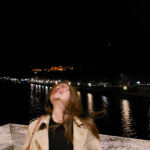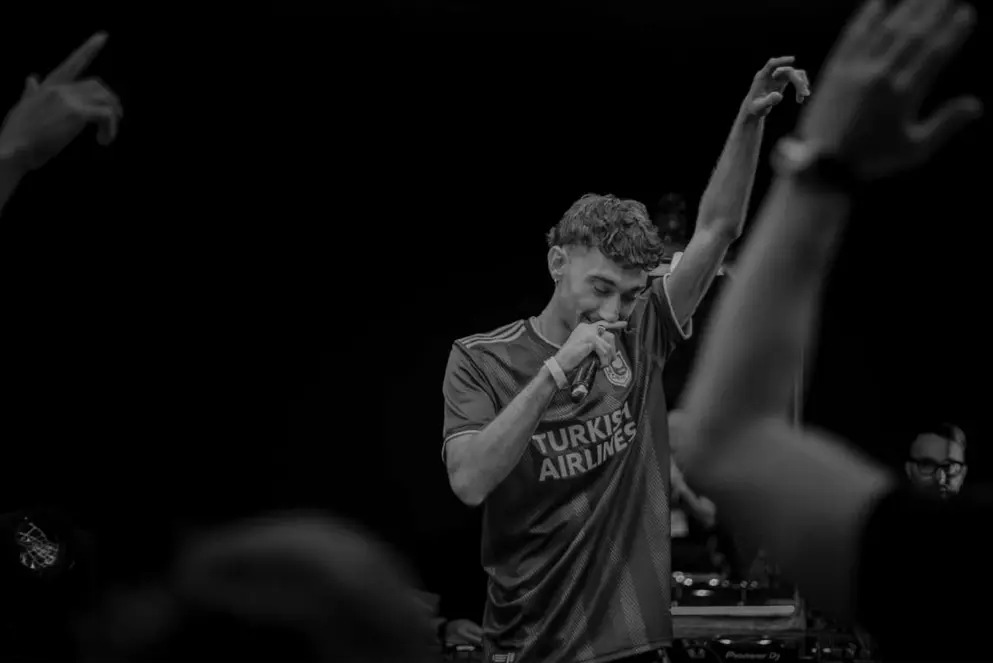
“Me on a scooter, a friend riding behind, coasting downhill through Garčići, my hometown, red-roofed houses on either side, mountains at my back, and a moon that rose earlier than expected. Everything essential about me is right there.”
That’s the image that Alen Đokić, known on stage as Doppelgänger, recalls when asked to sum up his music. It’s an image of movement: someone descending through a landscape without needing to explain himself to anyone. It captures, better than any biography could, what it means for him to be Bosnian and Italian at once, not a conflict to resolve, but a landscape he moves through naturally.
Born in Rome in 2000 to parents from Kotor Varoš, near Banja Luka, Alen started making music in 2020, driven by a need for vindication and a desire to tell a story he felt no one else was telling. Over the last decade, Italy has seen a steady rise in second-generation rappers who broke into the mainstream, but nearly all of them trace their roots to North Africa. No one, until Alen, was speaking for the Balkans. He wanted to prove he was more than “the Bosnian kid from the neighborhood,” and he found his answer in music: not just a new identity story, but a new way of telling it.
“I want to show that we can re-narrate our own story beautifully,” he says.
For him, that’s what music is for. It is “a tool for rewriting yourself, for taking a condition that had always been described for you and finally describing it yourself.”

His choice of stage name, the German noun Doppelgänger, is meant to emphasize the duality of his identity.
“I didn’t want a name that was either Italian or Bosnian, but rather something that could somehow evoke both. At the time, I was studying German and came across this term, which I felt represented me perfectly. In his songs and on social media, I often alternate the name with Doppeltata, a lighter, more playful variation that reflects the my more humorous and goliardic side”, said Alen.
“Rappresento quella generazione che per anni è stata messa al margine, figli di immigrati, troppo italiano per essere bosniaco, troppo bosniaco per essere italiano. Un cuore a metà, lontano da tutto e da tutti, senza sapere chi sono. Io sono Doppelgänger.”
– I represent the generation pushed to the margins for years, children of immigrants, too Italian to be Bosnian, too Bosnian to be Italian. A heart split in half, far from everything and everyone, not knowing who I am. I am Doppelgänger. –
Doppelgänger, “DIASPORA (feat. Turbolento),” DIASPORA (feat. Turbolento), G. Lemon Records, 2025.
To understand why that split feels so specific, it helps to understand where it comes from. Bosnia and Herzegovina has, in proportion to its population, has one of the largest diasporas in the world, second only to a handful of countries like Guyana. Estimates of how many people of Bosnian descent live outside the country’s borders range from two to four million, a number that rivals or exceeds the population that remains inside Bosnia itself.
That scattering didn’t happen all at once, and it mostly didn’t happen by choice. The largest wave came during the 1992–95 war, when ethnic cleansing and mass violence forced hundreds of thousands of people out of their homes almost overnight, some to neighboring Croatia and Serbia, many further out, to Germany, Austria, Sweden, and other parts of Western Europe that opened their borders to refugees.
Earlier waves of labor migration, dating back to the 1960s and 70s, had already planted Bosnian communities in Germany and Austria before the war; the 1990s turned that trickle into a flood, and grief and displacement became as much a part of the diaspora’s identity as the homeland itself. Italy, while not among the largest host countries, absorbed its own share of that exodus through asylum claims, family reunification, and the slower, quieter migration of people simply looking to rebuild.
The children of that generation are now coming of age in Italy and elsewhere as second-generation Bosnians, navigating a reality their parents did not experience in quite the same way: the constant negotiation of belonging to two worlds, neither of which feels entirely complete on its own. It’s why the diaspora refers to itself, almost universally, as naši — “ours” — a single, warm, deliberately vague word that draws a circle around everyone who shares that condition, no matter which country they grew up in. It’s a word that says: your split heart is not a defect; it’s a membership card.
“Questa è la mia storia, fra me cresciuto a Roma, lontano dalla Bosnia, lontano da ogni cosa. Per ogni strofa una lacrima che sa di verità, per quelli che come me son divisi in due metà.”
– This is my story, torn apart, raised in Rome, far from Bosnia, far from everything. In every verse, a tear that tastes like truth, for those who, like me, grew up split in two halves.-
Doppelgänger, “Alen,” Alen – Single, G. Lemon Records, 2022.
His roots come through not only in his lyrics, but also in the music itself. “While the beats remain firmly rooted in rap,” he explains, “the samples draw heavily from Balkan folk and pop traditions, often built from vinyl fragments I find at flea markets”; physical, second-hand pieces of a place he did not grow up in, but never stopped belonging to. Italian, Bosnian and English move through his tracks without much ceremony, each language chosen for what it can express better than the others.
Even when a song is mostly in Italian, a Bosnian phrase is rarely more than a verse away.
“It’s a stylistic choice, but also because Bosnian just hits differently”, he said.
“Even though rap in Italy has become increasingly pop-oriented, with more accessible hooks, I still see it as something fundamentally social,” he says. “That’s the reason rap exists in the first place.”
For Alen, authenticity is at the heart of the genre; a way of telling the truth, and he intends to keep telling his own. Not every truth in his songs, though, is one he lived by himself.
War surfaces in his lyrics too, but only ever in passing, a detail among many, not a subject in its own right. Alen is too young to have experienced it firsthand, and he doesn’t pretend otherwise.
He knows Bosnia through family and personal visits, inherited memories, and stories handed down, not through everyday life there. What he carries are fragments: an abandoned house near Kotor Varoš, a minefield sign still standing decades later, the quiet way his relatives split time into “before” and “after.” He folds these into his music without dwelling on them, careful, too, not to let the war stand in for the whole country.
“I want to show Bosnia as it really is, with all three of its realities, because none is worth more than the others,” he says, referring to the Bosniak, Serb and Croat communities whose divisions the war hardened.
It’s less a demand to remember the war itself than a wish that people simply know it happened.
None of that, though, is where most of his songs start. He traces his songwriting back to something almost unglamorous: long nights talking with friends and the people closest to him.
“The words of the people around me inspire me,” he explains.
For Alen, songwriting does not begin with a particular subject or a conscious attempt to create a song. It comes from simply living his life in all its forms, paying attention to the conversations, experiences, and moments that stay with him. Everything he goes through eventually finds its way into his music, often in ways he does not immediately expect. The result may be less than what others expect from him in terms of quantity or frequency, but he sees that as a strength rather than a limitation. In the end, it is this personal process—living, absorbing, and then transforming those experiences into music—that gives his songs their meaning and authenticity.
Doppelgänger’s music doesn’t resolve the distance between Italy and Bosnia; it makes that distance livable, even generative. In the space between the two, the second generation stops looking like a group suspended between an origin and a present and starts looking like a generation capable of building a language entirely its own: not choosing between two halves, but narrating them together, like that ride home on a scooter, mountains at your back, the moon already rising.
It’s fitting, in the end, that Alen chose a name meaning “double” rather than picking a side. Doppelgänger was never meant to resolve into one identity or the other; it was built to hold both at once, the way his songs do. What started as a private search for a word that fit him has become something closer to a public one: proof, for the wider naš scattered across Europe, that a heart split in two doesn’t need mending to be whole. Where that proof goes next, Alen says, he’s still figuring out, one song, one true story at a time.