A permanent memorial would acknowledge them all equally.
Each year, Bosnia and Herzegovina marks 12 Days of Activism for Peace, running from the International Day of Peace on 21 September to the International Day of Non-Violence on 2 October. It is a season for reflecting on how the country moves forward from war. This year, that reflection should include a plain fact: more than thirty years after the war ended, recognition for survivors of conflict-related sexual violence (CRSV) remains uneven. A permanent memorial to all survivors, the first in Bosnia, would be a significant step in correcting this imbalance.
Significant progress has been made for survivors in the last three decades. The International Criminal Tribunal for the former Yugoslavia (ICTY)’s landmark judgements established wartime rape as a crime against humanity. In the years since, Bosnia has taken further steps: survivors can now be recognised as civilian victims of war or victims of wartime torture, opening access to monthly financial support and healthcare. Witness protection and psychological support for survivors testifying in court have also improved considerably. These deserve to be acknowledged.
Yet recognition on paper has not always meant equal treatment in practice. Because these rights are administered separately across Bosnia’s entities and cantons, two survivors of the same crime can receive very different support depending on where they live. Compensation remains just as uneven: even when a perpetrator is convicted, a survivor may still receive no healthcare, psychological support or long-term economic assistance as a result. What a court decides and what a survivor receives can be two very different things.
There is also a new urgency to this conversation. More than three decades on, survivors are ageing, their health needs are growing more serious, and with each passing year, evidence and witnesses are lost. The support Bosnia built was designed for survivors navigating criminal proceedings — it was never built for survivors now in their sixties, seventies and eighties, who need long-term healthcare, social support and psychological care that has little to do with a courtroom.
“Discussion and recognition are the only two things that can help us to move from this negative point. Stop saying that everything is wrong and start working towards solutions and better future.” – Hasija, Survivor, Bosnia and Herzegovina
The same urgency applies to children born of wartime sexual violence — now adults themselves, and a group Bosnia has only recently begun to recognise. In 2022, the Brčko District became the first area in Europe to legally recognise these children under its Law on Civilian Victims of War. The Federation of Bosnia and Herzegovina followed in 2023, and by January 2024, their rights to healthcare, education, employment and housing had taken effect.
This has been one of the most significant recent developments in the field, raising questions of identity, privacy, stigma and access to rights that institutions are still learning how to address without creating new labels or new harm. That this group is recognised today owes much to the courage of a small number of individuals who refused to remain invisible. However, while legal frameworks exist for children of survivors in the Brčko District and in the Federation, they do not in Republika Srpska.
A national memorial to survivors of wartime sexual violence would be a form of meaningful recognition that does not depend on where someone lives, which entity or canton governs their case, or which court has heard it. It would simply say: this happened, and Bosnia remembers all of you, equally.
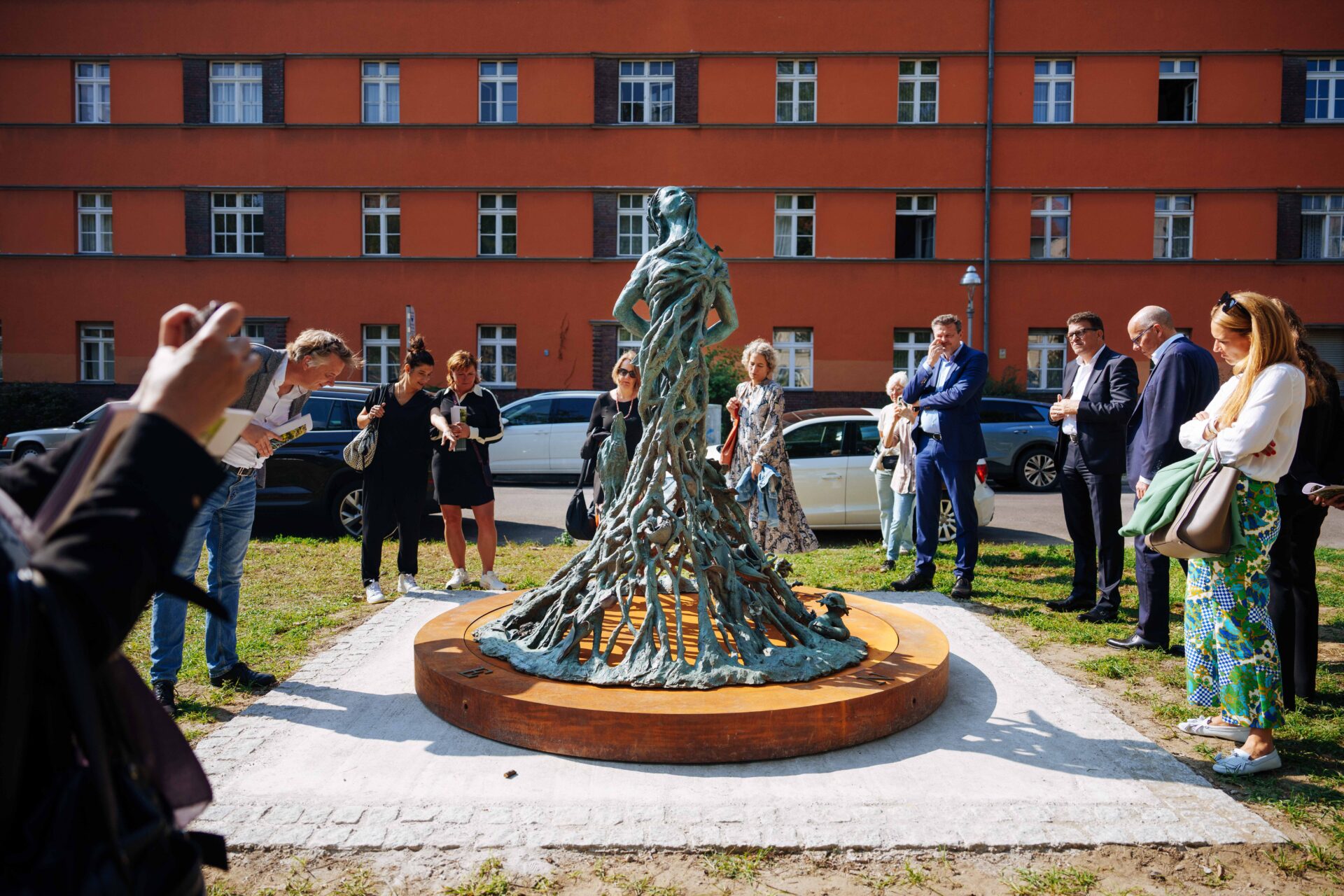
Bosnian experts have already described what such a memorial ought to be: survivor-led, neutral, dignified, not divided along ethnic or political lines. That description already exists, in Petrified Survivors, a global memorial created with survivors from over 30 countries, including those from Bosnia. Bosnian survivors chose the white rose as their own symbol of resilience and hope within it, the result of a partnership between us and another Bosnian partner organisation, Kvinna til Kvinna. Petrified Survivors shows what dignified, survivor-led memorialisation can look like in practice.
Memorialisation matters because it does something a legal verdict alone cannot. A conviction closes a case. A memorial keeps a fact alive in public memory long after the courtroom has emptied, for survivors, for the children born of these crimes, and for a country still negotiating its own history. The understanding of what justice requires has itself shifted in Bosnia, from a narrow focus on proving what happened towards a broader question of what happens to survivors decades later: their health, their economic security, their ageing, their families, their privacy. A permanent memorial belongs to that broader understanding of justice, not apart from it.
Bosnia deserves a permanent memorial, equally accessible regardless of entity or canton, delivered not as a symbolic gesture but as part of the long-term support survivors were promised. Twelve days dedicated to peace are not enough if, thirty years on, there is still nowhere to stand and remember. It is time Bosnia built that place.